
Yes, many people with psoriasis can enjoy a pedicure, as long as the skin on your feet is intact and your technician knows what to go easy on. The rule of thumb is simple. Postpone if you have bleeding, raw or open patches, or a suspected toenail fungal infection. Otherwise, tell your technician about your psoriasis, keep cuticles untouched, keep soaks short and skip aggressive scraping. Check with your dermatologist first if you are unsure, because they know your skin.
Below you will find what to check before you book, what to say at the chair, how psoriasis affects toenails, how to choose polish, and what to do after.
TL;DR
- Ask your doctor whether a pedicure is right for you, and postpone if plaques on your foot or ankle are bleeding or raw, or if you have open wounds near your toes.
- Tell your technician you have psoriasis. Ask them to leave your cuticles alone, keep any soak short and avoid scraping under your nails.
- Do not shave your lower legs for at least 24 hours before your appointment.
- Gentle buffing and polish can hide pitting. Remove polish about once a month to look at your nails.
- Ask how the salon cleans its footbaths and tools before you sit down.
Table of Contents
- Is it okay to get a pedicure with psoriasis?
- What happens to toenails with psoriasis
- What to tell your nail technician
- Before the appointment: prep that protects your skin
- Hygiene questions worth asking
- Nail polish and psoriasis
- When a medical pedicure may be the better route
- What can trigger psoriasis on the feet
- A psoriasis-aware pedicure, step by step
- Prices at Foxy Nails
- Aftercare for the first few days
- Our perspective
- Book a gentle pedicure in Reno
- FAQ
- Sources
Is it okay to get a pedicure with psoriasis?
For most people with stable skin, a gentle pedicure is fine. WebMD’s guidance on pedicures and psoriasis says to ask your doctor whether it is OK for you, and it lists the situations in which you should skip it: bleeding or raw plaques on the foot or ankle, a toenail fungal infection, or broken cuticles and other open wounds near your toes.
The reasoning is practical. Salon products can sting and aggravate skin that is already open. Broken skin is also an easy way in for bacteria. And psoriasis has a quirk that makes injury matter more than it would for other people: new patches can appear where the skin has been hurt. Dermatologists call this the Koebner phenomenon, and the American Academy of Dermatology (AAD) names rough cuticle work as one way to trigger it, in its nail-care tips for psoriasis.
So the question is less “can I?” and more “is my skin ready today, and will the service be gentle?” Both are things you can control.
A quick check before you book
Look at your feet in good light the day before, and again before you leave home. You are fine to go ahead when:
- The skin on your feet, ankles and around the toenails is intact, with no bleeding, weeping or raw areas.
- Your cuticles are not cracked or torn.
- Your toenails are not thickened, crumbly or discolored in a way that is new to you.
Wait and call your doctor if any of that is off. WebMD advises asking your doctor about thickening or discoloration, since it could signal a fungal infection rather than psoriasis. A pedicure can wait a week or two. A flare that spreads, or an infection, is a lot harder to undo.
What happens to toenails with psoriasis
Nail psoriasis shows up in different ways. Toenails can lift away from the nail bed, and material can build up underneath, according to the AAD. You may also notice small dents called pitting, which is the thing many people want to cover with polish.
Two facts follow from that:
- A nail that is already lifting is easy to push further. Aggressive scraping under the nail can make the lift worse, which is why WebMD says technicians should be told to avoid it.
- Short toenails are easier to look after. The AAD recommends keeping them short to prevent nails from lifting and to reduce buildup underneath.
That is the whole logic of a psoriasis-friendly pedicure: protect the skin, protect the nail bed, keep things clean.
What to tell your nail technician
A good technician wants this information. At the start of the appointment, say plainly that you have psoriasis and name the areas that are sensitive. Then ask for the following.
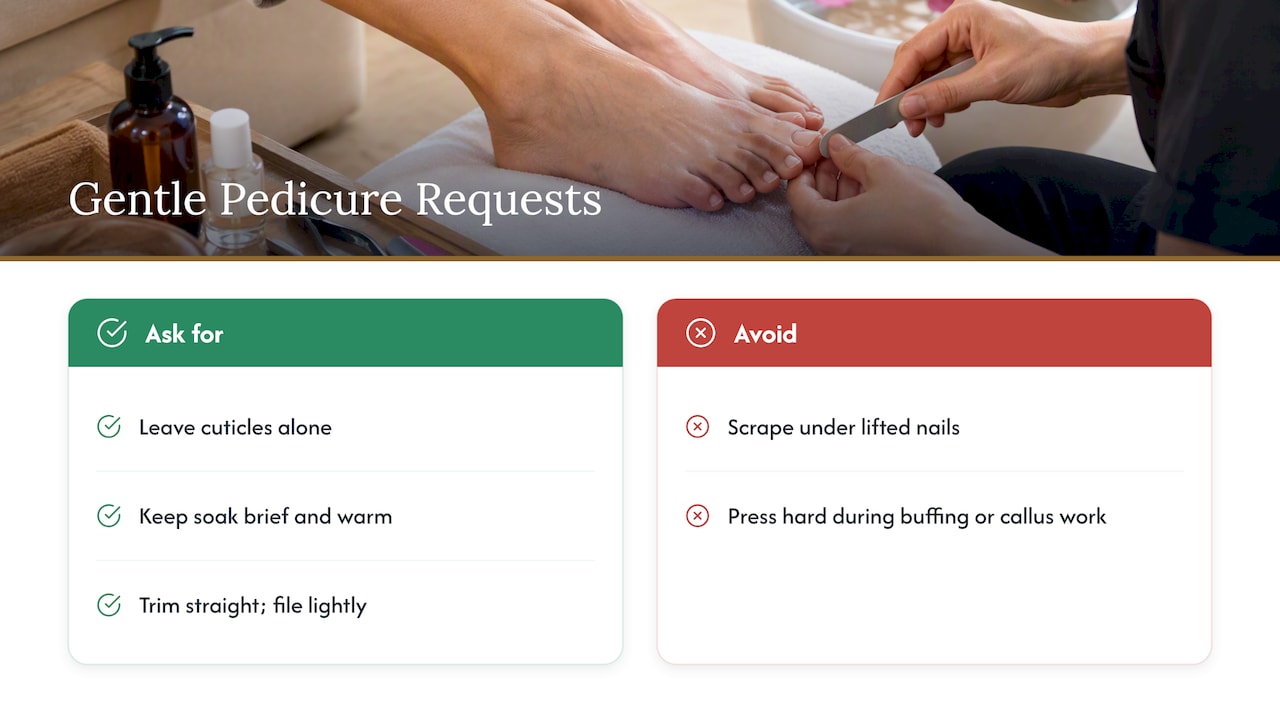
Leave the cuticles alone
Cuticles should not be cut or aggressively pushed back. The AAD notes this can injure the skin, lead to infection and trigger the Koebner phenomenon. If your cuticles look dry, a little moisturizer or cuticle oil is a gentler fix than any tool.
Keep the soak short, or skip it
WebMD suggests keeping soaks brief or skipping them. Long water exposure can leave psoriatic skin dry and tight afterward. If you want the warmth, ask for a few minutes and a warm, not hot, temperature, then ask for a rich moisturizer during the massage.
No digging under the nails
Ask the technician to clean the nail edge gently and avoid scraping under the nail plate. This is the single most useful sentence to say if your toenails are lifting.
Trim straight across, file lightly
The American Podiatric Medical Association (APMA) recommends a straight-edge toenail clipper, cutting straight across, then lightly filing the edges in one direction with an emery board. That fits well with the psoriasis advice to keep nails short and avoid rough handling.
Go easy on buffing and callus work
Gentle buffing is fine for smoothing the nail surface. Vigorous buffing, rasping or heavy callus removal is where people with sensitive, psoriatic skin tend to get into trouble. Say “light pressure, please” and mean it. If anything stings, speak up right away.
Before the appointment: prep that protects your skin
Hold off on shaving. The AAD advises not shaving your lower legs for at least 24 hours before a pedicure, since nicks and micro-cuts create pathways for bacteria. This is in its manicure and pedicure safety guidance. If you shave, do it after, or a couple of days ahead.
Moisturize normally. Use whatever emollient your dermatologist recommends, and mention it to the technician so they know what is on your skin.
Arrive with nails already short if you can. That leaves less to file and less time under the tools.
Book a quieter time. A calm, unhurried appointment makes a gentle pace easier to ask for.
Hygiene questions worth asking
People with psoriasis have good reason to care about cleanliness, because an infection can set off a flare. Medical News Today, summarizing AAD information, notes that a flare can follow an infection by 2 to 6 weeks, and a skin injury by 10 to 14 days. That is why the safety basics matter more for you than for the average client.
The AAD tells clients to check that footbaths and filters are thoroughly disinfected before use and to ask how the salon cleans its tools. Put that into practice with these questions:
- How do you clean and disinfect the footbath between clients?
- How are metal tools cleaned, and are files and buffers single-use or kept for one client?
- Can you use a fresh file for me and skip anything that might break the skin?
A professional salon will not mind. We cover the same ground in more detail in our guide to hygiene questions to ask before a sensitive skin pedicure and in our walkthrough of a hot towel pedicure routine that keeps feet safe.
Nail polish and psoriasis
Polish is one of the easiest ways to make pitted or uneven toenails look smooth. WebMD says gentle buffing or polish can hide pitting and other nail psoriasis signs, and the AAD agrees that you should check with your dermatologist that polish is fine for your nails.
A few habits make polish easier on your nails:
- Take it off about once a month so you can see what your nails are doing, as WebMD suggests. Changes in color, thickness or lifting are worth showing your doctor.
- Skip polish if you have a nail infection. Cover-up can hide a problem that needs treatment.
- Consider “5-free,” “7-free” or “10-free” formulas. These labels mean the polish leaves out some common irritants and allergens, according to MyPsoriasisTeam. The number of “frees” is a marketing label, not a guarantee, so test a small amount first if your skin reacts easily. For the same mindset applied to makeup, these checks for sensitive-skin products show how to read ingredient lists before you buy.
If you want a gel finish on your toes, ask about it at booking and mention your skin. Our page on spa pedicure extras, gel polish and what to skip explains the add-ons and how to decide which ones suit you.
When a medical pedicure may be the better route
Some situations call for a clinical setting rather than a salon. Cleveland Clinic notes that medical pedicures, provided by professionals trained in foot health, may be a safer alternative for people with autoimmune diseases or compromised immune systems. Psoriasis is an immune-driven condition, so this is worth raising with your dermatologist or a podiatrist if:
- You have active, open or painful plaques on your feet.
- Your toenails are thick, crumbling or lifting and you are not sure why.
- You take medication that affects your immune system.
- You have psoriatic arthritis with painful or swollen toes.
A salon pedicure is a cosmetic, comfort-focused service. It is not treatment. When your feet need care, a doctor or podiatrist is the right person, and a salon visit can come back into the picture once your skin settles. Our article on why professional foot care matters in Reno explains how the two fit together.
What can trigger psoriasis on the feet
Feet take a lot of knocks, so it helps to know the common triggers. Based on the AAD-sourced list from WebMD, the main ones include:
- Skin injury: cuts, scrapes and bruises can produce new patches where the skin was hurt. This is the Koebner phenomenon again, and the reason pedicure technique matters.
- Infections: yeast, strep, staph and respiratory infections are known triggers.
- Smoking: it is linked to worse psoriasis, with outbreaks often appearing on the hands and feet.
- Stress: a 2018 review cited by Medical News Today found that between 31% and 88% of people with psoriasis say stress triggers their symptoms.
Triggers differ from person to person. Keeping a simple note of what you did before a flare, including salon visits, can help you and your dermatologist spot a pattern.
A psoriasis-aware pedicure, step by step
Here is how a gentle visit can look when you plan it well.
- At booking, mention that you have psoriasis and ask for a calm appointment slot.
- On arrival, show your feet and point out any sore or sensitive areas. Confirm that skin is intact.
- Soak: short and warm, or skipped.
- Nails: clipped straight across, edges lightly filed in one direction, no scraping underneath.
- Cuticles: left alone, with oil or moisturizer instead.
- Skin: light smoothing only, no aggressive rasping.
- Massage and moisturizer: a generous layer on dry skin, avoiding any irritated spots.
- Polish: optional, and chosen with your skin in mind.
If at any point something hurts, stop. A good technician would much rather skip a step than send you home with a sore foot.
Prices at Foxy Nails
If you want a gentle, simple service, a basic pedicure is often the easiest to adjust. These are the pedicure prices published on our services page:
| Service | Price |
|---|---|
| Pedicure | $25 |
| Spa Pedicure | $40 |
| Deluxe Pedicure | $45 |
| Foxy Deluxe Pedicure | $55 |
| Foxy Signature Pedicure | $65 |
More elaborate services include extra steps. If you have psoriasis, the shorter and simpler the service, the fewer steps you need to ask your technician to modify. Tell us at booking and we will talk through what suits you.
Aftercare for the first few days
What you do afterward counts as much as the appointment. Keep your feet moisturized, wear comfortable shoes that do not rub, and watch for redness, soreness or new patches over the following days. Because a flare after skin injury can show up 10 to 14 days later, as noted above, do not assume you are in the clear straight away. Our 0 to 72 hour pedicure aftercare guide lists the steps we suggest after a salon visit.
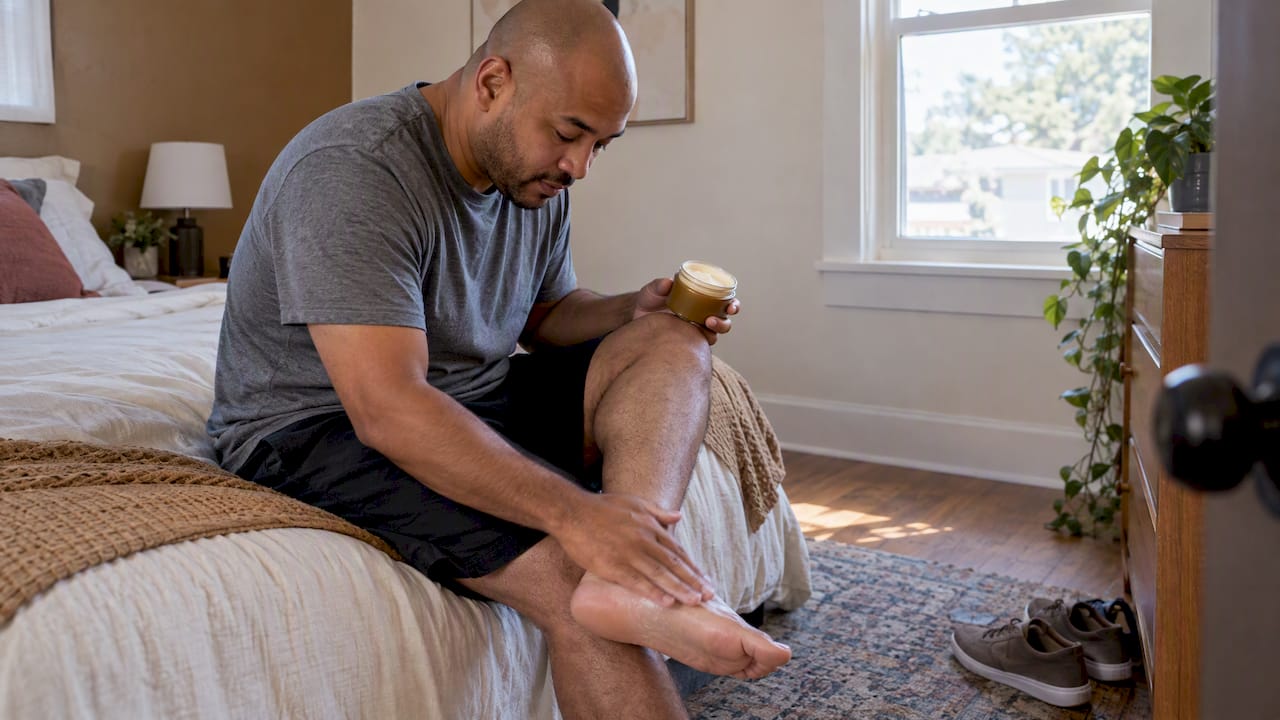
Call your dermatologist if you notice new scaling, bleeding, swelling, pus or pain, or nails that start lifting after a visit.
Our perspective
Over the years, we have learned that the best pedicure for sensitive skin is the one where the client speaks up and the technician slows down. Nobody should feel rushed at our chairs, and nobody should feel awkward for saying, “I have psoriasis, please go gently.”
We build our service on personal attention. That means listening first, looking at your feet with you, and adjusting the steps to what your skin can handle today. It might mean a shorter soak, no cuticle work and a lighter touch with files. It might also mean suggesting you wait until a sore patch heals.
We also believe a pedicure can be a real comfort when your skin has been a source of stress. Feeling looked after, and leaving with neat, polished toes, matters. A calm, clean and unhurried visit is exactly what our team aims to give.
Cuong
Book a gentle pedicure in Reno
If your skin is clear and your doctor is comfortable with it, we would be glad to look after your feet. Tell us about your psoriasis when you book, and we will plan a gentle service around it. See every pedicure and its price on our services page, or read how a spa pedicure can be a restful break.

Families, busy professionals and first-timers all book with us, and we are happy to adapt each service. Find us at Foxy Nails in Reno.
FAQ
Can you get a pedicure with psoriasis?
Often yes, when the skin on your feet is intact and your doctor agrees. Postpone if plaques are bleeding or raw, you have a toenail fungal infection, or you have broken cuticles or open wounds near your toes. Tell your technician about your psoriasis so they can adjust the service.
Should I skip the foot soak?
You can keep it short or skip it entirely. WebMD suggests brief soaks or none for people with psoriasis, since long water exposure can dry out the skin. Ask for a warm rather than hot soak, then moisturize generously afterward.
Is nail polish safe for psoriatic toenails?
Polish and gentle buffing can hide pitting, and most dermatologists are comfortable with it. Ask your own dermatologist first, remove polish about monthly to check your nails, and skip it if you suspect an infection. Polishes labeled “5-free” or higher leave out some common irritants.
Should I shave before a pedicure?
No. Avoid shaving your lower legs for at least 24 hours before, because tiny nicks can let bacteria in. Shave a few days ahead or wait until after your appointment.
When should I see a doctor instead of a salon?
See a dermatologist or podiatrist if your plaques are open or painful, your toenails are thickened, discolored or lifting, or you notice a flare after a visit. A medical pedicure from a foot-health professional may suit you better when your immune system is affected.
Sources
- Getting a Pedicure When You Have Psoriasis: What to Know (WebMD)
- Manicure and pedicure safety (American Academy of Dermatology)
- 7 nail-care tips that can reduce nail psoriasis (American Academy of Dermatology)
- Pedicure Pointers (American Podiatric Medical Association)
- What To Know About Medical Pedicures (Cleveland Clinic)
- 12 psoriasis triggers and how to avoid them (Medical News Today)
- 10 Psoriasis Triggers and How to Handle Flare-ups (WebMD)
- Nail polish and nail care tips for psoriasis (MyPsoriasisTeam)
- Choosing makeup for sensitive skin (Mineralissima)