
Many people with diabetes can get a salon pedicure, but only if their feet are healthy and the salon takes hygiene and gentle technique seriously. If you have numb feet, poor circulation or a past foot ulcer, talk to your doctor or podiatrist before you book. This guide covers who should check first, how to lower the risk, what to tell your technician, which steps to skip, and which symptoms mean you should call a clinician.
TL;DR
- Many people with diabetes can safely get a pedicure when they have no active foot problems. Scripps Health advises seeing a doctor or podiatrist first if you have neuropathy, poor circulation or a history of foot ulcers.
- Tell the salon you have diabetes. Ask for a gentle service: no foot razors, no aggressive trimming or scraping, and no cutting into the corners of the nails.
- Bring your own tools, book early in the day, and ask how foot baths and instruments are cleaned between clients.
- Skip shaving for at least 24 hours beforehand, and check your feet closely afterward.
- Call your health care provider promptly about redness, swelling, drainage, or a cut that has not started to heal after a few days.
Table of Contents
- Can people with diabetes get pedicures?
- Why pedicures carry extra risk with diabetes
- Before you book: a short checklist
- What to tell your technician
- How a diabetes-friendly pedicure should be done
- Salon pedicure or medical pedicure?
- Does insurance cover a pedicure for diabetics?
- After the pedicure: what to check and when to call
- Our perspective at Foxy Nails
- Booking a pedicure with us
- FAQ
- Sources
Can people with diabetes get pedicures?
Yes, often. Diabetes does not rule out a pedicure. What matters is the condition of your feet and how the service is performed.
The Scripps Health guidance says many people with diabetes can safely get a pedicure when they have no active foot problems. It says people with neuropathy, poor circulation or a history of foot ulcers should consult a doctor or podiatrist first. The NIDDK, part of the National Institutes of Health, says that if you want a salon pedicure, you should bring your own nail tools to help prevent infection. It also says to ask your health care provider what other steps can help.
A simple way to sort yourself:
| Your situation | What to do |
|---|---|
| Good sensation, good circulation, no sores or ulcer history | A careful salon pedicure is generally reasonable. Follow the steps below. |
| Numb or tingling feet, poor circulation, or a past foot ulcer | Ask your doctor or podiatrist before booking. Consider a medical pedicure or podiatrist care instead. |
| Thick, yellowed or curved nails, or nails growing into the skin | Have a foot doctor trim them. |
| You cannot see, feel or reach your feet | Have a foot doctor trim your nails. |
| Any open sore, infection or blister | Skip the pedicure and call your provider. |
The last three rows come straight from the NIDDK: a foot doctor should trim toenails when a person cannot see, feel or reach the feet, or when nails are thick, yellowed, curved or growing into the skin.
Why pedicures carry extra risk with diabetes
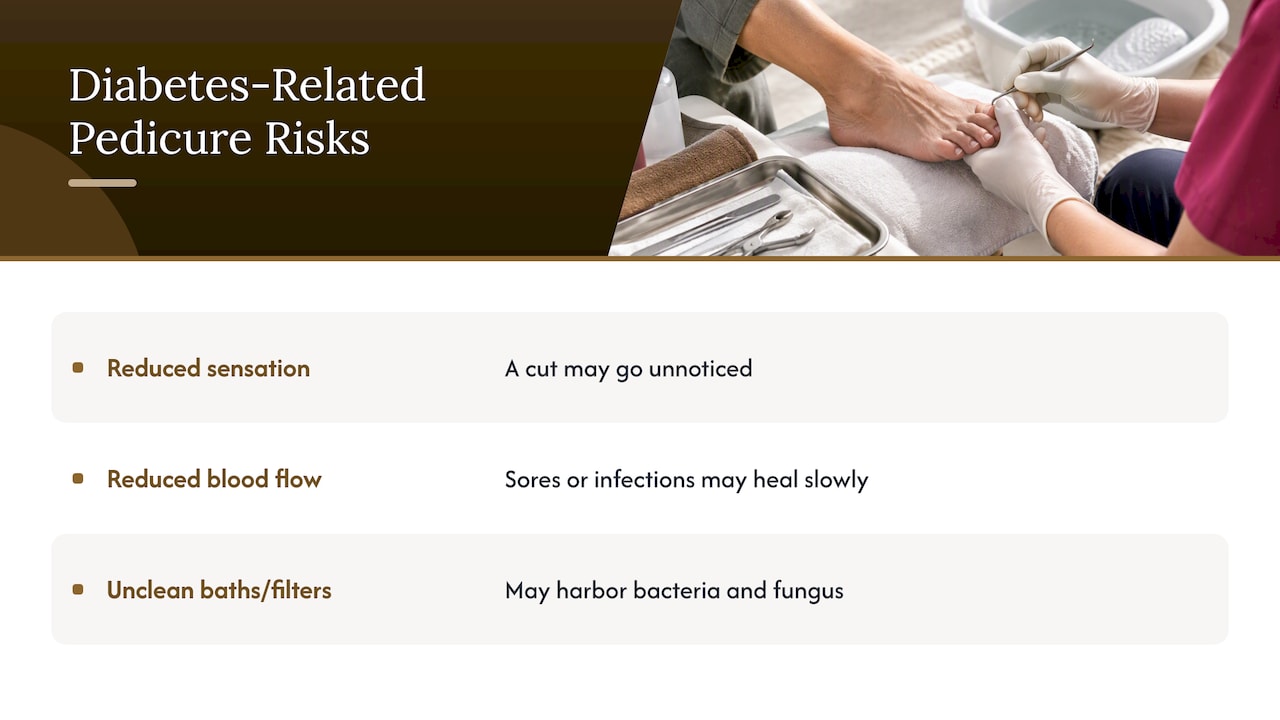
A pedicure is a pleasant service, but it involves sharp tools, water and skin contact. For most people, a nick is a minor annoyance. With diabetes, it can be a bigger problem for two reasons.
You may not feel an injury. According to the NIDDK, nerve damage from diabetes may cause a person to lose feeling in their feet and not feel a blister, which can lead to cuts and sores. If a tool slips, you might not know until later.
Healing can be slow. The same source explains that reduced blood flow can make a sore or infection hard to heal. The CDC likewise notes that diabetes can damage foot nerves and affect blood flow in the feet and legs, and that poor foot hygiene raises infection risk.
Scripps Health says even a small cut or nick from a pedicure tool can increase infection risk, particularly with diabetic neuropathy, and that an untreated infection can progress to a foot ulcer or another serious problem. The NIDDK adds that infected cuts or sores can become serious, and that a poorly healing infection or gangrene can ultimately threaten a toe, foot or leg.
Then there is the equipment. The American Academy of Dermatology says pedicure foot baths and filters that are not properly cleaned can harbor bacteria and fungus. None of this means you must give up pedicures. It means the details matter more for you than for most clients.
Before you book: a short checklist
A few minutes of preparation does more for your safety than anything done in the chair.
- Ask your clinician first if you have risk factors. The American Podiatric Medical Association says people with diabetes or poor circulation should consult a podiatrist for a customized pedicure plan that the salon can follow. Bring that plan with you.
- Choose a licensed, clean salon. The CDC recommends a clean salon licensed by the state cosmetology board, with instruments such as clippers and scissors sterilized after each use.
- Book early in the day. The APMA notes that salon foot baths are typically cleanest at the start of the day. If you cannot go early, confirm the bath is filtered and cleaned between clients.
- Do not shave beforehand. The AAD recommends not shaving the lower legs for at least 24 hours before a pedicure, because shaving nicks can increase infection risk. We cover the timing in more detail in our guide on shaving before a pedicure.
- Pack your own tools. Nail clippers, a file and a pusher that you clean at home remove one shared-tool risk. This is the NIDDK’s advice for salon visits.
- Inspect your feet the night before. Look between the toes and at the soles, using a mirror if needed. If you find a sore, blister or sign of infection, reschedule.
What to tell your technician
Say you have diabetes when you book and again when you sit down. It is not an awkward disclosure; a good technician wants to know. Scripps Health recommends telling the salon and asking the technician to avoid aggressive trimming, scraping and cutting.
Here is a script you can use:
- “I have diabetes, so please keep everything gentle.”
- “No foot razor, no cutting my cuticles or the corners of my nails, and no digging at calluses.”
- “If you see anything unusual on my feet, please tell me instead of treating it.”
- “Please use my tools, or tools taken fresh from sterilization.”
The AAD also suggests looking for signs of a well-run station: a technician who is appropriately experienced or licensed, clean stations, hands washed between clients, and tools that are not dirty. If something looks off, you can leave. You are paying for the service and you can stop it at any point.
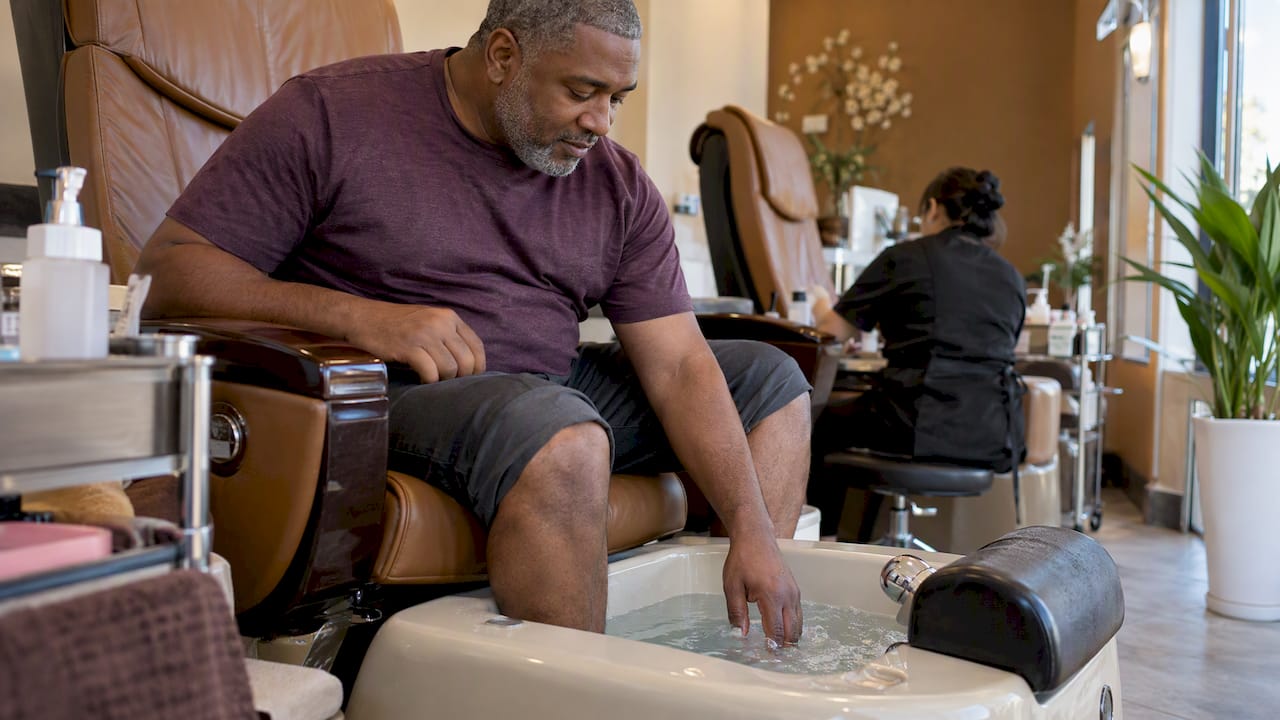
If your feet feel numb, tell the technician that too. They cannot tell how hot water is on your skin, and you may not either. Ask for lukewarm water and check it with your hands or ask someone to check it.
How a diabetes-friendly pedicure should be done
The safest pedicure for you is a gentle, simple one. Here is what to expect, and what to refuse.
What a careful pedicure includes
- A short soak or none at all. Long soaks soften skin and make it easier to tear. Some professionals suggest keeping a soak to a few minutes, and a dry or damp-towel approach is a reasonable alternative.
- Straight-across nail trimming. The NIDDK says toenails should be trimmed straight across after washing and drying, without cutting into the corners, and gently smoothed with an emery board or nonsharp file. The APMA agrees: use a straight-edge clipper and lightly file the edges in one direction.
- Moisturizer on the tops and bottoms of the feet. Skip lotion between the toes, where trapped moisture can encourage fungus.
- Polish, if you like. Regular polish is fine for most people with healthy nails. Ask your provider if you have nail fungus or nail disease, because polish can hide changes you need to watch.
What to skip
- Foot razors and blades. The APMA says foot razors should not be used to remove dead skin, because removing too much skin can cause injury and infection.
- Cutting cuticles. Cuticles protect against germs. Ask for them to be gently pushed back, or left alone.
- Aggressive scraping or heavy filing of calluses. If you have thick calluses, see a podiatrist. Our guide to safe callus removal explains when a callus is a doctor’s job.
- Hot water, hot stones or heating pads. If your feet are numb, heat can burn without you noticing.
- Used tools or tools of unknown origin. Ask to see them come out of a sealed pouch or sterilizer, or use your own.
Salon pedicure or medical pedicure?
A medical pedicure is a clinical version of a salon pedicure. Cleveland Clinic describes it as emphasizing technician training, infection prevention and foot health. It names diabetes, peripheral artery disease, peripheral neuropathy and immune compromise among the reasons a medical pedicure may be preferable. If you are asking about one, Cleveland Clinic suggests checking the technician’s certification, any podiatric association, cleanliness and sterilization.
How to choose:
- A medical pedicure or podiatrist visit fits you better if you have neuropathy, poor circulation, a history of ulcers, thick or ingrown nails, or heavy calluses.
- A regular salon pedicure can fit if your feet are healthy, your provider has cleared you, and the salon follows the hygiene steps above.
If you are comparing a salon with a medical option for stubborn calluses, our page on salon versus medical pedicure for calluses lays out the difference.
Does insurance cover a pedicure for diabetics?
Salon pedicures are not covered. Medical foot care is a different story, but coverage is narrow and depends on your plan.
- Medicare. Medicare Part B covers medically necessary podiatrist exams or treatment for foot injuries or diseases. It usually does not cover routine foot care such as nail trimming, callus removal, cleaning or soaking, and patients generally pay all costs for noncovered routine care.
- Private plans. One Medica coverage policy, effective February 1, 2026, says routine foot care may be covered when medically necessary for diabetes or related conditions and performed by an eligible licensed provider. It states that pedicure services without nail disease and retail-salon pedicure services are not covered, and that your plan document controls. A Premera policy revised February 9, 2026 says routine care is generally excluded, though it may be medically necessary for diabetes, peripheral vascular disease, or peripheral neuropathy with loss of protective sensation.
The practical takeaway: if you need nail care because of neuropathy or circulation problems, ask your podiatrist’s office whether your plan covers it. Do not expect insurance to pay for a salon visit.
After the pedicure: what to check and when to call
Look at your feet that evening and over the next few days. Check the toes, the nail folds, the heels and between the toes. Use a mirror or ask someone to help.
Scripps Health advises contacting a doctor promptly for redness, swelling, drainage, increasing pain or other concerning changes. The NIDDK gives a more specific list. Call a health care provider right away for:
- A cut, blister or bruise that does not start healing after a few days
- Skin that is red, warm or painful
- A callus with dried blood in it
- A foot infection that turns black and smells bad
Do not wait to see whether it improves on its own. With diabetes, small problems can turn serious quickly. Our pedicure aftercare guide covers general steps for the first 72 hours, such as keeping the skin moisturized and avoiding tight shoes.
Our perspective at Foxy Nails
We are a nail salon in Reno, not a medical practice, and we say that plainly. We do not diagnose foot conditions or replace your doctor or podiatrist. If you have neuropathy, circulation problems or a history of ulcers, your clinician’s plan comes first, and we are glad to work around it.
What we can offer is what we care about most: personal service. When a client tells us they have diabetes, they should feel looked after, not rushed. That means listening to what they need, keeping the service gentle, and answering questions about how we work before they sit down. We have clients of all ages, from kids to seniors, and each needs a different pace. If you are caring for an older relative, our safety guide for seniors has a checklist and red flags to watch for.
Our advice is simple. Choose the simplest service that does the job. For many people with diabetes, a basic pedicure that focuses on straight-across trimming, light filing and moisturizer is better than a long, elaborate treatment. You can always add color afterward.
— Cuong
Booking a pedicure with us
If your feet are healthy and your provider is comfortable with it, you can book a pedicure at our Reno salon and tell us about your needs at the start. Our published prices:
| Service | Price |
|---|---|
| Pedicure | $25 |
| Spa Pedicure | $40 |
| Deluxe Pedicure | $45 |
| Foxy Deluxe Pedicure | $55 |
| Foxy Signature Pedicure | $65 |
Most people who want a gentle, simple service start with the basic Pedicure or the Spa Pedicure. See the full list on our services page. If you want to know how we keep feet comfortable and clean, read about our hot towel pedicure routine.
FAQ
Can diabetics get pedicures?
Many can, when they have no active foot problems. People with neuropathy, poor circulation or a history of foot ulcers should check with a doctor or podiatrist first. Bring your own tools and tell the salon about your diabetes.
Is a pedicure safe for someone with diabetes?
It can be, with precautions. The main risks are unnoticed cuts, slow healing and unclean equipment. Choose a licensed, clean salon, avoid foot razors and aggressive trimming, and inspect your feet afterward.
Should I get a medical pedicure instead?
It may be the better choice if you have diabetes with neuropathy, peripheral artery disease, poor circulation or a weakened immune system. Cleveland Clinic lists these as reasons to consider one. Ask your podiatrist which option fits your feet.
Are diabetic pedicures covered by insurance?
Salon pedicures are not. Medicare Part B covers medically necessary podiatrist care but usually not routine nail trimming, callus removal or soaking. Private plans vary, so check your plan document.
What should I do if I get a cut during a pedicure?
Tell the technician right away so the area can be cleaned and covered. Then watch it closely. Call your health care provider if it has not started to heal after a few days, or if you see redness, warmth, swelling, drainage or increasing pain.
Sources
- Diabetes & Foot Problems, NIDDK
- How to Get a Safe Pedicure with Diabetes, Scripps Health
- Healthy Habits: Foot Hygiene, CDC
- Manicure and pedicure safety, American Academy of Dermatology
- Pedicure Pointers, American Podiatric Medical Association
- What To Know About Medical Pedicures, Cleveland Clinic
- Foot Care Coverage, Medicare.gov
- Foot Care coverage policy, Medica
- Routine Foot Care Services policy, Premera