
Callus removal is safe for most healthy adults when you stick to soaking, gentle single-direction filing, and moisturizing. It becomes dangerous when people cut skin with blades, leave strong acid pads on too long, or self-treat with diabetes or poor circulation. The Mayo Clinic backs the gentle approach; a 2022 pilot study supports low-strength keratolytics used exactly as directed. If you notice bleeding, pus, or you have diabetes, call a podiatrist instead of grabbing a razor.
TL;DR:
- Gentle, consistent callus treatment using soaking, one-direction filing, and moisturizing is effective for most people, with visible improvements within a few weeks.
- Avoid using blades, leaving acid pads on too long, or over-sanding, especially if you have diabetes, poor circulation, or nerve issues, to prevent severe injuries.
- Signs that require professional intervention include bleeding, pus, persistent redness, or a recurring, unchanged, or dark-centered callus after several weeks of home care.
- State regulations prohibit licensed salons from using razor blades on calluses to prevent infections, so technicians rely on pumice and softeners, not sharp tools.
- Address pressure sources like ill-fitting shoes or gait issues to prevent recurrent calluses, as they form where friction and pressure concentrate.
Table of Contents
- The Safe At-Home Routine, Step by Step
- What to Avoid: The Real Risks of Cutting and Chemicals
- When Should You See a Podiatrist Instead of Treating It Yourself?
- What Can a Nail Salon Legally Do About Your Calluses?
- Why Do Calluses Keep Coming Back, and How Do You Stop It?
- How Foxy Nails Approaches Safe Callus Smoothing
- Ready for a Safe, Professional Foot Smoothing?
- Where This Advice Comes From
- Sources
- FAQ
The Safe At-Home Routine, Step by Step
Calluses respond to patience, not force. The routine that clinicians actually recommend takes about ten minutes, a few times a week, and it works with your skin’s own softening process instead of fighting it.
- Soak first. Warm (not hot) water for around 10 minutes softens the thickened skin so it files off instead of tearing. Do this 2 to 3 times a week.
- File in one direction. Use a pumice stone or foot file with light pressure, moving the same way each stroke. Stop the moment you see pink, healthy skin underneath. Sawing back and forth causes micro-tearing that actually thickens the callus faster on the rebound.
Moisturize the area with urea-containing creams that help soften skin between sessions. Lower concentrations are used for maintenance; higher concentrations are for thicker calluses, but may sting if the skin is cracked. Be cautious with salicylic acid products: if used, they should be applied exactly as directed to the affected area only, avoiding surrounding healthy skin. - Repeat over short sessions, not one aggressive pass. Thinning a callus is a multi-week project, not a one-night fix.
Most people see visible improvement within a couple of weeks and a fully smoothed callus after several weeks of consistent care. If there is no improvement after a few weeks, that is your signal to stop DIY treatment and get it looked at rather than filing harder.
Pro Tip: Soak your feet at the end of a shower instead of running a separate basin. The skin is already softened from the steam, and you’ll actually remember to do it because it is attached to a habit you already have.
What to Avoid: The Real Risks of Cutting and Chemicals
The line between smoothing a callus and injuring your foot is thinner than most people assume, and most of the damage comes from three habits.
- Cutting with razors, credo blades, or graters. These tools remove too much tissue at once and open a path for infection. That’s precisely why many state cosmetology boards prohibit them outright.
- Leaving acid pads on too long or under occlusion. Salicylic acid trapped under a bandage or sock for hours instead of the labeled time can cause a chemical burn, especially on thin or aging skin.
- Over-sanding with electric files. Motorized foot files feel efficient, but pressing too hard or holding one spot too long thins skin past the point of comfort and increases infection risk.
- Self-treating with diabetes, peripheral artery disease, or neuropathy. Reduced sensation means you can injure yourself without feeling it happen, and reduced circulation means that small wound heals slowly, if at all.
A 2022 pilot study found that potassium hydroxide softeners under 10% strength, used for 3 to 5 minutes exactly as directed, improved callus grades with no reported adverse events. The keyword there is “as directed.” The same class of ingredient at higher concentrations, left on longer, is a documented cause of consumer chemical burns. Dosage and time, not the ingredient alone, decide whether it’s safe.
When Should You See a Podiatrist Instead of Treating It Yourself?
Some signs mean stop filing and pick up the phone. Others mean the callus itself, not your technique, is the problem.
- Bleeding, pus, or spreading redness. These point to a break in the skin that’s already infected or heading that way, and they need medical attention immediately.
- Fever or red streaks running up the foot or leg. This can signal a spreading infection and warrants urgent care, not a home remedy.
- No improvement after about 3 weeks of consistent home care. At that point the callus likely has a structural cause a file can’t fix.
- A callus that keeps coming back in the exact same spot. Recurrence usually means a pressure or gait issue underneath it.
- A dark spot inside the callus. This can indicate a deeper lesion and deserves a professional look rather than a guess.
Podiatrists handle these with sterile debridement, a proper mechanical and structural assessment of your foot, and orthotics when pressure distribution is the real culprit.
What Can a Nail Salon Legally Do About Your Calluses?
Salons can smooth calluses. They cannot legally perform medical debridement, and the distinction isn’t just semantics. Its the line state regulators drew to separate a cosmetic service from a clinical one.
Nevada’s cosmetology code explicitly prohibits razor-type callus shavers on licensed premises, and inspectors can treat mere possession of the tool as evidence of a violation. California enforces a similar ban under 16 CCR 993, and Georgia’s board follows the same logic. The rationale is straightforward: cutting tools carry bloodborne pathogen risk and sit outside what a cosmetology license covers, no matter how skilled the technician.
A salon following safe practice will use pumice, foot files, and liquid softeners rather than blades. If you want to check before you sit down, a couple of quick questions tell you a lot:
- “Do you use razors or credo blades on calluses, or do you smooth them?”
- “Do you ask clients about diabetes or foot wounds before treatment?”
If a technician can’t answer either clearly, that’s worth noting. Our guide on screening a salon in two minutes covers a couple more questions worth asking before any pedicure.
Why Do Calluses Keep Coming Back, and How Do You Stop It?
Removing a callus without fixing what caused it is like repainting a wall with a leak behind it. Calluses form where pressure and friction concentrate, usually from footwear, gait, or a bone prominence, and they will regrow in that exact spot until something changes the mechanics.
- Switch to a wider toe box. Cramped shoes push friction onto the same points every step.
- Add cushioned insoles or silicone pads. These redistribute pressure away from the thickened area.
- Adjust high-impact activity temporarily. Running or standing for long shifts on hard floors accelerates buildup.
- Get a gait assessment if calluses cluster on one foot or one specific spot. That pattern usually means a structural or biomechanical cause an orthotic can correct.
Pro Tip: If a callus returns in under a month despite consistent care, the fix probably isn’t a better file. It’s whatever is pressing on that spot every day.
How Foxy Nails Approaches Safe Callus Smoothing
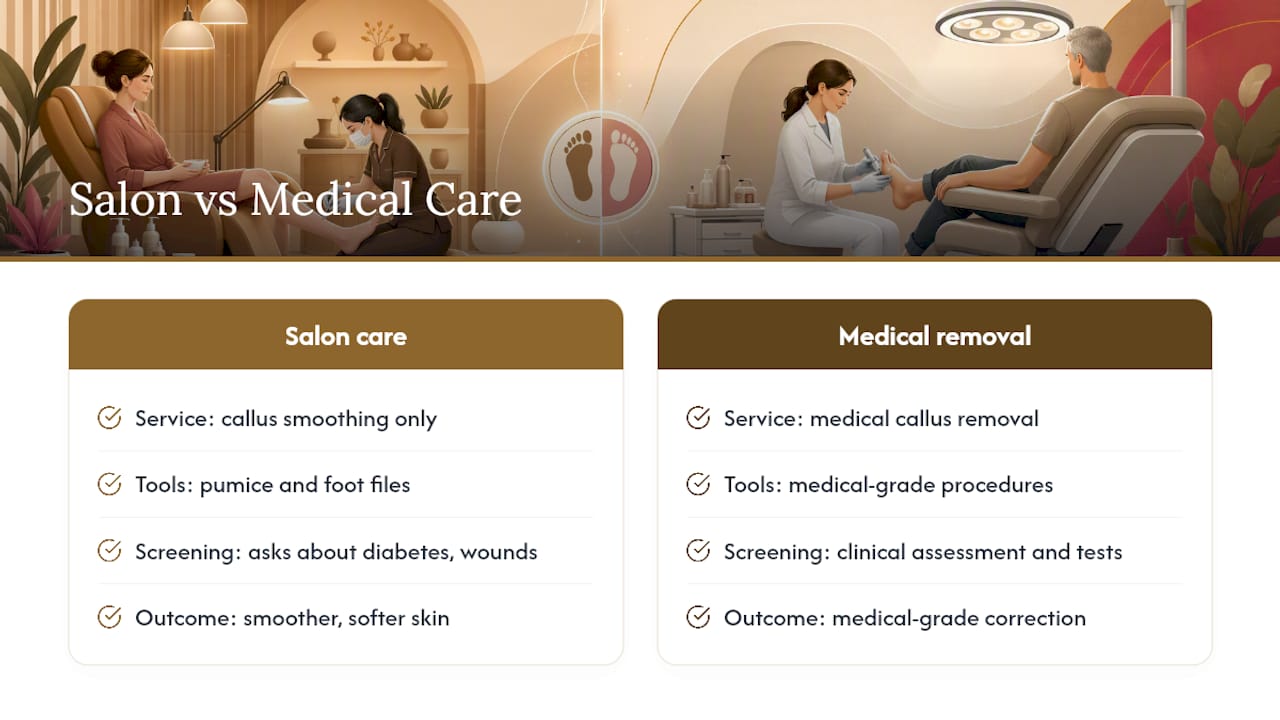
At Foxy Nails, smoothing a callus and removing one medically are treated as two different services with two different rulebooks. Our technicians use pumice and foot files, not blades, and that’s a deliberate policy, not a workaround. Before working on a client’s feet, we ask about diabetes, open wounds, or recent injuries, because that screening step is what separates responsible salon care from a liability.
Clients get the best results when they mention any circulation or sensation issues upfront rather than after the fact. What you can realistically expect from a salon visit is smoother, softer skin, not a medical-grade correction. For anything beyond that, a podiatrist referral is the honest answer, not a service we’ll pretend to provide.
— Cuong
Ready for a Safe, Professional Foot Smoothing?
Foxynailsreno gives you a safer alternative to the razor kits and high-strength acid pads sold for home use. Technicians smooth calluses with pumice and urea-based treatments instead of blades, and every appointment starts with a quick check for the conditions that make self-treatment risky.

Booking is simple: mention any diabetes, circulation issues, or open skin when you schedule, and your technician will tailor the pedicure around that. If cracked heels are part of the problem, our urea-based pedicure protocol targets that specifically. For a general spa pedicure with gentle callus smoothing built in, check out our manicure and pedicure services in Reno and grab a time that works this week.
Where This Advice Comes From
The home-care steps here follow Mayo Clinic guidance on soaking, filing, and moisturizing, alongside Kaiser Permanente’s warning for people with diabetes or poor circulation. The chemical-safety notes draw on a 2022 peer-reviewed pilot study on low-strength keratolytics, and the salon rules cite actual state cosmetology code. For more general at-home foot and nail care habits, this overview of common at-home manicure mistakes is worth a read too.

This article is general information, not a substitute for advice from a qualified doctor. Consult a qualified healthcare professional about your own circumstances before acting on anything here.
Sources
- PubMed: 2022 pilot study on potassium hydroxide callus softeners
- Mayo Clinic: Corns and calluses care instructions
- Kaiser Permanente: Corns and calluses care instructions
- Nev. Admin. Code § 644A.805 – Prohibited devices
- Naples Podiatrist: Callus removal — when to treat at home and when to see a podiatrist
FAQ
Is Callus Removal Safe to Do at Home?
Yes, for most healthy adults, as long as you stick to soaking, single-direction filing with a pumice stone, and moisturizing rather than cutting the skin.
Is a Callus Razor Illegal to Use?
Razor-type callus shavers are banned in licensed salons in states like Nevada and California, and dermatologists generally advise against using them at home because they risk cutting too deep.
How Long Does Safe Callus Removal Take to Work?
Most people notice improvement within 2 weeks of consistent care and a fully smoothed callus by around 4 weeks; if nothing changes after 3 weeks, stop and see a podiatrist.
Can People With Diabetes Remove Calluses at Home?
No. Kaiser Permanente and Mayo Clinic both advise people with diabetes, poor circulation, or reduced foot sensation to avoid self-treatment and see a doctor or podiatrist instead.
Can a Nail Salon Remove Calluses Safely?
Salons can legally smooth calluses using pumice or foot files, but cutting tools like razors are prohibited in many states, so a licensed technician should never shave skin with a blade.