
If you play fingerstyle or classical guitar, your picking-hand nails are part of your instrument. Keep them just past the fingertip, filed smooth with no hard edges. Keep fretting-hand nails short. If your natural nails split or wear down, a professionally applied acrylic set is a proven way to get consistent length and durability. Below is how to choose a length, shape the nail, protect it, and book the right service.
TL;DR
- Picking hand: start with nails just past the fingertip. Sources suggest anywhere from 1 mm to 6 mm depending on style, so adjust by ear.
- Fretting hand: keep nails as short as you can without exposing the nail bed.
- File, don’t clip. Use a fine glass file or buffer, in one direction, and finish the edge smooth.
- Steel-string players who wear through natural nails often choose acrylics. At Foxy Nails a full acrylic set starts at $55 and a refill at $45.
- Pick players and tappers usually need short nails on both hands.
Table of Contents
- Why nails matter to a player
- How long should your nails be?
- Shaping the nail for a clean sound
- Keeping natural nails strong
- When acrylics make sense for players
- Our perspective
- Book a set at Foxy Nails in Reno
- Other instruments
- FAQ
- Sources
Why nails matter to a player
On guitar, the string leaves the nail at the moment the note begins. The Aaron Shearer Foundation says tone is produced at the instant the string departs your nail, and that how gradual or abrupt that release is shapes the sound. Nail shape, finger movement and hand position all feed into it.
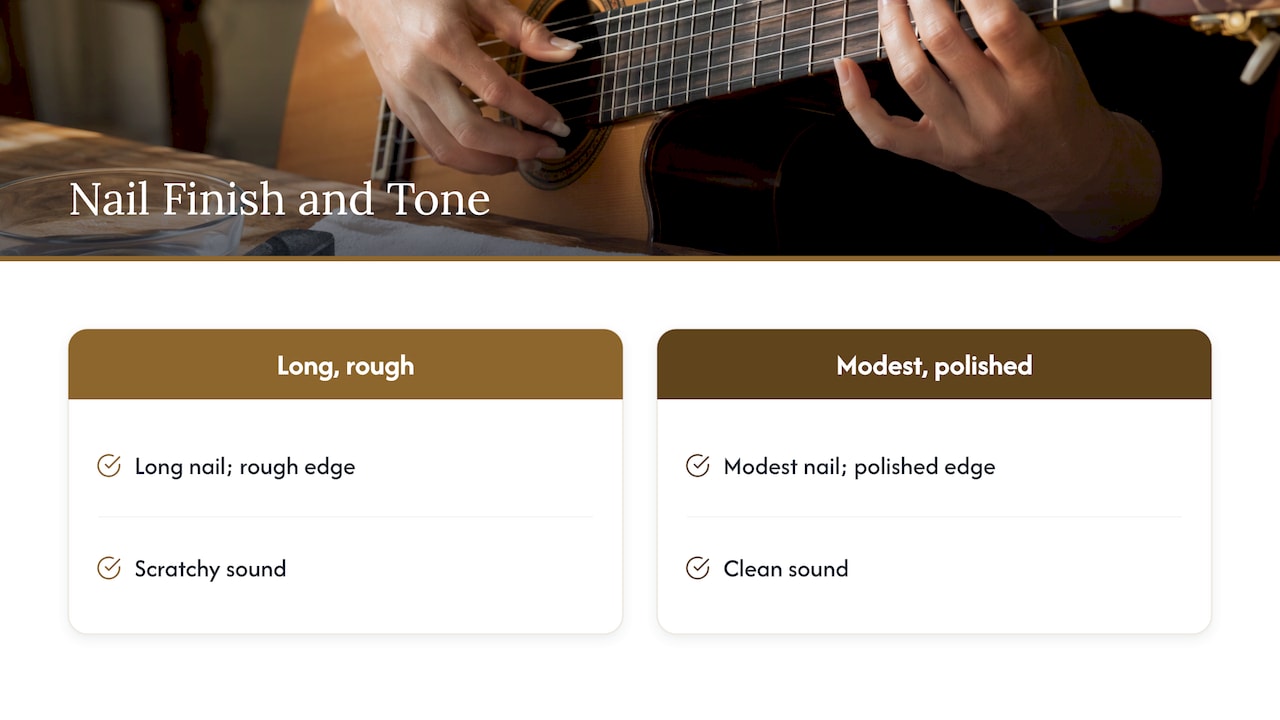
Shape and finish matter more than raw length. MusicRadar reports that for acoustic tone, shape matters more than length, and the quality of the nail’s finish is critical. A long nail with a rough edge sounds scratchy. A modest nail with a polished edge sounds clean.
The nail also works with the fingertip, not alone. The American Guitar Academy describes classical, flamenco and fingerstyle plucking as a combination of flesh and nail. Most of the tone comes from the finger, and the nail adds volume and definition.
Not every guitarist wants nails. Tremolo Guitar School notes that most professional classical players use them, but many accomplished players use only flesh. Their listed benefits of nails include a louder sound, more right-hand control, a wider range of colors from mellow to harsh, and a quicker right hand.
How long should your nails be?
There is no single number. Every source agrees the right length is personal and found by experiment. Still, the ranges give you a starting point.
| Source | Picking-hand guidance |
|---|---|
| MusicRadar | No more than 1 to 2 mm past the fingertip as a starting point |
| Hub Guitar | For fingerstyle, no longer than 2 to 3 mm as a starting point |
| Classical Guitar Corner | About 3 mm for newer players, with a gentle curve that follows the fingertip |
| Tremolo Guitar School | 3 to 6 mm over the finger line, with the palm facing you |
The spread is wide because styles differ. A short nail gives a warmer, mellower tone, and a longer one gives a brighter, louder attack. Classical Guitar 101 sums it up: long nails suit free stroke and loud, bright playing, while short ones suit rest stroke, speed and warmth.
The thumb is usually longer than the fingers. The same source puts the thumbnail at about half a centimeter past the tip, while the index, middle and ring fingers sit at 2 to 3 mm.
The fretting hand is the opposite story
Guitarists of every style agree on this one. The American Guitar Academy says fretting-hand nails should stay short, because long ones make notes hard to press and cause buzzes. Hub Guitar adds that shorter is better but overtrimming can expose the sensitive nail bed, so leave a small sliver of white.
Pick players and tappers
If you play with a pick, you often don’t need longer picking-hand nails. For fret tapping, common in rock and metal, Hub Guitar says shorter picking-hand nails are ideal because that hand strikes the fretboard. A neat short manicure is the right call here. Our short nail design ideas show what a clean short set can look like.
Shaping the nail for a clean sound
Shape is where tone is won. A simple routine:
- Use a file, not clippers. Guitar Wiz advises a fine-grit or glass file and warns that clippers can cause micro-cracks that lead to breakage.
- Follow the fingertip. Tremolo Guitar School suggests a rounded shape and a light upward stroke at about 45 degrees, thumb side toward pinky side. That makes a ramp with no hard edges.
- File in one direction. Going back and forth creates rough edges you can hear.
- Finish fine. Classical Guitar Corner recommends a buffer, micro mesh or very fine sandpaper, 1200 grit and up. After enough buffing the edge shines, and you will likely hear the difference right away.
- Touch up often. Keep a file in your case and trim to your ideal length every few days, as Guitar Domination suggests. A consistent length keeps your tone consistent.
A gentler curve is more forgiving. Classical Guitar Corner notes that the softer the curve, the more forgiving the sound when your attack varies.
Keeping natural nails strong
Playing wears nails down, and steel strings do it faster than nylon. Hydrating hands and nails regularly helps, especially in dry places, according to Play Fingerstyle Guitar. Reno’s dry air makes that relevant, and our dry climate nail care routine covers it in detail.
Two medical sources give the baseline habits:
- The American Academy of Dermatology says to keep nails clean and dry, file snags with an emery board, and wear gloves when washing dishes or cleaning. It also says not to bite nails, remove cuticles or use nails as tools.
- Mayo Clinic recommends moisturizing nails and cuticles and says a nail hardener might help strengthen them. If you are thinking of taking biotin, ask a healthcare professional first.
Tonebase adds practical habits from the guitar side: stay hydrated, go easy on coffee, and avoid long soaks in soapy water. If your natural nails are always the weak link, our guide to strengthening natural nails and our page on the best manicure for brittle nails are good next reads.
When acrylics make sense for players
Some players don’t have the time, or the nail quality, to grow a reliable playing surface. Breaking a nail is a real worry: Acoustic Guitar magazine says that the only thing worse than breaking a nail before a gig is breaking it during one. Many players turn to adhesives or pre-shaped plastic nails to avoid it.
Acrylic is the salon route. Guitar Player says acrylic nails are the most durable option and are recommended for aggressive steel-string playing. They give a bright sound and need regular filing. The same article says they should be applied by an experienced professional and refurbished every few weeks to a few months.
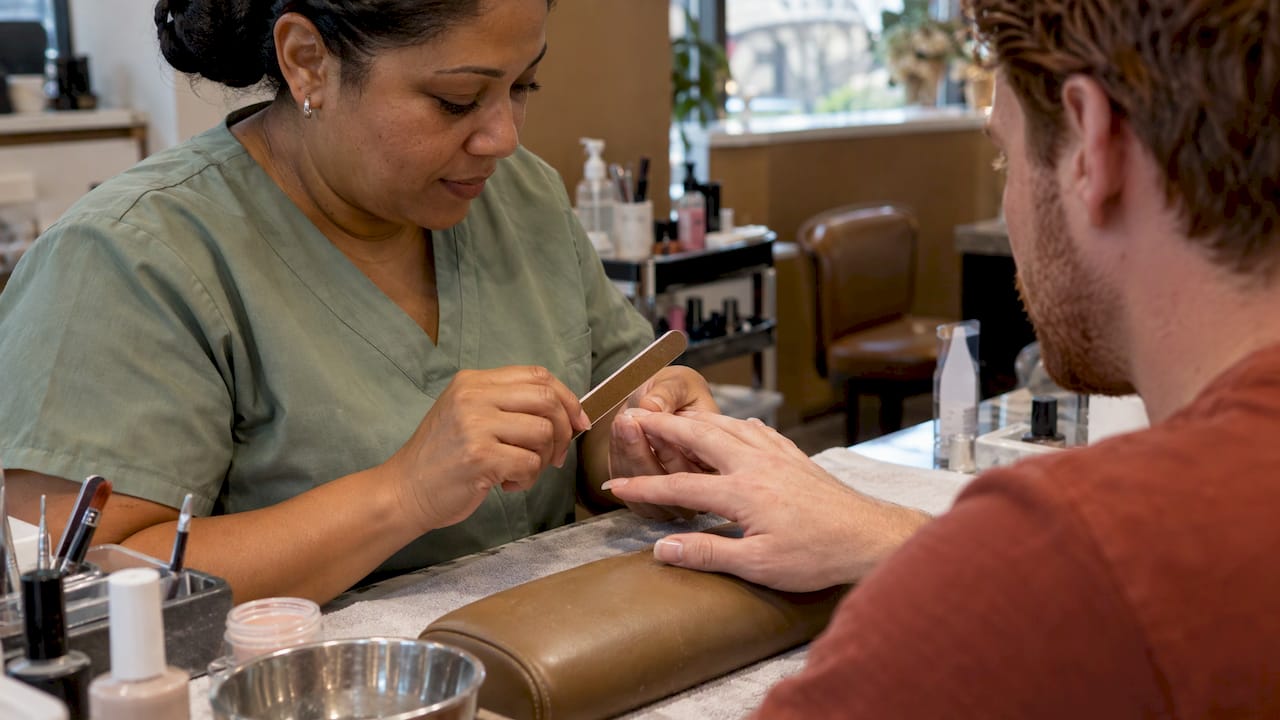
That last point is where the salon visit matters. As the set grows out, the gap between the artificial nail and the natural one gets larger. Guitar Player warns that if it isn’t maintained, the nail can catch on a string and tear off. A fresh backfill can extend the life of the set by several weeks. In practice, that means booking refills on schedule rather than waiting for a lift.
Some fingerstyle players pair acrylics with a thumbpick. Wikipedia’s fingerstyle guitar entry notes that this combination can improve tone and cut nail wear. Heavier-gauge strings can damage nails, so lighter steel or nylon strings are kinder to them.
What to tell your nail tech
Bring the details a player needs, because a standard salon shape is not a playing shape:
- Which hand plays, and which fingers pick (a thumb plus index, middle and ring is typical).
- The length you want past the fingertip, in millimeters if you can.
- A gentle, fingertip-following curve with a smooth, polished free edge, and no sharp corners.
- Short, natural-looking nails on the fretting hand.
- Whether you play nylon, steel or both. Steel-string players usually benefit most from the added durability.
If you’re deciding between materials, our comparison of gel vs acrylic nails and our complete acrylic nails guide explain how each is applied and maintained.
Our perspective
We see musicians come in with the same problem: one nail that always breaks, or a set that grows out unevenly right before a show. The fix usually isn’t more length. It is a consistent, smooth shape that you can rely on week after week.
That is why we like acrylic for players who need durability. A full set gives every picking finger the same length and the same curve. Regular refills keep the shape from drifting, so your tone stays steady from one week to the next.
We keep our service personal. Tell us how you play, show us the length you want, and we will shape each nail with care. Parents and younger players are welcome too, and we offer gentle services for kids.
Cuong
Book a set at Foxy Nails in Reno
We are a luxury nail salon in Reno, NV, offering acrylic, hard gel, Gel X and dipping powder. Our published prices for the services musicians ask about most:
| Service | Price |
|---|---|
| Full Set of Acrylic | from $55 |
| Refill of Acrylic | from $45 |
| Acrylic Take Off | $20 |
| Regular Manicure | $30 |
| Gel Manicure | $40 |
A regular manicure is a clean way to tidy the fretting hand. The full list is on our services page.

When you book, ask for a playing shape and tell us your instrument. If you want to know how acrylic sets are done and cared for first, read our acrylic nails guide, or see Reno acrylic nails. Between visits, our manicure aftercare tips help your set last.
Other instruments
Guitar dominates the searches, but the logic carries over. The nail only matters where it touches the instrument.
- Piano and keys: nails hitting the keys click and slow you down, so keep them short. A tidy short manicure suits you.
- Violin, cello and other strings: the fretting hand needs short nails so the fingertip presses cleanly. Stay short on that hand.
- Bass: fingerstyle bassists often want a little nail on the plucking hand, while pick players keep them short.
- Ukulele and harp: if you pluck with the nail, the same shaping and finishing rules apply as for guitar.
When you can’t tell, the safe start is the one the guitar sources agree on: short on the hand that frets or presses, and slightly longer on the hand that plucks, if your style uses it.
FAQ
Can guitar players wear acrylic nails?
Yes. Guitar Player describes acrylics as the most durable fake nail and recommends them for aggressive steel-string playing. They should be applied by an experienced professional and refilled every few weeks to a few months. Book refills on schedule so the set keeps its shape.
How long should fingerstyle nails be?
Start small and adjust by ear. Published starting points run from 1 to 2 mm past the fingertip up to 3 to 6 mm, depending on the teacher and the style. The thumb is usually a little longer than the fingers. Shape and a smooth edge matter as much as length.
Should my fretting-hand nails be long too?
No. Keep them short so you can press strings cleanly without buzzes. Leave a thin sliver of white so you don’t expose the nail bed, which can be sensitive.
Do I need nails if I play with a pick?
Not usually. Pick players generally don’t need longer picking-hand nails, and tappers prefer them short. A neat, short manicure keeps things comfortable and snag-free.
How do I stop nails from snagging or splitting?
File snags right away with an emery board, keep nails moisturized, and wear gloves for dishes and cleaning, as dermatologists advise. Keep a fine file in your guitar case and touch up every few days. If splitting continues, a salon set can give you a more durable playing surface.
Sources
- Aaron Shearer Foundation: Tone Quality and Your Nails
- MusicRadar: How your fingernails can improve your acoustic guitar tone
- American Guitar Academy: Do I Need Long Nails to Play Guitar?
- Tremolo Guitar School: Classical Guitar and Fingernails
- Hub Guitar: Guitar Nails, Care and Grooming
- Classical Guitar Corner: Classical Guitar Nail Shaping
- Classical Guitar 101: How to Grow and Shape Classical Guitar Nails
- Guitar Wiz: Fingerstyle Guitar Nail Care
- Classical Guitar Corner: Tone production
- Guitar Domination: How To Fingerpick
- Play Fingerstyle Guitar: Fingernails for Fingerstyle Guitar
- American Academy of Dermatology: Healthy nail tips
- Mayo Clinic: Fingernails, do’s and don’ts for healthy nails
- Tonebase: Nails for Classical Guitar
- Acoustic Guitar: The Care and Feeding of the Picking Hand
- Guitar Player: The Acoustic Guitar Player’s Guide to Using Fake Nails
- Wikipedia: Fingerstyle guitar