
The best manicure for brittle nails is the one that touches your natural nail the least. For most people that means regular polish over a bonding base coat. If you want something that lasts two to three weeks, a flexible hard gel or gel overlay, applied gently and removed patiently, is the next best choice. Dip powder and acrylic can work on nails that are hard but split, and they tend to fail on nails that are soft and bendy. Which camp you are in decides almost everything.
Below we explain how to tell the difference, how each service behaves on weak nails, what the research says, and what to ask your technician before you sit down.
TL;DR
- Brittle nails are hard and split at the tip. Thin nails are soft and bend like paper. They need different manicures.
- The gentlest option is regular polish with a bonding base coat. The damage from gel and dip usually comes from rough prep and removal, not only the product.
- Flexible overlays (hard gel, liquid gel, Gel X fills) suit thin, bendy nails. Rigid dip powder suits hard, splitting nails better.
- Never let anyone cut or aggressively push back your cuticles, and oil your nails daily.
- No manicure heals a nail. Strength grows in from the matrix over about six months.
Table of Contents
- First, work out what kind of weak you have
- Why manicures can make brittle nails worse
- The options, compared
- What we recommend by nail type
- Our perspective on brittle nails
- What to ask your technician before you sit down
- Care between appointments
- How the cost adds up at Foxy Nails
- Book a gentle manicure in Reno
- FAQ
- Sources
First, work out what kind of weak you have
“Weak nails” covers two different problems, and most articles blur them.
Brittle nails are hard but prone to splitting, chipping and peeling at the free edge. They do not flex much. Thin nails are soft and bend easily. Press the tip of your nail against your fingertip: if it folds like paper, you are on the thin side.
This matters because a rigid coating behaves differently on each. A dip powder guide for weak nails puts it simply: dip works on some weak nails and fails on others, and the difference is flex. Hard nails that split at the tip are fair candidates. Bendy nails under a stiff coating tend to lift and snap, because the coating will not bend with the nail underneath.
Many people have a mix: a strong thumb, thin ring finger, a split on the index. A good technician will assess finger by finger instead of applying one system to all ten.
Why manicures can make brittle nails worse
The American Academy of Dermatology notes that gel manicures can be beautiful and long lasting, but they can be tough on nails, causing brittleness, peeling and cracking. A PubMed report on nail damage from a gel polish system describes weakness, brittleness and thinning in five subjects after one manicure system was applied.
Three things do most of the harm:
- Aggressive prep. Over-filing the nail surface thins the plate.
- Rough removal. Dermatology guidance on removing gel polish favors acetone soaking over scraping or peeling. Heavy electric-file removal can thin the natural nail, and a rushed appointment is where that happens.
- Back-to-back cycles. Soaking the product off every two weeks, then re-applying, dries the nail out repeatedly.
It is also worth knowing what a manicure cannot do. The nail you see today grew out of the matrix weeks ago, so nothing painted on top heals it. A good service protects and camouflages while healthy nail grows in. Nails take roughly six months to fully regrow, so patience is part of the plan.
The options, compared
| Service | Best for | Watch out for | Typical wear |
|---|---|---|---|
| Regular polish with bonding base | Any weak nail, especially thin and bendy | Chips sooner | About a week or so |
| Gel polish | Hard nails that are not badly damaged | Acetone removal, UV curing, peeling if prep is rough | 2 to 3 weeks |
| Hard gel or liquid gel overlay | Thin, bendy or splitting nails needing support | Needs fills, and a gentle take-off | 3 weeks or more with fills |
| Gel X | Adding length to weak nails without heavy filing | Soak-off removal needed | 2 to 3 weeks, then fill |
| Dip powder | Hard nails that split at the tip | Lifts on thin, flexible nails; removal soak | 2 to 4 weeks |
| Acrylic | Strong enough nails needing structure | Rigid, needs careful removal, easy to over-file | 2 to 3 weeks, then refill |
Wear times vary with your nail growth, your job and how your hands live. Treat them as ranges, not promises.
Regular polish over a bonding base coat
If your nails are in rough shape, this is the lowest-risk professional choice. There is no lamp, no heavy filing, and removal does not need a long acetone soak. You trade durability for gentleness. If you are in a recovery phase, it is a smart place to start, and our guide to gel versus regular polish walks through the trade-offs in more detail.
Gel polish
Gel is a thin coating, so it can be reasonable for hard nails that are not severely damaged, provided the technician preps lightly and you give the nails a break between sets. The AAD recommends a nail polish holiday of one to two weeks between manicures. If your gel keeps peeling off the nail in sheets, that is a sign of dehydrated or over-prepped nails, and our five-step peeling repair covers the fix.
Hard gel, liquid gel and overlays
This is where the “scaffolding” approach comes in. A thin, flexible layer of builder-style gel gives the nail physical support while it grows out. Instead of soaking everything off every two weeks, the technician fills the new growth, which cuts the repeated cycle of drying and removal. Hard gel and liquid gel are both on our menu for exactly this reason. For thin, bendy nails that need support but not extra length, an overlay is often the answer. We explain it in Nail Overlays.
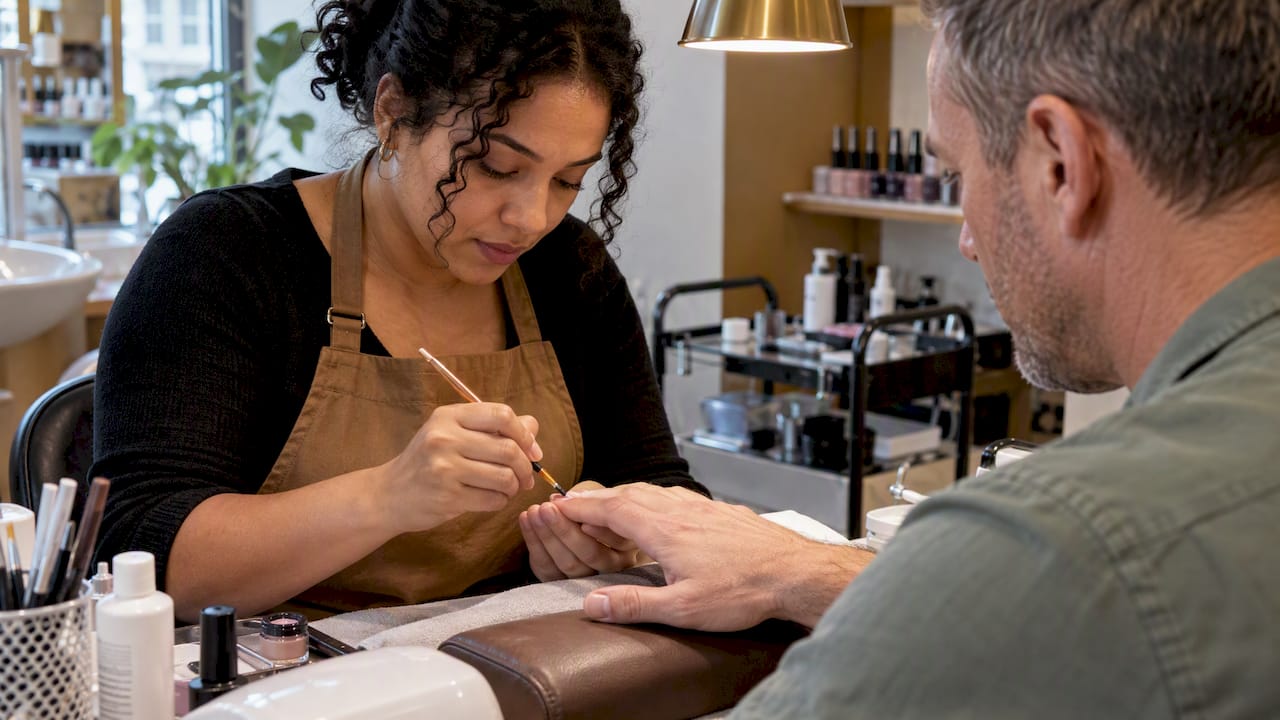
A flexible base matters most here. A rubber base or soft gel underlayer moves with the nail. A stiff, thick layer does not.
Gel X and extensions
Extensions are not off limits just because your nails are weak. The question is how the nail is prepped and how the set comes off. Gel X uses pre-shaped soft gel tips that are applied with less filing than traditional sculpted sets and soaked off at the end. If you want length and your natural nails are short because they keep breaking, this can be a practical route. Our overview of nail extension types compares the choices. Plan on fills rather than repeated full sets, because a fill leaves your natural nail alone.
Dip powder
Dip is popular because it is sturdy and quick. A comparison of dip and gel for thin nails shows why people reach for it, and for hard nails that split at the tip, that added rigidity can hold the free edge together. For soft, bendy nails it is more likely to snap or lift. A 2025 ultrasound case series on cosmetic nail changes found structural complications in some users of semi-permanent polish, so dip is not a free pass either. If you are weighing it, read Dip Powder Nails: Is This Manicure Right for You? first, and know that removal is a soak, not a scrape: our dip powder removal guide shows safe timing.
Acrylic
Acrylic is strong, and a skilled technician can use it to protect a hard nail that keeps breaking. It is also the least forgiving if the prep is heavy. The dermatology literature links artificial nails with damage through instrumentation, polish, removers and the enhancement itself. If you choose acrylic, ask for light prep, refills instead of new sets, and a proper soak-off. More detail is in our acrylic nails guide.
What we recommend by nail type
Hard but splitting at the tip. Dip powder or a hard gel overlay, kept short and rounded. Rigid products can hold the free edge together.
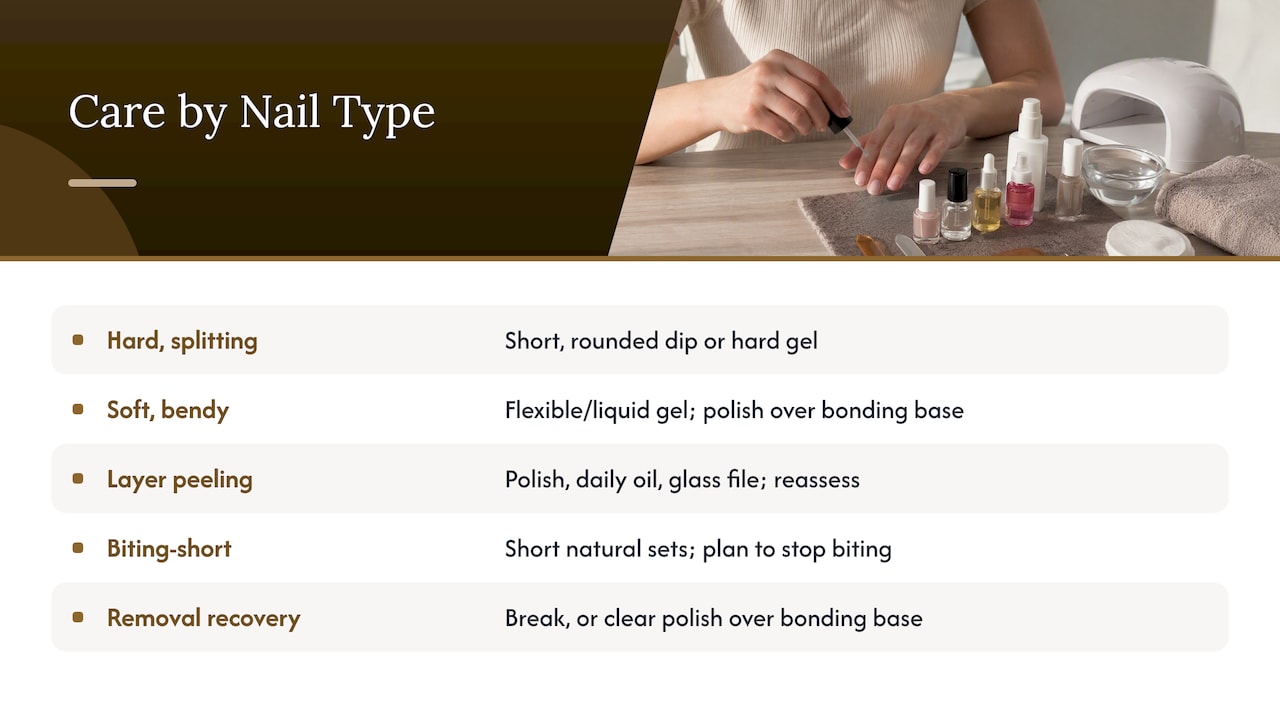
Soft, thin and bendy. A flexible gel or liquid gel overlay, or regular polish over a bonding base. Skip thick rigid dip.
Peeling in layers. Regular polish for a few weeks, daily oil, and a glass file. Then reassess.
Short because you bite them. Short, natural-looking sets, and a plan to stop the habit. We cover that in Nails for Nail Biters.
Recovering from a damaging removal. Take a break, or use clear polish over a bonding base while healthy nail grows in. See our routine for strengthening natural nails.
Our perspective on brittle nails
We see a lot of clients who arrive saying their nails are ruined and that gel did it. Often the story is more specific: a rushed removal, a coating that was too stiff for a bendy nail, or no break between sets. The product gets blamed, but the process is usually the problem.
Our approach is to start with the question of how much your natural nail can handle right now. We offer regular and gel manicures, hard gel, liquid gel, Gel X, dipping powder and acrylic, so we are not pushing one system. We would rather match the service to your nails. That sometimes means telling a client that a simple manicure this month will serve them better than a full set.
Three habits we hold to for clients with fragile nails:
- Gentle cuticle care. Dermatologists warn against cutting or aggressively pushing back the cuticle, because it seals the area where new nail grows. We prep gently.
- Patient removal. Soak-off beats scraping every time. Removal is part of the service, not an afterthought.
- Honest expectations. A manicure protects your nails while they grow. It does not repair them.
Because we are a family-friendly salon, we also see how much healthy habits matter early, including for kids and teens whose nails are still developing and who are often hard on them.
— Cuong
What to ask your technician before you sit down
A short conversation before the service protects your nails more than any product choice.
- “Can you check whether my nails are thin and bendy or hard and splitting?” The answer should shape the system.
- “Will you avoid cutting my cuticles?” The answer should be yes.
- “How will you prep the nail surface?” Light buffing, not heavy filing with a drill.
- “Will you soak the product off?” Gentle acetone soak-off is the safer route.
- “Can I do a fill instead of a new set?” Fills keep you from stripping the product every cycle.
- “How long should I wait before the next set?” A good answer includes a rest period.
If an appointment feels rushed, say so. Gentle work takes a few more minutes, and it is worth them.
Care between appointments
What you do at home changes how long a manicure lasts and how your nails feel.
- Oil daily. Apply cuticle oil several times a day, including the underside of the free edge and around the cuticle. Hydration helps brittle nails more than most single treatments.
- Use a glass file, one direction. Coarse emery boards cause tiny tears that lead to peeling, which is why dermatologists quoted by SELF suggest switching to glass.
- Wear gloves for cleaning and dishes. Water and detergents dry nails out.
- Do not pick at lifting product. Peeling gel takes layers of nail with it. Come in and have it fixed. Our manicure aftercare guide explains how to stop lifting.
- Moisturize hands often. Reno’s dry air is hard on nails, and our dry climate routine is written for that.
- Be careful with biotin. Research on it is mixed. A published review notes small studies showing thicker nails at high doses over many months, but evidence is limited. The FDA warns that high-dose biotin can interfere with lab tests, including troponin and thyroid tests, so talk to your doctor before starting it.
When to see a doctor instead
A manicure is not a treatment. The Mayo Clinic advises talking to your healthcare professional or a dermatologist if you notice a color change in the whole nail, a dark streak, curled nails, or nails that get thinner or change in other ways. Painful, swollen or discolored nails also deserve a medical visit before any enhancement.
How the cost adds up at Foxy Nails
Here are the prices we publish for services relevant to brittle nails:
| Service | Price |
|---|---|
| Manicure | $15 |
| Regular Manicure | $30 |
| Gel Manicure | $40 |
| Gel X Full Set | from $60 |
| Gel X Fill | from $45 |
| Full Set of Liquid Gel | from $55 |
| Refill of Liquid Gel | from $45 |
| Dipping Powder | from $55 |
| Full Set of Acrylic | from $55 |
| Refill of Acrylic | from $45 |
| Gel Polish Take Off | $10 |
| Hard Gel Take Off | $20 |
| Acrylic Take Off | $20 |
The take-off prices are worth noticing. A proper removal is a separate, small cost, and it is the cheapest insurance your nails have. Fills cost less than most new sets, and they spare your nail plate repeated stripping.
Book a gentle manicure in Reno
If your nails are splitting, peeling or bending and you are not sure which service suits them, come in and let us look at them first. We will tell you what your nails can handle now, whether that is a simple manicure or a flexible overlay, and what to plan for next. See all prices and services on our services page, or start from Foxy Nails in Reno.
FAQ
What is the best manicure for weak, brittle nails?
Regular polish over a bonding base coat is the gentlest, because it avoids UV curing and heavy filing. If you want longer wear, a flexible hard gel or gel overlay is a good next step for thin nails, and dip or acrylic can suit hard nails that split. A technician should check which type you have before choosing.
Is gel or dip better for brittle nails?
It depends on flex. Hard nails that split at the tip can benefit from the rigidity of dip, while thin, bendy nails are better with a flexible gel, since stiff dip tends to lift and snap on them. In both cases, patient soak-off removal matters as much as the product.
Can hard gel or Gel X work on weak nails?
Yes, when applied with light prep and removed by soaking. Hard gel overlays give support while nails grow, and Gel X can add length with less filing than sculpted sets. Choose fills over repeated new sets to avoid stripping the nail each time.
How long do brittle nails take to recover?
Nails take about six months to regrow, so noticeable strength builds slowly. Daily oiling, a glass file, gloves for wet work and a break between manicures all help. If nails keep thinning or change shape or color, see a dermatologist.
Sources
- Gel manicures: Tips for healthy nails, American Academy of Dermatology
- Dermatologist’s secret for removing gel nail polish at home, American Academy of Dermatology
- Nail damage from gel polish manicure, PubMed
- Ultrasound Evaluation of Cosmetic Changes in Nails, PubMed
- Dip Powder for Weak Nails: Critical Safety Advice to Know
- Dip vs. Gel: Choosing the Best Option for Thin Nails
- 10 Legit Ways to Strengthen Nails, According to Dermatologists, SELF
- Fingernails: Do’s and don’ts for healthy nails, Mayo Clinic
- Biotin and nail health review, PMC