
The safest way to remove dip powder is to file off the shiny top layer, soak each nail in pure acetone until the product softens, and then gently slide the loosened powder away. Never peel or pry it. Allow 20 to 40 minutes at home, and stop if the product resists. This guide covers the steps, the mistakes that damage nails, and the point where a professional removal is the better call.
TL;DR
- Pure acetone is the solvent that works. Regular non-acetone polish remover, oil, rubbing alcohol and hand sanitizer are not reliable substitutes.
- File the top coat and bulk first, without touching the natural nail, so the acetone can get in. Then soak, wait, and slide off only what has loosened.
- Peeling, scraping and filing down to the natural nail do more harm than a second soak does.
- Dip nails don’t always need a full removal. Lifting, cracks, trapped moisture or thin, sore nails are reasons to take everything off and let the nail recover.
- Kids, and anyone who can’t sit still for half an hour with acetone, are better off in a salon chair than at a kitchen table.
Table of Contents
- Why dip powder is so hard to take off
- What you need before you start
- How to remove dip powder at home, step by step
- Safety: acetone is flammable and drying
- Shortcuts that don’t work
- What damages nails during removal
- Our perspective: removal is part of the service
- When a salon removal is the better choice
- How much does a removal cost?
- Do dip nails have to come off every time?
- Aftercare: what to do once the product is off
- Book a removal or a new set in Reno
- FAQ
- Sources
Why dip powder is so hard to take off
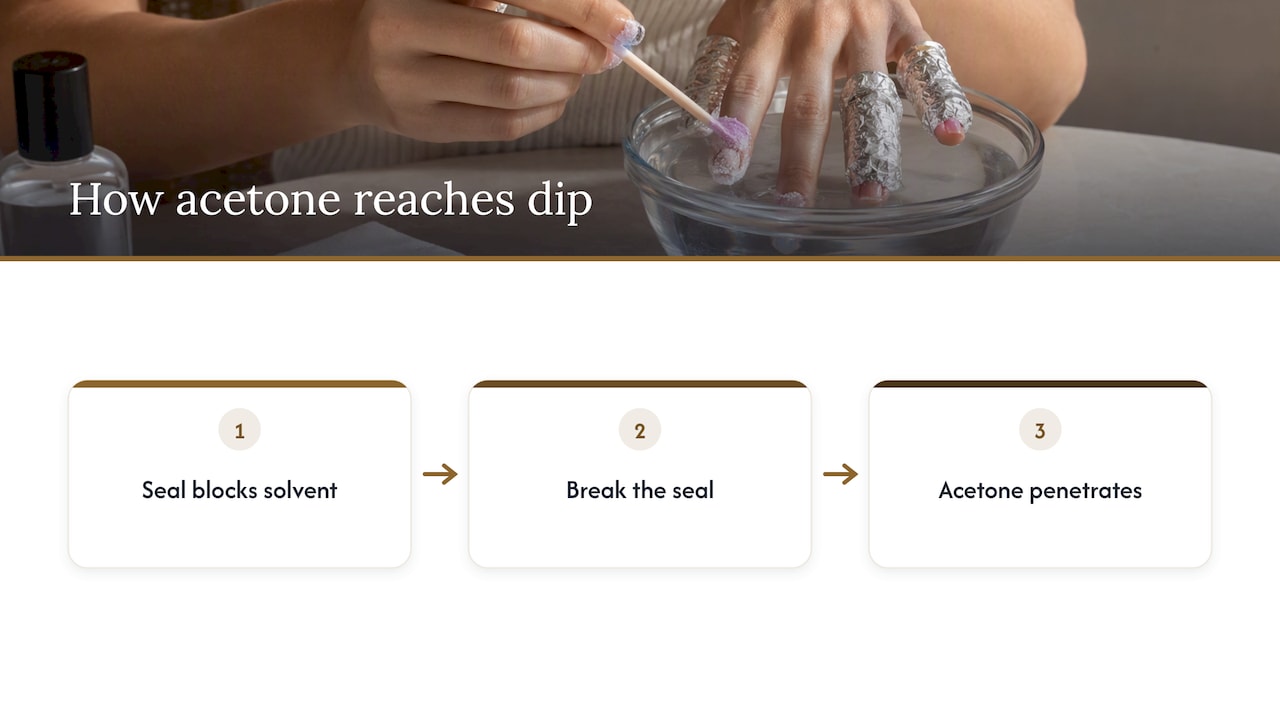
Dip powder is built in layers: a bonding adhesive, colored powder, more adhesive, and a sealing top coat. Healthline explains that the system is cyanoacrylate-based, which is why it grips so well and why ordinary polish remover barely touches it. The top coat is a seal. Until you break it, the solvent has nowhere to go.
Manicurist Joy Terrell makes the same point in Byrdie’s removal guide: the key step is removing the seal first so acetone can penetrate. That is the step people skip when they get impatient, and it is the reason a soak “doesn’t work.”
The other half of the problem is what happens when you give up on the solvent. If softened product still resists and you force it, that is the moment your natural nail layers are most likely to come off with it.
What you need before you start
Gather everything first, because once your fingers are wrapped you won’t want to go looking for things.
- 100% pure acetone. Check the label. Nailboo’s help page states plainly that regular nail polish remover won’t dissolve dip powder and that you need 100% pure acetone.
- A medium-grit file or buffer, plus a softer buffer for finishing.
- Cotton balls or pads and foil, or reusable removal clips.
- A wooden or orange stick for nudging loosened product, never for digging.
- Petroleum jelly or cuticle oil to protect the skin around each nail.
- A well-ventilated spot with no flames, cigarettes, heaters or other ignition sources nearby.
- Moisturizer and cuticle oil for afterward.
How to remove dip powder at home, step by step
- Trim if you need to. If your nails are long, clip off excess length so there is less product to dissolve.
- Break the seal. File or buff away the glossy top coat and some of the bulk. Stop while a thin layer of color is still visible. OPI’s professional e-file procedure uses the same logic: leave color as a safety margin, use light pressure, and let the tool do the work.
- Protect your skin. Rub petroleum jelly or oil around the nail and onto the cuticles. Keep it off the nail surface itself.
- Apply the acetone. Saturate a piece of cotton, set it on the nail, and wrap the fingertip in foil or use a clip. Alternatively, soak in a bowl of acetone.
- Wait. Published professional instructions give roughly 10 to 15 minutes for some artificial-nail removers and about 25 minutes for a bowl soak, with an extra 5 to 7 minutes if residue remains (see OPI). Thick applications can take longer.
- Slide, don’t scrape. Press gently from the cuticle toward the tip with a wooden stick. Product that has softened will move. Product that hasn’t should go back under acetone.
- Re-wrap if needed. Nail artist Evelyn Lim notes in Byrdie that thick applications may need a second soak, and that the powder can turn gummy or crumble depending on the formula. Odd texture is not a reason to scrape harder.
- Finish gently. Lightly buff any leftover residue with a soft buffer, then wash your hands.
- Rehydrate. Moisturize and apply cuticle oil. If you’d like a tidy finish on your toes as well, a decent pair of toenail nippers helps you trim cleanly without tearing.
Timing at a glance
| Stage | Typical time |
|---|---|
| Filing off top coat and bulk | 5 to 10 minutes |
| Acetone soak (wraps or bowl) | 10 to 25 minutes |
| Second soak, if residue remains | 5 to 7 minutes more |
| Buffing, washing, moisturizing | 5 minutes |
The soak figures come from the professional instructions above. The filing and finishing times are our own ballpark from experience and will vary with how thick your set is.
Safety: acetone is flammable and drying
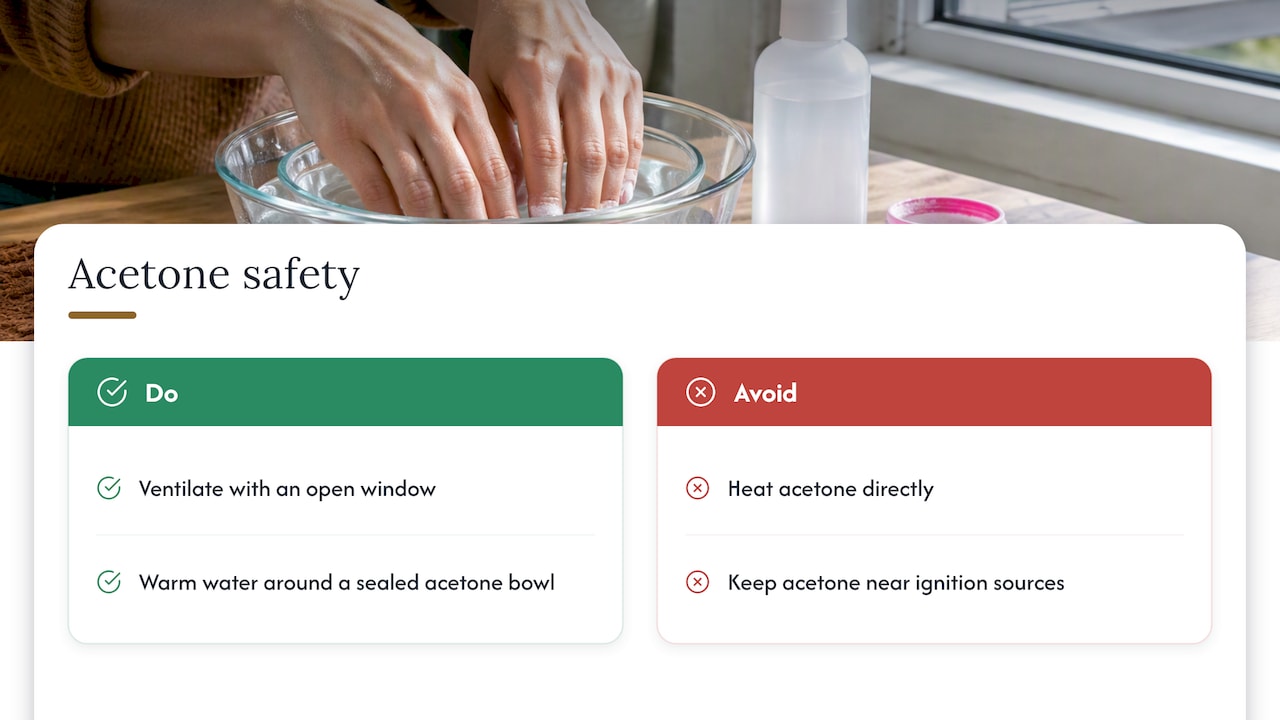
Acetone is a solvent, and you are putting it on your hands for a long time. OSHA lists headaches, dizziness, and irritated eyes, skin and throat among the effects of acetone exposure, and says ventilation is the best way to lower chemical levels in the air. At home, that means an open window or a room with good airflow, and doing the removal in one sitting rather than hovering over the bowl for an hour.
Heat is where people get into trouble. Never heat acetone directly on a stove, in a microwave or near an open flame. If you want warmth, warm the water that a sealed bowl of acetone sits in, or use indirect heat only. Keep acetone away from anything that can ignite it.
Shortcuts that don’t work
The top search results are full of hacks. Here is how they hold up.
- Non-acetone polish remover: Healthline describes this route as very challenging, and in practice it mostly wastes an hour.
- Oil alone: Oil protects skin but cannot penetrate and dissolve the product.
- Rubbing alcohol, mouthwash or hand sanitizer: These are not the salon-standard method and are not dependable substitutes for acetone.
- Hot water and a fake nail: Removal tutorials that skip acetone replace the solvent with mechanical force.
Nail artist Syreeta Aaron argues in Allure that a chemical-free shortcut isn’t automatically safer, because swapping solvent for aggressive filing creates greater mechanical risk. We agree. A short, well-run acetone soak is gentler on the nail than ten minutes of grinding.
What damages nails during removal
The product itself is rarely the villain. Technique is. A peer-reviewed study in the International Journal of Dermatology reported brittleness and splitting among the changes it observed after nail coatings and their removal. It also found drill and file removal produced the greatest nail-plate destruction among the methods tested. That supports gentle technique. It does not mean every professional removal harms your nails.
The habits that cause trouble:
- Peeling or biting product off at the edges, which takes layers of the nail plate with it.
- Filing all the way down to the natural nail.
- Scraping at product that hasn’t softened.
- Stacking several long acetone soaks back to back.
The Acibadem Hospitals Group makes the same point: peeling or prying dip nails can remove layers of the natural nail and increase breakage.
If you already have thin or sore nails from previous enhancements, our guide to recovering from damaged nails after acrylics applies to dip as well.
Our perspective: removal is part of the service
At Foxy Nails, we treat a removal as a nail check, not a stripping job. Before anything comes off, we look at the nail: Is the product lifting? Is there moisture trapped underneath? Is the natural nail tender or thin? What we see decides whether we remove everything, reduce the product and keep going, or recommend a break.
We also tell clients what we tell ourselves: how a removal looks mid-process is not a reason to rush it. Powder that turns gummy needs another soak and a little patience, not a harder file. Our personal service approach means you aren’t hurried through this part, and kids get gentle handling with a technician who knows how to keep a small client comfortable.
If you wear dip regularly, the removal is where your next set is decided. A good removal leaves a smooth, flexible nail ready for whatever comes next, whether that is dip again, a gel manicure, or a few weeks of bare nails.
— Cuong
When a salon removal is the better choice
Do it yourself if your nails are healthy, the set is fresh, and you have 40 minutes, good ventilation and patience. Book a salon removal if any of these apply:
- Your nails are painful, visibly thin, splitting or irritated. Persistent tenderness, redness, swelling, itching, lifting or unusual discoloration means you should stop cosmetic reapplication and get professional or medical advice. See a doctor or dermatologist if the symptoms don’t settle.
- The set is thick or old. Heavy builds usually need reduction before any soak will work.
- You can’t sit still or work safely. Acetone is flammable and drying, and Nailboo’s guidance leads to the same conclusion we do: a child, or anyone who can’t stay put, should get controlled professional service rather than an improvised bowl soak.
- You don’t know what product is on your nails. Unknown chemistry makes the timing a guess.
A professional setup also controls the air. OSHA and NIOSH treat ventilation as an exposure-control issue, and NIOSH’s evaluation of four nail salons looked at both chemical exposure and ventilation. A pleasant smell or a small tabletop fan tells you nothing about whether fumes and filing dust are being pulled away. It is fair to ask a salon how it handles this.
How much does a removal cost?
Prices vary widely by salon, and we don’t publish a separate dip powder removal price. What we do publish is what comes off other systems: gel polish take off is $10, and acrylic or hard gel take off is $20. Call or ask at the desk for a quote on your specific set before you book. For the full picture of what dip costs over a year, including the removal and refill cycle, see our dip powder cost guide.
Do dip nails have to come off every time?
Not always. A technician can reduce the existing product and perform a maintenance service when the product and the nail are in good condition. OPI’s professional procedure supports controlled reduction plus soak-off as the working method.
There are clear reasons to take everything off and start over:
- Lifting at the edges or cuticle
- Moisture trapped under the product
- Cracks in the set
- Heavy growth that has moved the stress point
- Unknown product from another salon
- Natural nails that are damaged
Burying those problems under a fresh coat of powder rarely ends well.
How often should you redo dip nails?
Most people come back every two to four weeks, depending on how fast their nails grow and how hard they are on their hands. Growth at the cuticle is the usual signal. That is a general range rather than a rule. If you’re curious whether dip suits your lifestyle in the first place, start with our dip powder overview.
Aftercare: what to do once the product is off
- Wash your hands with mild soap and water to remove acetone residue.
- Moisturize, then press cuticle oil into the nail folds and the nail itself.
- Keep nails short for a few days so they are less likely to snag or split.
- Skip re-applying enhancements right away if your nails feel sore, look thin or are splitting. Give them time.
- Don’t pick at any remaining residue. A soft buffer or a short extra soak is gentler.
For long-term upkeep between appointments, our manicure aftercare guide covers habits that keep any manicure from lifting early. The same principle applies if you wear Gel X: our page on safe Gel X removal shows the same sit-back-and-let-the-solvent-work approach.
Book a removal or a new set in Reno
If you’d rather hand this over, Foxy Nails in Reno, NV, offers dipping powder from $55, along with acrylic, hard gel, Gel X and gel manicures. Gel polish take off is $10, and acrylic and hard gel take off are $20 each. Browse the full service menu and tell us at your visit what is on your nails and when it went on, and we’ll plan the removal around that.
FAQ
Does rubbing alcohol remove dip powder?
Not reliably. Rubbing alcohol is not the salon-standard method, and it won’t dissolve the adhesive layers the way pure acetone does. If you try it, expect a long wait and a temptation to scrape, which is the real danger.
Why are dip nails so hard to remove?
They are made of layered adhesive and powder under a sealed top coat. Solvent can’t reach the product until you file through that seal. Once it can, acetone softens the layers and they slide off.
Can I soak off dip powder without acetone?
It’s possible in theory but not practical. Healthline calls non-acetone removal very challenging, and the usual workaround is heavy filing, which carries more risk for your nail than a soak. Use 100% pure acetone, or book a salon removal.
How long should I wait before getting a new set?
There is no fixed number. If your nails feel healthy and flexible, you can rebook right away. If they are painful, visibly thin, splitting or irritated, wait, moisturize, and check with a professional or doctor if the symptoms persist.
Sources
- How to Remove Dip Nails: Visiting a Salon May Be Best, Healthline
- How to Remove Dip Nails at Home, Allure
- How to Remove Dipping Powder by E-File, OPI
- Health Hazards in Nail Salons: Chemical Hazards, OSHA
- Dip Powder Removal, Nailboo Help Center
- How to Remove Dip Powder Nails at Home, According to Manicurists, Byrdie
- Evaluation of Ergonomics, Chemical Exposures, and Ventilation at Four Nail Salons, NIOSH
- Evaluation of structural damage and pH of nail plates, International Journal of Dermatology