
Yes, pedicures are safe for runners, and often beneficial, as long as you protect your calluses and time the appointment around your training. Podiatrist-backed guidance from SELF and Runner’s World points to one rule above all: trim straight across, keep some callus for protection, and schedule your last pedicure with enough time before race day to allow any minor skin irritation to heal. Foxy Nails and similar salons can absolutely work with that request if you say it out loud.
TL;DR:
- Proper communication with the technician is crucial: request straight-across nail trimming, avoid cuticle cutting, and emphasize preserving calluses for protection.
- Book your last pre-race pedicure at least two weeks before race day to allow healing of any minor irritation or skin injury.
- Regular self-trimming of toenails every one to two months, combined with proper footwear, helps prevent nail injuries like runner’s toe.
- A medical pedicure is recommended for issues like thickened nails, fungal infections, or painful calluses, while routine healthy feet can handle standard salon pedicures.
- Use runner-specific footwear and moisture-wicking socks to minimize friction and fungal risks, and maintain callus and nail care between visits to support training and injury prevention.
Table of Contents
- Exact Instructions to Give Your Nail Technician
- Timing a Pedicure Around Training and Race Day
- Medical Pedicure vs Regular Salon Pedicure
- Callus Management and Skin Care for Runners
- Toenail Care and Runner’s Toe: Prevention and Fixes
- How to Choose a Safe Salon or Technician
- How Foxy Nails Supports Runners
- Footwear and Sock Recommendations to Prevent Pedicure-Related Issues
- Signs of Fungal Infections and Other Runner Foot Problems
- Moisturizing and Skin Care After a Pedicure
- How Pedicures Affect Running Performance and Injury Prevention
- Balancing Looks and Performance
- Book a Runner-Friendly Pedicure at Foxy Nails
- Sources
- FAQ
Exact Instructions to Give Your Nail Technician
Most pedicure mishaps happen because the technician doesn’t know they’re working on a runner’s feet. Say it plainly at the start of the appointment, before they pick up a single tool.
- Ask for nails trimmed straight across, not rounded, and left just barely above the skin, not clipped flush to it.
- Request no cuticle cutting. Pushing back is fine; cutting invites infection right where your shoe rubs all day.
- Say you want calluses smoothed, not stripped. A pumice stone or gentle file works; anything that leaves skin looking raw or shiny went too far.
- Mention you’re training for a race or logging heavy mileage, so the tech skips aggressive tools meant for someone who spends their week in sandals.
- Skip the appointment entirely if you have an open blister, an active fungal infection, or a nail that took a hit in the last week or two. Healing tissue does not need a pedicure; it needs time.
Podiatrists generally recommend runners trim their own nails every one to two months between salon visits, so nails never grow long enough to jam into the front of a shoe during a run.
Pro Tip: Bring a photo of your running shoe’s toe box to your appointment. It gives the technician a visual reference for how much clearance your nails actually need, which is usually more than a typical pedicure client requires.
Timing a Pedicure Around Training and Race Day
Book your last pre-race pedicure at least two weeks out. That buffer gives any accidental nick, hangnail, or irritated cuticle enough time to fully close up before 26.2 miles of friction tests it, a rule SELF and several podiatrists back for the same reason.
During base building and taper weeks, a routine cadence works well for most runners:
- Every 4 to 6 weeks for a standard salon pedicure or medical pedicure if you’re managing a chronic issue like thickened nails.
- Skip any pedicure close to race day unless it’s strictly maintenance, like a light nail trim with no tool near the skin.
- If something needs fixing close to race day, ask for the smallest possible intervention. A quick nail file to smooth a rough edge heals in a day or two. Callus reduction or cuticle work needs a longer runway, sometimes a full week, before it feels normal under a shoe again.
Medical Pedicure vs Regular Salon Pedicure
A medical pedicure, often called a medi-pedi, uses medical-grade tools and is frequently performed by technicians who work directly with podiatrists. It’s a different service from a standard spa pedicure, built around correcting a problem rather than relaxing.
Here’s how to decide which one fits your feet right now:
- Choose a medical pedicure if: you have thickened or discolored nails, recurring ingrown toenails, painful calluses that keep coming back, or any sign of fungal infection.
- Choose a standard salon pedicure if: your feet are healthy, you just want nails trimmed and skin smoothed, and you’re not managing an ongoing issue.
- Trade-off to know: medi-pedis trade some of the spa relaxation and lower price for sterility and clinical precision, which matters more when nail matrix damage or infection risk is on the table.
- Follow-up: runners managing a chronic problem often return every 4 to 6 weeks for a medi-pedi until the issue resolves, then can taper back to a standard pedicure schedule.
Foxy Nails’ Foxy Signature Pedicure suits the second group well, and it’s worth mentioning any recurring nail concern when you book so the salon can set expectations.
Callus Management and Skin Care for Runners
Calluses form because your foot is protecting itself from repeated friction. Strip them away completely and you expose raw, tender skin that blisters far more easily on your next long run.
- Preserve, don’t erase. A thin, smooth callus layer absorbs shock. The goal is thickness control, not elimination.
- Stick to pumice or trained hands. A pumice stone or a gentle electric file run by a licensed technician thins buildup safely. Microplane and Credo-style blades scrape too aggressively and are banned in a number of U.S. states for good reason.
- Maintain at home. After a shower, when skin is soft, a few passes with a pumice stone plus a urea-based cream keeps calluses manageable between salon visits. Skip moisturizer between the toes, where trapped moisture invites fungus.
- Know when to escalate. Cracking, bleeding, or a callus that keeps returning despite regular care is a signal to see a podiatrist for actual debridement, not another round of salon filing.
Pro Tip: If a technician reaches for a blade that looks like a cheese grater, it’s fine to say no. A proper callus removal approach never needs one.
Toenail Care and Runner’s Toe: Prevention and Fixes
Runner’s toe, medically a subungual hematoma, is blood pooling under the nail from repeated impact against the front of a shoe. It shows up as a bruised, sometimes blackened nail after weeks or months of downhill runs, tight-fitting shoes, or long races.
Correct trimming prevents most cases: cut straight across, and leave a small white edge of nail just below the tip rather than clipping it flush with the skin. Shoes a half size too small, or laced too loosely so the foot slides forward, are the most common culprits.
- On race day, thicker socks and a shoe with real toe box room reduce friction, even if that means going up half a size for marathon distances.
- Toe padding or lubricant on pressure points can buy relief for a nagging nail during a race you’re not willing to skip.
- Trim nails a few days before a long race, never the night before, so there’s no fresh edge to catch.
- See a podiatrist if the pain is severe, if pressure builds under the nail, or if you suspect the nail matrix itself is damaged, since repeated trauma to the matrix can cause permanent nail loss in rare cases.
How to Choose a Safe Salon or Technician
Not every salon handles a runner’s feet the same way, and the wrong tool or a shortcut on sanitation can undo months of careful training. A short screening conversation before you sit down solves most of that.
- Ask whether tools are sterilized in an autoclave between clients, not just wiped down.
- Confirm the salon uses single-use liners in pedicure tubs, since shared, unlined basins are a common source of infection.
- Bring your own file or pumice stone if the salon allows it, especially if you visit often.
- Decline any offer to use a microplane or Credo-style blade. A safe pedicure setup simply won’t include one.
- Look for a technician trained in medical pedicure work or one who mentions working alongside a podiatrist, a strong sign they understand runner-specific nail issues.
Watch the appointment itself, too. A technician who skips a fresh tool wrap or reaches for a communal file without wiping it down first is telling you something about the rest of the salon’s habits.
How Foxy Nails Supports Runners
Foxy Nails offers a Spa Pedicure and a Foxy Deluxe Pedicure built around personal attention rather than a rushed assembly line, which matters when you need specific requests followed instead of ignored.
When booking, mention:
- That you run regularly and want nails trimmed straight across, not rounded.
- That calluses should be smoothed, not stripped completely.
- Any recent nail bruising or sensitivity, so the technician adjusts pressure accordingly.
This approach centers on making every client, including families and kids, feel genuinely cared for rather than processed through a standard routine. That same attentiveness is exactly what a runner needs when the ask is more specific than “make it look nice.”
Footwear and Sock Recommendations to Prevent Pedicure-Related Issues
A great pedicure gets undone fast by the wrong shoe. Running shoes with a snug heel and a roomy toe box protect both your polish and your nail beds, since a shoe that’s too narrow up front is the single biggest cause of bruised nails and blisters that later need salon attention.
Buy running shoes a half size larger than your everyday shoe, especially for marathon or trail training, since feet swell on long runs and need room to move without the toes jamming forward on every downhill step. If you can wiggle your toes freely while your heel stays locked in place, the fit is right.
Socks matter almost as much as the shoe. A moisture-wicking synthetic or wool blend keeps feet dry, which reduces the friction that causes blisters and the damp environment fungus thrives in. Cotton socks hold sweat against skin and are worth skipping for anything beyond a short easy run.
Double-layer socks, designed with two thin layers that rub against each other instead of your skin, cut blister risk further on long runs. Combine that with good foot-care habits like lubrication and proper taping, and a pedicure becomes maintenance rather than damage control. Runners who train on technical terrain, like forest trail running, tend to see this fastest, since uneven footing multiplies every fit problem a shoe already has.
Signs of Fungal Infections and Other Runner Foot Problems
Athlete’s foot and toenail fungus show up more in runners than in most people, simply because sweaty shoes and dark, warm socks are exactly the environment fungus needs to spread. Watch for peeling or cracking skin between the toes, a persistent itch that doesn’t fade after a shower, or a nail that turns yellow, thickens, or starts lifting from the nail bed.
A routine pedicure, done at a salon with proper sanitation, actually helps here. Clean, well-maintained nails and skin give fungus less surface area to take hold, and a technician trained to spot early signs can flag a problem before it spreads to other nails.
Blisters and ingrown toenails round out the most common complaints. Ingrown nails often trace back to rounded trimming instead of a straight cut, which is why the trimming instructions in this guide matter beyond just appearance. If a nail edge is already digging into the skin and looks red or swollen, that’s a case for a podiatrist rather than a salon, since improper at-home or salon correction can make an ingrown nail worse.
Persistent fungal infections resist over-the-counter treatment more often than people expect, and self-treating for months while continuing to run in the same damp shoes rarely solves the underlying cause. A dermatologist or podiatrist visit, paired with better sock and shoe hygiene, tends to work faster than another round of drugstore cream.
Moisturizing and Skin Care After a Pedicure
The two days after a pedicure matter almost as much as the appointment itself. Skin that’s just been buffed and softened is slightly more vulnerable until it re-hardens a bit, so how you treat it shapes whether the pedicure helped or set you up for a blister on your next run.
Moisturize the tops and soles of your feet with a thick, urea-based or lactic acid cream once or twice a day. Skip the space between your toes entirely. Trapped moisture there is exactly what fungus needs, and it’s the single most common mistake runners make after a pedicure that otherwise went well.
Give your feet at least a day before a hard run if the technician did any callus reduction, since freshly smoothed skin has slightly less protective buildup than it did the week before. An easy short run is usually fine; a long tempo effort the same afternoon is asking for trouble.

Keep toenails dry and check them the next morning for any redness or tenderness around the edges, a sign the trim went slightly too close and needs a day to settle. Most runners find this settles within 24 to 48 hours with nothing more than moisturizer and normal shoes.
How Pedicures Affect Running Performance and Injury Prevention
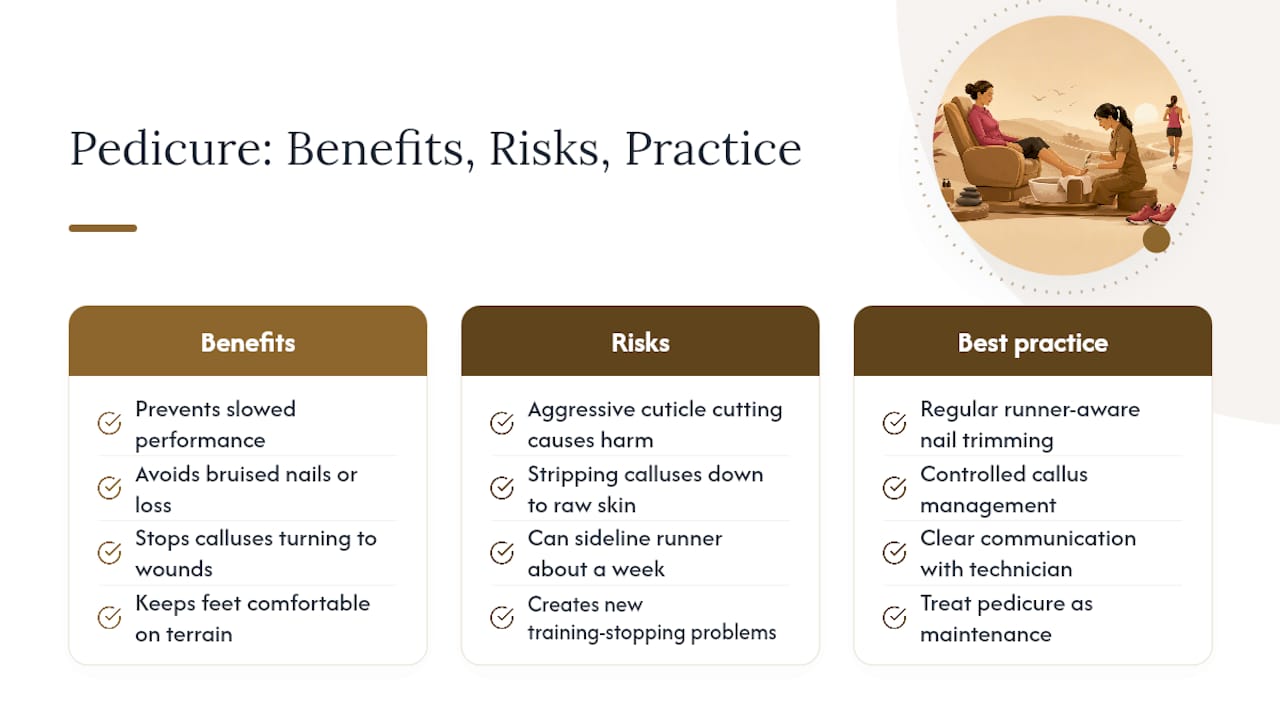
A pedicure won’t make you faster, but neglected feet can absolutely make you slower, or sideline you entirely. Overgrown nails jamming into a shoe’s toe box on every stride cost runners real training days through bruised nails and, in rare cases, nail loss. Untreated calluses that crack open mid-run turn into open wounds that need days to heal before running comfortably again.
Where a pedicure genuinely supports performance is in prevention. Regular, runner-aware nail trimming keeps toenails at a length that won’t catch on shoe fabric during a marathon’s worth of forward motion. Controlled callus management keeps feet comfortable across variable terrain without removing the natural padding that protects against blisters in the first place.
The flip side is real, too. A pedicure done wrong, with cuticles cut too aggressively or calluses stripped down to raw skin, can put a runner out of training for a week while cuts and irritation heal. That’s why the timing rules and technician instructions covered earlier in this guide aren’t just about comfort. They’re about not losing training time to a completely preventable mistake.
Think of a pedicure as maintenance, similar to rotating running shoes or replacing worn insoles. Skipped entirely, small problems compound. Done with the wrong technique, it creates new ones. Done with clear communication and the right timing, it removes one more variable that could derail a training block.
Balancing Looks and Performance
Plenty of runners avoid pedicures altogether, worried a salon will undo months of careful foot conditioning. That fear is reasonable, but avoidance isn’t the answer. Preserve your calluses, time your visits around race day, and treat the conversation with your technician as part of the appointment, not an afterthought. Feet that look good and hold up over 20 miles aren’t mutually exclusive.
— Cuong
Book a Runner-Friendly Pedicure at Foxy Nails
Foxy Nails is a practical option for Reno-area runners who want a pedicure that respects training, not just polish color. Request the Spa Pedicure at $40 or the Foxy Deluxe Pedicure at $55, and mention upfront that you run regularly so nails get trimmed straight across and calluses get smoothed rather than stripped.

Booking is straightforward through the Foxy Nails services page, where every pedicure option is listed with current pricing. If you’re managing a specific issue like a recurring ingrown nail or thickened toenail, say so when you book so the appointment can be planned around it rather than discovered mid-service. A short note before your visit is often the difference between a pedicure that helps your training and one that gets in its way.
Sources
- What All Runners Should Know Before Getting a Pedicure | SELF
- Medical Pedicure: What It Is, Benefits, and Why Runners Need It | Runner’s World
- Should runners get pedicures? | The New York Times (Well)
- Runner’s complete foot care guide | Michigan Foot Doctors
FAQ
Should you get pedicures as a runner?
Yes, as long as you request straight-across trimming, ask the technician to preserve calluses rather than strip them, and skip the appointment within two weeks of a major race. Done this way, pedicures actually reduce infection risk rather than causing problems.
Do marathon runners take their toenails off?
Some marathoners do lose toenails, usually from repeated trauma against the front of the shoe on long or downhill training runs, a condition known as runner’s toe. It’s common enough not to be alarming on its own, but persistent pain or nail matrix damage warrants a podiatrist visit.
How do I protect my toenails as a runner?
Trim nails straight across every one to two months, leave a small white edge rather than cutting flush, and make sure running shoes have enough toe box room, often a half size up from your everyday shoe. Moisture-wicking socks and correct shoe fit prevent most of the friction that damages nails in the first place.
What is runner’s toe?
Runner’s toe is a subungual hematoma, bruising or bleeding under the toenail caused by repeated impact against the shoe during long or downhill running. Mild cases heal on their own as the nail grows out, but severe pain or pressure buildup should be checked by a podiatrist.
How much does a runner-friendly pedicure cost?
At Foxy Nails, a standard Pedicure starts at $25, with the Spa Pedicure at $40 and the Foxy Deluxe Pedicure at $55 for more intensive callus and skin care. Mentioning your running routine at booking helps the technician plan the service around your feet.