MMA (methyl methacrylate) still turns up in some off-brand acrylic systems, and it carries real risks: skin dermatitis, permanent nail-plate damage, and inhalation sensitization for anyone breathing the dust regularly. If your nails came out rock-hard, wouldn’t soak off, or smelled overwhelming during application, don’t pry them off. Ask the salon for the product name and safety sheet, and get help from a dermatologist or a technician trained in safe removal.
TL;DR:
- Salons using MMA monomer often file the natural nail aggressively and apply nails at a significantly lower price point, indicating unregulated supply.
- MMA causes severe skin irritation and can lead to permanent damage, and it also poses respiratory risks for technicians due to exposure to vapors.
- Signs of MMA use include overpowering chemical smell, heavy filing, nails feeling glass-like, and soak-off taking over an hour, often combined with unbranded, low-cost products.
- Proper removal requires professional soaking with approved systems, and DIY prying or peeling increases the risk of nail damage and infection.
- Consumers should ask for the product name and safety data sheet before service, and salons should source only EMA-based or approved gel systems to ensure safety.
Table of Contents
- What MMA in Nails Actually Means, and Why EMA Is Different
- Health Risks: What Dermatitis and Breathing Problems Have to Do With Nail Products
- Warning Signs That MMA Was Used on Your Nails
- What to Do If You Suspect MMA Was Used on You
- Where U.S. Regulation on MMA Stands Right Now
- Safer Alternatives Worth Asking For by Name
- How to Choose a Safe Nail Salon: A Quick Pre-Appointment Checklist
- How Foxy Nails Approaches MMA Prevention
- What Foxy Nails Wants You to Take Away From All This
- Sources
What MMA in Nails Actually Means, and Why EMA Is Different
MMA is a liquid monomer, the acrylic building block that gets mixed with a powder to form a hard enhancement. The professional standard is EMA (ethyl methacrylate), a chemically similar but far less irritating monomer that dominates licensed salon products today. MMA got phased out of professional use decades ago mostly because it bonds too aggressively to the natural nail plate, according to industry guidance from the Nail Manufacturers Council.
That bonding strength is the actual problem. EMA-based acrylics are designed to release cleanly with light filing or an acetone soak. MMA grips so hard that technicians often have to over-file the natural nail just to get product to stick, thinning the nail plate before a single coat goes on.
A separate source of confusion: PMMA, the polymerized powder used in many legitimate nail systems, is chemically distinct from liquid MMA monomer and is considered safe when used as intended, according to BuilderGel’s ingredient breakdown. The letters look similar. The safety profile does not.
A few label realities worth knowing:
- Ingredient lists on nail liquids aren’t always complete or accurate.
- Gray-market and imported products can be mislabeled or contaminated with MMA even when marketed as “MMA-free.”
- A technician may not know what’s actually in the bottle they’re using if it was bought off a discount supplier.
Health Risks: What Dermatitis and Breathing Problems Have to Do With Nail Products
The most common complaint is contact dermatitis: redness, swelling, and burning around the cuticle and fingertips after repeated MMA exposure. Left unaddressed, that irritation can progress to permanent thinning or ridging of the nail plate, since the nail has to grow out fully to repair itself.
The bigger concern for people working in nail salons is inhalation. Peer-reviewed occupational health research documents methacrylate monomers, MMA included, as respiratory sensitizers detected in salon air, with links to occupational asthma and reduced lung function among technicians with regular exposure.
MMA exposure by the numbers: The same occupational study found methacrylate compounds measurable in salon air during acrylic application, tying that exposure to documented respiratory harm in workers rather than a one-off sensitivity issue.
Some occupational literature also notes headaches, dizziness, and nausea tied to poorly ventilated workspaces where methacrylate vapors build up over a shift. Clients typically get one exposure per appointment. Technicians get it five or six days a week, which is why ventilation and product choice matter as much for staff safety as for client comfort.
Warning Signs That MMA Was Used on Your Nails
Some tells show up during the appointment, others only after you get home. Here’s the sequence to watch for.
- An overpowering chemical smell. EMA has a noticeable odor too, but MMA’s is sharper and lingers in the room longer.
- Heavy, painful filing before product goes on. Technicians using MMA often over-file the nail plate to force adhesion, a real-world tell that the liquid isn’t a standard EMA system.
- Nails that feel unusually rigid, almost glass-like, compared to a typical gel or EMA acrylic set.
- Soak-off that takes over an hour and still won’t budge. MMA resists standard acetone removal far longer than professional systems.
- The technician reaches for pliers or starts prying at the edge. That’s a mechanical removal shortcut, and it’s a sign the product wasn’t meant to soak off cleanly.
- Pricing that’s noticeably below every other salon in the area, often paired with unmarked bulk containers instead of branded bottles.
Client reports on forums like Reddit’s r/Nails frequently describe exactly this pattern: hours-long soak-offs and technicians resorting to force. It’s anecdotal, but it lines up closely with what regulators and manufacturers describe.
Pro Tip: Ask to see the liquid monomer bottle before your service starts. A salon confident in its products will show you the label without hesitation.
What to Do If You Suspect MMA Was Used on You
The instinct to just rip the enhancement off is the worst move you can make. MMA doesn’t dissolve in standard acetone soak the way EMA does, and salons using it often resort to prying or mechanical removal, which strips layers of the natural nail plate along with the product.
Here’s the safer sequence:
- Don’t pry, peel, or force removal yourself. You’ll take healthy nail layers with it.
- Ask the salon directly for the product name and its safety data sheet (MSDS). A legitimate business should have this on file.
- Request professional removal using an approved soak-off system, even if it takes multiple sessions.
- See a dermatologist if you notice swelling, oozing, severe pain, or signs of infection around the nail bed.
- Report the salon to your state cosmetology board or a local consumer-protection agency if they refuse to disclose product information or pressure you into forced removal.
If your nails come off damaged either way, a recovery plan for acrylic damage can help you rebuild nail health before your next enhancement. Nutritional support during regrowth is worth a look too. Some nail supplement options focus specifically on strengthening nails as they grow back.
Where U.S. Regulation on MMA Stands Right Now
The FDA has history here. It acted against 100% MMA monomer nail products back in the 1970s and still warns consumers about unsafe practices in nail enhancements today, according to the FDA’s own nail care guidance. That early action is why MMA disappeared from mainstream professional supply chains, though it never fully vanished from the market.
More recent movement has come at the state level, and now in California specifically:
- Many states restrict or ban MMA in licensed salons through their cosmetology boards, though rules vary. Check your state board directly rather than assuming a blanket federal ban exists.
- California’s Department of Toxic Substances Control listed MMA-containing nail products above 1,000 ppm as a Priority Product effective April 1, 2026, with manufacturer notifications due by June 1, 2026.
- That listing puts the compliance burden mainly on manufacturers first, requiring disclosure and alternatives analysis before it trickles down to what’s on salon shelves.
Practically, this means the biggest near-term shift happens upstream, at the manufacturing and distribution level, not at your local salon’s front desk. But it also means asking about sourcing is becoming a more standard, and more answerable, question for clients to raise.
Safer Alternatives Worth Asking For by Name
EMA remains the standard liquid monomer in professional acrylic systems, and it’s the name you want to hear when you ask what’s in the bottle. PMMA powder, the polymer form, is a separate ingredient entirely and is considered safe in properly formulated products.
Beyond traditional acrylics, several systems avoid the MMA question altogether:
- Builder gel and hard gel cure under UV or LED light rather than relying on a liquid monomer mix, and they tend to soak off more predictably than acrylic.
- Dipping powder systems use a different bonding process, though they trade off some of the strength and shape control acrylic offers.
- Traditional EMA acrylics, when applied by a trained technician, remain durable and remove cleanly with standard acetone soak.
Product quality still matters more than category. A cheap, unbranded EMA product with contamination risk can behave worse than a reputable brand’s straightforward acrylic. Ask about sourcing and brand reputation, not just the ingredient name on paper. Comparing gel versus acrylic systems in more detail can help you figure out which option fits your nails and your maintenance schedule.
How to Choose a Safe Nail Salon: A Quick Pre-Appointment Checklist
Run through this before you sit down for a fill or a full set:
- Ask what liquid monomer they use. “EMA” is the answer you want. Hesitation or a vague answer is a flag.
- Ask to see the product’s safety data sheet. Salons using approved acrylic systems generally have this on hand without needing to search for it.
- Watch how hard they file before applying anything. Aggressive, painful filing before product touches the nail is a warning sign, not a normal step.
- Notice the room’s ventilation. A strong, unmoving chemical smell that lingers suggests poor airflow around methacrylate vapors.
- Be skeptical of prices that undercut every other salon nearby. Quality liquid monomer and proper training cost money, and rock-bottom pricing sometimes reflects cutting corners on both.
A more detailed rundown of questions to ask before booking walks through this in under two minutes if you want a printable version for your phone.
How Foxy Nails Approaches MMA Prevention
Foxynailsreno uses EMA-based acrylic and gel systems sourced from vetted suppliers, not unmarked bulk liquid. Staff are trained to recognize product quality issues and to keep safety documentation available for any client who asks. Removal follows soak-off protocols designed to protect the natural nail rather than force product off.
You can hold any salon, including ours, to the same standard: ask what monomer they use, ask to see the safety sheet, and watch how they handle filing and removal. If a salon can’t answer those questions plainly, that tells you something on its own. Book a manicure or pedicure appointment with us in Reno if you’d rather skip the guesswork entirely.
What Foxy Nails Wants You to Take Away From All This
The conventional wisdom treats MMA as a relic, something that got banned decades ago and stopped mattering. That’s not quite right. It got restricted from mainstream professional supply, not eliminated, and gray-market product still finds its way into low-cost salons through unmarked bulk containers. California’s 2026 Priority Product listing exists precisely because regulators know this.
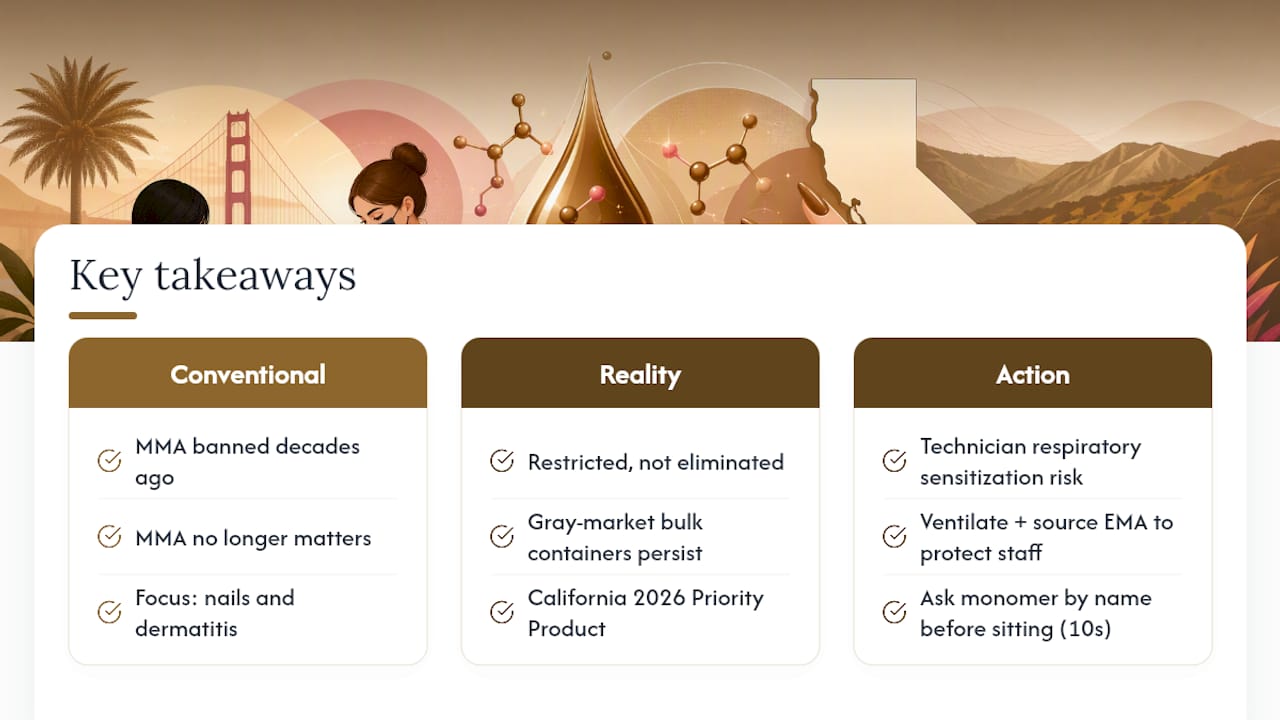
What gets underestimated is the worker side of the equation. Most consumer coverage of MMA focuses on your nails, your dermatitis, your soak-off time. The occupational research tells a different story: technicians breathing methacrylate vapors five days a week face documented respiratory sensitization risks that have nothing to do with how your manicure looks. A salon that ventilates properly and sources EMA products isn’t just protecting your nail plate. It’s protecting the person doing your nails from a chronic exposure problem you’ll never personally experience.
If there’s one practical habit worth adopting, it’s this: ask about the monomer by name before you sit down, not after something goes wrong. It takes ten seconds and it filters out the salons cutting corners far more reliably than price or online reviews ever will.
— Cuong
Sources
- Adopted Priority Product: Nail Products Containing MMA at Concentrations Greater Than 1,000 ppm | Department of Toxic Substances Control
- Chemical and respiratory safety in the nail industry: occupational exposure and its effects on the respiratory system
- Nail care products | U.S. Food and Drug Administration (FDA)
- Methyl Methacrylate Monomers (Nail Manufacturers Council report)