
A regular manicure is a natural-nail service that grooms the nail plate, cuticle, and surrounding skin, finishing with traditional air-dry polish. No UV lamp, no soak-off chemicals, no structural overlay. According to Cosmopolitan’s nail artist breakdown, the typical service runs about $15–$40 at a salon and polish wear lands somewhere between 3–10 days, most commonly 5–7 days.
It’s the right call for three types of people:
- Frequent color changers who want a fresh shade every week or two without a removal appointment
- Natural-nail advocates who prefer to skip UV curing and harsh soak-off acetone
- People recovering between gel or acrylic sets who need a low-stress service that lets nails breathe
A standard appointment takes a moderate amount of time, typically less than an hour. That’s it. No waiting for gel to cure, no foil wraps, no extra charge for removal.
Key Takeaways
A regular manicure is a nail-friendly professional service offering grooming, hand care, and traditional polish with no UV exposure or soak-off chemicals.
| Point | Details |
|---|---|
| What it is | Natural-nail grooming with shaping, cuticle care, massage, and optional air-dry polish. |
| Typical wear | Polish lasts 5–7 days on average; up to 10 days with thin coats and daily top coat reapplication. |
| Best for | Frequent color changers, nail-health focused clients, and anyone recovering between gel or acrylic sets. |
| Extend your wear | Reapply top coat every 2–3 days, wear gloves for chores, and use cuticle oil daily. |
| Foxynailsreno | Offers regular manicures in Reno, NV with a focus on natural-nail health and proper technique. |
Table of Contents
- What does a regular manicure include?
- How to do a regular manicure step by step
- How long does a regular manicure last?
- What are the real benefits of a regular manicure?
- Regular polish vs. gel, dip powder, acrylic, and press-ons
- Aftercare tips that actually extend your manicure
- Tools and products used in a regular manicure
- How often should you get a regular manicure?
- What nail technicians actually recommend
- Book a regular manicure at Foxynailsreno
- Frequently asked questions about regular manicures
- Sources
What does a regular manicure include?
Wikipedia’s manicure entry defines the service as filing and shaping the free edge, pushing and trimming nonliving cuticle tissue, hand soak or exfoliation, hand massage, and optional polish. That last word matters: polish is the final step, not the defining one. A client who wants a buffed natural finish still receives a complete manicure.
Here’s how the steps break down, with rough time estimates:
- Polish removal (2–3 min): acetone or non-acetone remover clears any existing color
- Trimming and filing (3–5 min): clippers bring nails to the desired length; a file shapes the free edge in one direction (not a sawing motion, which weakens the plate)
- Cuticle softening and care (3–5 min): a softener or warm soak loosens the cuticle; a pusher moves back the nonliving tissue; a nipper removes only the dead skin, never the live cuticle
- Light buffing (1–2 min): smooths ridges without thinning the nail plate
- Hand soak or exfoliation (3–5 min): warm water or a scrub softens the skin
- Massage and moisturizer (5–8 min): hand cream or lotion applied from fingertips to wrist
- Base coat, color, top coat (8–12 min): thin base coat first, then two thin color coats, then a top coat; or a simple buff finish if no polish is wanted
- Drying (5–10 min): air-dry time, sometimes with a quick-dry drop
Some salons skip the soak in favor of a dry manicure, which can sometimes extend polish wear since water temporarily swells the nail plate. Neither version is wrong; they’re just different approaches.
How to do a regular manicure step by step
At the salon
Arrive with bare or lightly polished nails if possible. Your technician will confirm your preferred shape (square, oval, round, almond, squoval), ask about length, and check for any nail concerns before starting. From there, the flow follows the steps above. The massage is usually the longest single step, and it’s worth asking your tech to spend extra time there if you carry tension in your hands.
At home
You don’t need a full kit to do a decent job. Here’s a simplified version:
- File dry nails to your preferred shape, moving in one direction only
- Soak fingertips in warm water for 2–3 minutes, then pat dry
- Apply a drop of cuticle oil, wait 30 seconds, then gently push back the cuticle with an orangewood stick
- Buff lightly if needed, one or two passes maximum
- Apply a thin base coat and let it tack up for 60 seconds
- Apply two thin color coats, letting each level before adding the next
- Finish with a thin top coat, capping the free edge
Pro Tip: Never cut your own live cuticle. According to WikiHow’s manicure guide, the cuticle protects the nail matrix from bacteria. Cutting it creates a small wound and raises infection risk. Push gently, trim only the loose dead skin, and stop there.
How long does a regular manicure last?
Standard polish typically holds for 3–10 days, with most people landing in the 5–7 day range under normal conditions. The spread is wide because wear time depends more on what you do with your hands than on the polish brand.
What shortens wear:
- Frequent hand washing without gloves (water and soap degrade the polish bond)
- Heavy manual tasks: gardening, cleaning, cooking with acidic ingredients
- Thick polish application, which dries unevenly and chips from the edges
- Skipping base coat, which means color sits directly on the nail plate with no adhesion layer
What extends wear:
- Thin, even coats with full drying time between each
- A quality base coat and a fast-dry top coat
- Reapplying top coat regularly to reseal the edge
- Wearing gloves for dishes, cleaning, and any task involving prolonged water exposure
- Patting hands dry instead of rubbing, which can catch and lift polish edges
The single biggest factor most people overlook is the free edge. Capping it with base coat, color, and top coat (running the brush along the very tip of the nail) dramatically reduces edge chipping.
What are the real benefits of a regular manicure?
The Cleveland Clinic notes that long-wear gel systems and improper removal can damage the natural nail with repeated use. A regular manicure sidesteps that entirely. The polish comes off with standard remover in under five minutes, no foil, no filing, no acetone soak.
That gentleness is the core advantage, but it’s not the only one:
- Nail health: no UV exposure, no soak-off chemicals, no mechanical filing of the nail plate during removal
- Color flexibility: you can change shades every week without any removal fee or appointment
- Speed: 30–45 minutes start to finish, often the fastest service on a salon menu
- Cost: typically the most affordable professional nail service
- Recovery use: salon guides recommend booking a regular manicure between gel or acrylic sets so the natural nail can regain strength
- Workplace-friendly: no dramatic length or texture, easy to keep conservative
The trade-off is durability. If you work with your hands, swim regularly, or need polish to last two weeks without touching it up, a regular manicure will disappoint. That’s not a flaw in the service; it’s just the honest limit of air-dry lacquer.
Regular polish vs. gel, dip powder, acrylic, and press-ons
Vogue’s manicure type explainer frames it cleanly: regular polish is air-dried lacquer, while gel and builder systems cure under a lamp and require different removal procedures. Here’s how the main options compare:
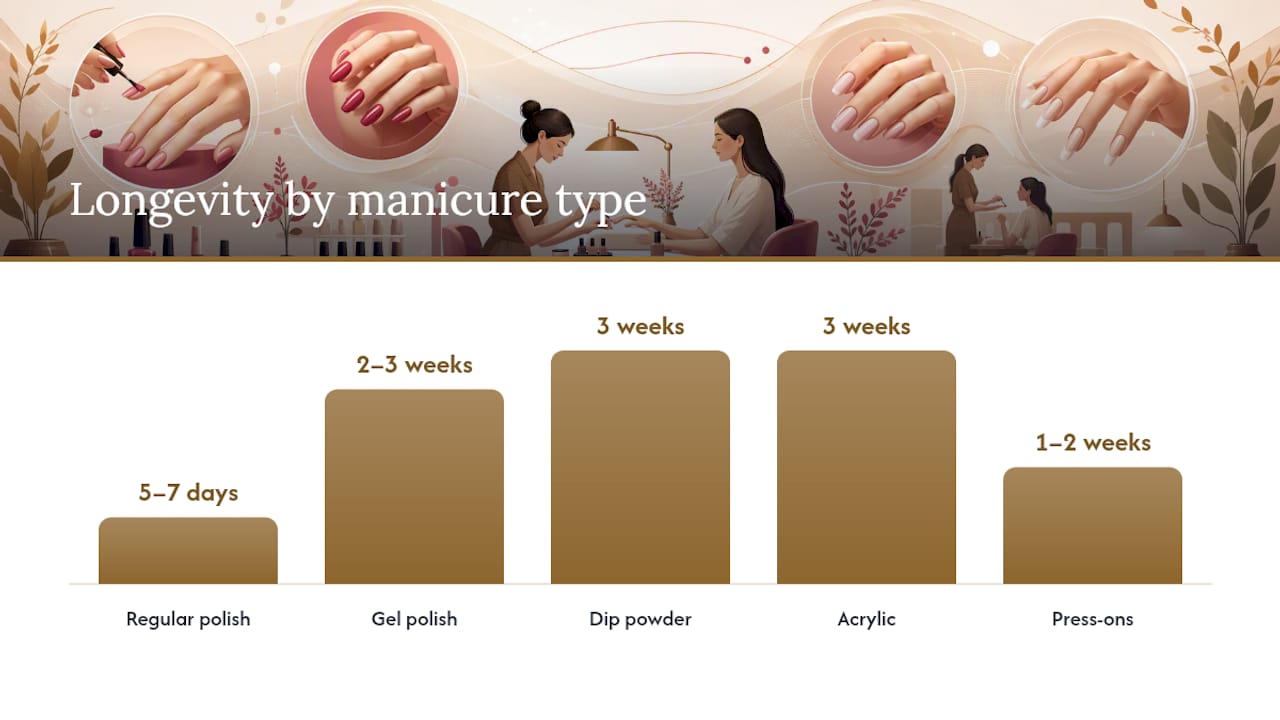
| Type | Longevity | Removal | Natural nail impact | Best for |
|---|---|---|---|---|
| Regular polish | 5–7 days avg. | Acetone remover, 5 min | Minimal | Frequent color changes, nail recovery |
| Gel polish | 2–3 weeks | Soak-off acetone, 15–20 min | Moderate with repeated use | Longer wear without extensions |
| Dip powder | 3 weeks | Soak-off, filing required | Moderate to high | Durability without UV curing |
| Acrylic | 3 weeks | Professional removal recommended | Higher with improper removal | Length and structure |
| Press-ons | 1–2 weeks | Soak or gentle peel | Low if applied correctly | Temporary events, no salon visit |
A few practical notes on the alternatives:
- Gel looks nearly identical to regular polish but requires a UV or LED lamp to cure. NPR’s reporting on gel nail safety and the Cleveland Clinic both flag that repeated improper removal is where most nail damage occurs, not the polish itself.
- Dip powder skips the lamp but involves more steps and a filing-heavy removal process that can thin the nail plate over time.
- Acrylics add structural length and are the most durable option, but they require professional removal and are the highest-commitment choice. See Foxynailsreno’s acrylic guide for a full breakdown.
- Press-ons have improved dramatically and are a legitimate short-term option, but they don’t include the grooming and skin care that make a manicure a health service, not just a cosmetic one.
Choose a regular manicure when you want flexibility, nail health, or a quick refresh. Choose a longer-wear system when you need two-plus weeks of durability or structural length.
Aftercare tips that actually extend your manicure
Most polish chips within the first 48 hours if aftercare is ignored. These habits make a measurable difference:
- Apply cuticle oil daily, working it into the nail bed and surrounding skin. The AAD’s healthy nail guidance recommends moisturizing regularly and avoiding aggressive cuticle cutting to reduce damage and infection risk.
- Use gentle soap rather than antibacterial formulas, which are harsher on the polish bond.
- Wear rubber or nitrile gloves for dishes, cleaning, and any task involving prolonged water or chemical exposure.
- Reapply top coat every 2–3 days, focusing on the free edge where chips start.
- Never use your nails as tools. Opening cans, peeling stickers, and prying lids are the fastest ways to snap a nail or lift an edge.
If you notice one nail chipping while the rest hold, that’s usually a technique issue at application, not a product failure. A thin layer of top coat over the chipped area can buy a few extra days.
Pro Tip: For hands that are frequently in water, pair your manicure aftercare with a nail-compatible hand moisturizer or a skin supplement. Fromwithin includes options formulated to support skin from the inside, which complements the topical care you’re already doing.
When to go back to the salon: if the polish has chipped on more than two nails, a full redo is usually more cost-effective than a patch. If only one nail is damaged, ask your technician about a single-nail refresh rather than a full appointment.
Tools and products used in a regular manicure
Understanding what’s on the tech’s tray helps you ask better questions and build a smarter home kit.
Tools:
- Nail clippers: for initial length reduction before filing
- Emery board or glass file: shapes the free edge; glass files are gentler and last longer
- Cuticle pusher: moves back the nonliving tissue without cutting
- Cuticle nipper: used sparingly to remove only dead skin, never live cuticle
- Buffer block: smooths ridges; over-buffing thins the nail plate, so one or two passes is enough
- Orangewood stick: pushes cuticles and cleans under the free edge
- Nail brush: removes debris before polish application
Products:
- Base coat: creates adhesion between the nail plate and color; skipping it is the most common cause of early lifting
- Standard lacquer: two thin coats give better coverage and dry faster than one thick coat
- Top coat: seals color and adds shine; fast-dry formulas contain solvents that evaporate quickly
- Acetone remover: fastest and most effective for full removal; non-acetone is gentler but slower
- Cuticle oil: jojoba, almond, or vitamin E oil keeps the cuticle flexible and the nail bed hydrated
- Hand cream: applied during the massage step; look for formulas without heavy silicones that can interfere with polish adhesion if applied too close to the nail
The AAD advises against cutting live cuticle tissue and recommends gentle removal methods to prevent infection and nail-plate damage. That guidance applies at home just as much as in a salon.
How often should you get a regular manicure?
Many clients book every few weeks, which aligns with natural nail growth and keeps the free edge from looking overgrown. Salon guides suggest this cadence for maintenance; clients focused purely on appearance sometimes come in weekly for a polish change.
Here’s a practical breakdown:
- Weekly: polish change only, no full grooming needed; suits people who change colors frequently
- Every 2 weeks: standard maintenance; includes shaping, cuticle care, and fresh polish
- Every 3 weeks: works if nails grow slowly or you prefer a more relaxed schedule
- As needed: for nail recovery between enhancements, book one session and reassess after
Typical price ranges:
| Service level | Typical price range | What’s included |
|---|---|---|
| Express polish change | $10–$20 | Polish removal and fresh color only |
| Standard regular manicure | typically affordable | Full grooming, massage, and polish |
| Luxury or spa manicure | a higher-priced service option | Extended massage, exfoliation, mask, premium products |
Prices vary by location, salon tier, and any add-ons. A luxury manicure is worth the premium when you want a genuine hand treatment, not just color. For a quick refresh between full appointments, an express polish change is the most cost-efficient option.
What nail technicians actually recommend
The most common piece of advice from experienced technicians is also the most ignored: use regular manicures as a recovery tool between gel or acrylic sets. After back-to-back gel appointments, the nail plate needs time without a cured coating. A regular manicure keeps nails groomed and protected without adding another layer of stress.
A few other consistent recommendations:
- Communicate your shape preference clearly at the start of the appointment. Bring a photo if you’re unsure how to describe it.
- Don’t rush the drying step. Polish that feels dry to the touch can still dent for up to an hour. Quick-dry drops help, but they’re not instant.
- Ask about a dry manicure if your polish tends to chip within two days. Skipping the water soak reduces swelling of the nail plate and improves adhesion.
- Book a men’s manicure if you want the full grooming service without color. The steps are identical; the finish is just a buff.
For clients who want to see technique in action before booking, Foxynailsreno’s video library shows real service steps and nail art options that pair well with natural-nail maintenance.
Book a regular manicure at Foxynailsreno

Foxynailsreno is a luxury nail salon in Reno, NV, where technicians treat the regular manicure as a genuine nail-health service, not a filler appointment between enhancements. Every session includes proper cuticle care, a relaxing hand massage, and clean polish application using the thin-coat technique that actually holds. The team works with all nail types, including clients recovering from gel or acrylic sets who need a gentler approach.
If you’re ready to book, Foxynailsreno’s manicure and pedicure page has current service options and availability. Pair your manicure with a spa pedicure for a full hands-and-feet session, or ask about nail art add-ons if you want something beyond a solid color.
Frequently asked questions about regular manicures
What is the difference between a regular manicure and a gel manicure?
A regular manicure uses traditional air-dry lacquer that removes easily with standard polish remover. Gel polish cures under a UV or LED lamp, lasts 2–3 weeks, and requires a soak-off removal process that takes longer and can stress the nail plate with repeated use.
Is a regular manicure good for your nails?
Yes, when done correctly. It’s the gentlest professional nail service because it involves no UV curing, no harsh soak-off chemicals, and no structural overlay. The AAD recommends avoiding aggressive cuticle cutting and harsh removal methods, both of which a well-executed regular manicure avoids by design.
How long does a regular manicure appointment take?
Most appointments run 30–45 minutes. A luxury version with an extended massage and exfoliation treatment can take up to an hour.
Can I shower after a regular manicure?
Wait at least 2 hours before exposing fresh polish to water. Polish may feel dry to the touch within 20–30 minutes, but it remains soft and vulnerable to denting or smudging for considerably longer.
How do I make my regular manicure last longer?
Apply a fresh layer of top coat every 2–3 days, wear gloves for household tasks involving water or chemicals, use cuticle oil daily, and avoid using your nails as tools. Capping the free edge during application is the single most effective technique for preventing edge chipping.
What nail shape is best for a regular manicure?
Any shape works. Oval and round shapes tend to be more durable on shorter nails because they have fewer sharp corners to catch and chip. Square and squoval shapes are popular for longer nails. Your technician can recommend a shape based on your nail bed width and lifestyle.
Sources
- A Breakdown of All the Different Manicure Types, According to a Nail Artist
- Manicure — Wikipedia
- You guessed right — gel nail polish is bad for your nails (Cleveland Clinic health article)
- Healthy nail tips — American Academy of Dermatology