Regular polish, gel polish, dip powder, acrylics, structured gels like BIAB, extension systems like Gel-X, press-ons, and specialty techniques cover the field of manicure types you’ll find at most salons. Choose between them using three factors: how much durability you need versus how much wear your natural nails can take, whether you want extra length or structure, and how much time and money you’re willing to spend on upkeep. The sections below break down each type’s pros, cons, longevity, and removal process, then close with a checklist to match your choice to your nails.
TL;DR:
- Gel polish lasts about two to three weeks, offering long wear and high shine but requires acetone soak-off for removal, which can thin the nails if done improperly.
- Dip powder manicures are more durable than gel and do not require a UV lamp, but removal involves filing and acetone soaking, risking natural nail damage if done at home.
- Acrylic nails provide maximum strength and customization for length or repair but can weaken natural nails over time if removed incorrectly.
- Builder in a bottle offers a natural-looking, support-enhancing alternative to acrylics, with a longer-lasting finish that can be removed more gently when done professionally.
- Proper removal techniques are essential for nail health; soaking off processes are safer than peeling or prying, which damage the natural nail plate.
Table of Contents
- What Is a Regular Manicure, and Who Is It Best For?
- Gel Polish vs. Regular: What’s the Real Difference?
- Dip Powder (SNS) Manicures: Process and Trade-Offs
- Acrylic Nails: Strength, Shape, and What They Cost Your Nails
- What Is BIAB, and Why Are Structured Gels Trending?
- Gel-X, Extensions, and Press-Ons: Which Fits Your Life?
- Russian Manicure, Japanese Gel, and Sculpted Nails: Are They Worth It?
- How to Choose the Right Manicure for Your Nails
- What Foxy Nails Recommends for Removal and Long-Term Nail Health
- A Few Rules of Thumb Worth Remembering
- Book Your Next Manicure at Foxy Nails in Reno
- Sources
What Is a Regular Manicure, and Who Is It Best For?
A regular manicure (also called a classic or dry manicure in some salons) is the baseline service: shaping, cuticle care, a base coat, polish, and a top coat, all air-dried without any UV or LED curing. It’s the most forgiving option for nail health because there’s no soak-off chemistry involved.
- Longevity: Typically around a week before chipping starts.
- Cost and time: Usually the fastest and least expensive service on the menu.
- Nail health: Minimal impact when polish is removed gently with standard remover.
- Best for: Anyone who likes changing colors often or wants a low-commitment option between bigger services.
Gel Polish vs. Regular: What’s the Real Difference?
Gel polish cures under a UV or LED lamp through a chemical process called photopolymerization, which is why it comes out of the lamp already hard, glossy, and chip-resistant. That curing step is the entire distinction in the gel manicure vs regular debate: regular polish air-dries and stays soft longer, while gel sets instantly and holds its shine for two to three weeks when applied and removed correctly.
- Pros: Long wear, high shine, holds up well for people who use their hands a lot.
- Cons: Requires acetone soak-off for removal, and picking at it can strip healthy nail layers with it.
- UV exposure: Brief and localized, but worth discussing with your technician if you have sensitive skin.
Most techs recommend a fresh set every few weeks rather than pushing it longer, since lifted gel invites moisture and fungus underneath.
Gel polish typically lasts about two to three weeks with minimal chipping, according to InStyle’s breakdown of manicure types, which makes it one of the most requested services among the popular manicure techniques salons offer today. If you’re weighing salon gel against an at-home kit, this gel manicure guide walks through cost and safety differences.
Dip Powder (SNS) Manicures: Process and Trade-Offs
Dip powder manicures build strength and color by dipping nails into pigmented powder in layers, sealing each with an activator, then finishing with a topcoat. No lamp required. The result sits somewhere between gel polish and acrylic in the dip vs gel manicure comparison: thicker and more durable than gel, but less sculptable than acrylic.
- Pros: Long-lasting, resistant to chipping, good for people whose nails don’t hold gel well.
- Cons: Removal needs filing plus an acetone soak, and the finish can feel bulkier than gel.
- Best for: Clients who want dip powder’s durability without the acrylic sculpting process, and who don’t mind professional removal.
Skipping the soak-off and peeling dip powder off yourself is one of the fastest ways to thin out your natural nail plate.
Acrylic Nails: Strength, Shape, and What They Cost Your Nails
Acrylics are built from a liquid monomer and a powder polymer that harden through a chemical reaction as soon as they’re combined, which is why acrylic sets never need a UV lamp to cure. That self-hardening quality is also what makes acrylic so easy to sculpt into dramatic length or shape.
- Pros: Strong, highly customizable, ideal for adding significant length or repairing a damaged nail bed temporarily.
- Cons: Incorrect filing during removal can thin the nail plate, and heavy sets put real stress on natural nails over time.
- Removal: Always worth doing at a salon rather than prying them off; see this salon-backed recovery plan if your nails feel thin after past acrylic sets.
Clients often use “acrylics” as a catch-all term, but newer systems can deliver the same look with less wear on the nail. If you’re deciding between the two, this gel vs acrylic comparison lays out where each one actually wins. For a deeper dive into the process itself, the complete acrylic nails guide covers what a full set involves start to finish.
What Is BIAB, and Why Are Structured Gels Trending?
Builder in a bottle, or BIAB, is a structured gel overlay applied directly onto the natural nail to add support and encourage healthy growth, rather than building an artificial extension. It cures under a lamp like gel polish but goes on thicker for reinforcement.
- Pros: Adds real strength, can be gentler on the nail bed than heavy acrylic when removed properly, and takes color just like gel polish.
- Cons: Still requires professional soak-off removal, and it costs more than a basic gel manicure.
- Best for: Anyone rebuilding weak nails after acrylic damage, or growing out length naturally with backup support.
Structured gels and BIAB are trending partly because they let clients keep changing color without the constant filing that heavier acrylic systems demand. This hard gel nails guide covers how these systems compare to traditional gel overlays.
Gel-X, Extensions, and Press-Ons: Which Fits Your Life?
Gel-X is a full-cover soft gel tip adhered to the natural nail with gel, and it’s gained real traction in 2026 as a faster, more natural-looking alternative to sculpted acrylic extensions.
- Pros: Lighter than acrylic, faster to apply, and generally easier to remove without the aggressive filing acrylic sometimes requires.
- Cons: Still needs fills every few weeks as your natural nail grows out underneath.
- Press-ons: Quality has improved enough that they’re a legitimate short-term option for an event, offering realistic fit at a fraction of the cost, though they won’t survive daily wear like a salon set.
Pick Gel-X for something that needs to last through weeks of normal life; pick press-ons for a weekend or a single event. Curious what a full set runs? This Gel-X cost breakdown covers salon versus DIY pricing, and the Gel-X nails overview covers the application process itself.
Russian Manicure, Japanese Gel, and Sculpted Nails: Are They Worth It?
A Russian manicure uses precise cuticle work, often with an e-file, to create an exceptionally clean, seamless regrowth line, which is why the look holds its polish appearance longer between fills. Japanese gel focuses on a natural, glass-like layered finish rather than thickness or extreme shine. Sculpted nails use a form under the free edge to build custom length and shape from scratch, similar to acrylic but tailored one nail at a time.
- Cost/time: All three take longer in the chair and cost more than a standard set.
- Best for: Clients who want detail work most techs won’t have time for in a basic appointment.
Pro Tip: If a specialty technique interests you, book it as its own appointment rather than adding it onto a rushed standard slot. Cuticle work especially needs unhurried attention to do safely.
How to Choose the Right Manicure for Your Nails
Start with four questions: How durable does this need to be? Do you want extra length or just color? How often do you change your mind about color? What’s your realistic budget for upkeep? Your answers point almost directly to a category.
- Want maximum durability and don’t mind the maintenance visit? Gel polish or dip powder covers that, with gel edging out dip for a glossier finish.
- Change your color weekly or don’t want soak-off chemistry near your nails? Stick with regular polish.
- Want strength without committing to a full extension? BIAB or a hard gel overlay adds support while keeping things natural-looking.
- Want significant length? Compare Gel-X against acrylic; Gel-X tends to apply faster and remove more gently, while acrylic still wins for extreme sculpting.
- Need something for one event only? Press-ons are the cheapest, fastest fix.
On scheduling, most gel and dip sets need refreshing every 2 to 3 weeks, while BIAB and extensions typically need a fill around the same window as the natural nail grows out underneath. Celebrity manicurists interviewed by trade press note that a lot of client frustration comes down to mismatched expectations: telling your tech exactly what you want (length, strength, low maintenance) matters more than picking a service by name alone.
Pro Tip: Ask your technician directly whether removal will require filing, soaking, or both. If the answer is “we’ll just pop them off,” that’s a red flag for your nail plate.
Whatever you pick, professional removal matters more than the service itself. Peeling or prying weakens the nail plate regardless of which system you’re wearing.
What Foxy Nails Recommends for Removal and Long-Term Nail Health
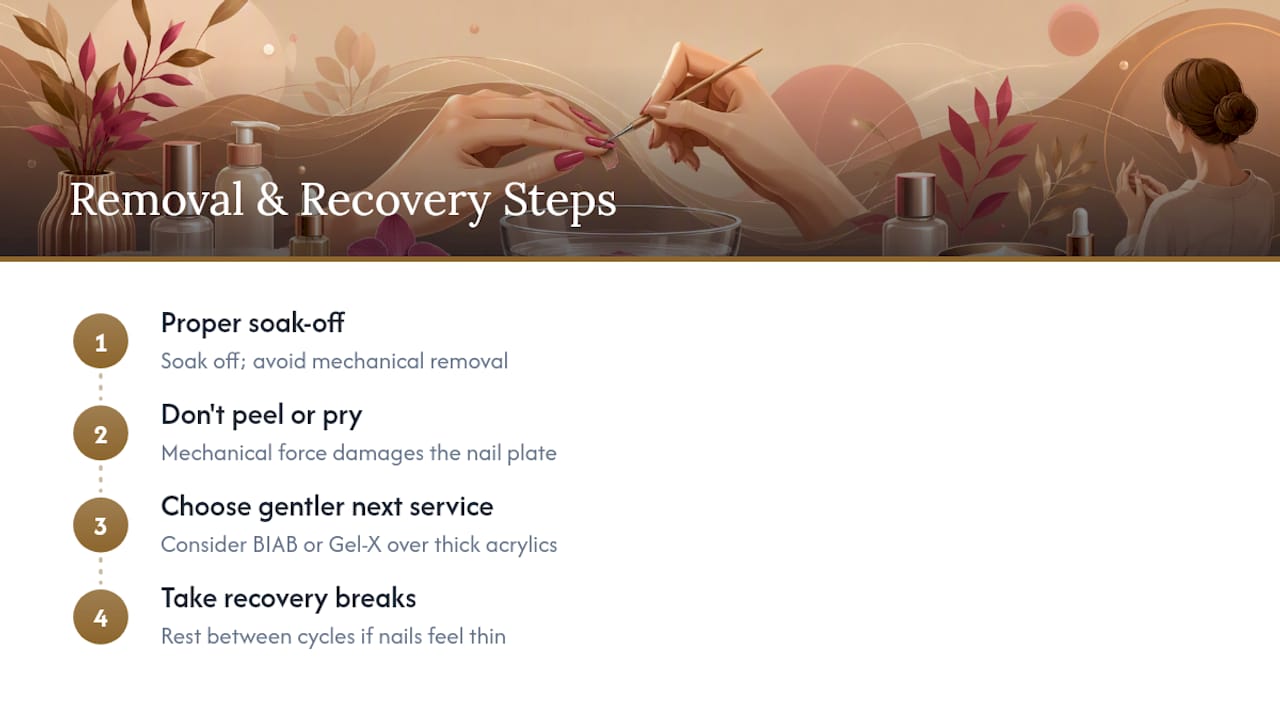
Removal should always mean a proper soak-off, not peeling or prying, because mechanical force is what actually damages the nail plate over repeated cycles. Clients coming off heavy acrylic sets are sometimes steered toward BIAB or Gel-X instead of another thick acrylic fill, since both offer strength or length with a gentler removal process. Recovery breaks between enhancement cycles also come up often in consultations, especially for anyone whose nails have started feeling thin or flexible.
If you’re unsure which type fits your nails right now, a quick look at nail overlays or a conversation at your next appointment settles it faster than guessing at home.
A Few Rules of Thumb Worth Remembering
Durability and nail health sit on a seesaw. The longer something is designed to last, the more it matters that removal is done properly. When in doubt, pick the option with the gentler removal process, not the one with the longest wear time on paper. And whatever you choose, build in a maintenance rhythm rather than waiting until something lifts or cracks. A technician who asks about your nail history before recommending a service is doing their job right; one who pushes the same set on everyone probably isn’t.
— Cuong
Book Your Next Manicure at Foxy Nails in Reno
The salon gives clients clear information about which manicure type actually fits their nails, instead of an upsell toward whatever’s fastest for the salon. That means a real conversation about durability, nail history, and budget before anyone touches a file.
Whether you want a classic polish change, a gel set that lasts through the work week, or a BIAB overlay to rebuild strength after acrylic damage, the service is matched to your nails. The salon also offers gentle options for kids’ appointments. If you’re ready to stop guessing and get a recommendation built around your actual nails, book your manicure or pedicure and bring your questions with you.