
Most salon gel manicures last about 2 to 3 weeks before they need attention. With careful prep and diligent aftercare, some people stretch that to 3 to 4 weeks, but nail technicians generally recommend removal or a refill around week three to keep the nail plate healthy. If your gels are chipping within the first week, the problem almost always traces back to prep or application, not the polish itself.
TL;DR:
- Proper application, including thin coats and free edge capping, is crucial for extending gel manicures beyond the standard two to three weeks.
- Builder gels or hard gel enhancements typically last longer, up to five weeks, especially when applied with correct technique.
- DIY gel kits often fail to match salon durability due to weaker lamps, rushed application, and inadequate prep or capping of the free edge.
- Regularly applying cuticle oil and avoiding exposure to water, heat, and chemicals can add several extra days to a gel manicure’s lifespan.
- Removal after two to three weeks is safest when performed professionally, as improper removal can cause long-term nail damage.
Table of Contents
- How Long Do Gel Nails Last by Type?
- What Makes Gel Polish Chip Early?
- Salon vs At-Home Gel: Why the Gap Is So Wide
- Daily and Weekly Habits That Stretch Gel Wear
- When to Remove Gel Nails: A Week-by-Week Guide
- How Foxy Nails Approaches Gel Longevity
- The Honest Take on Gel Nail Longevity
- Ready for Gel Nails That Actually Hold Up?
- Sources
- FAQ
How Long Do Gel Nails Last by Type?
Not all gel services are built the same, and the wear time changes depending on what’s actually on your nails. Soft gel polish over your natural nail plate holds up for about 2 to 3 weeks on average, which is the number most people mean when they ask how long gel nails last. Builder gels, often sold as BIAB (builder in a bottle), tend to run longer, commonly 3 to 4 weeks, because the reinforced layer resists flexing and cracking better than polish alone.
Gel-X and hard gel enhancements sit at the top end, typically lasting 3 to 5 weeks depending on your fill schedule and how the tech applied the product. Some Japanese pot-gel systems, applied in thin layers straight from the pot rather than a bottle, hold color and shape especially well when a trained technician does the long-lasting manicure work correctly.
- Soft gel polish (natural nails): 2 to 3 weeks
- Builder gel / BIAB: 3 to 4 weeks
- Gel-X or hard gel extensions: 3 to 5 weeks, tied to fill schedule
- At-home gel kits tend to last a shorter time than salon applications, mainly due to weaker lamps and rushed technique
Professional application usually outlasts a DIY kit by a meaningful margin. Salon-grade LED lamps cure resin more completely than the small lamps bundled with at-home kits, and that difference shows up fast.
What Makes Gel Polish Chip Early?
Five recurring technical issues explain most early lifting, according to nail industry technique guides. Understanding which one applies to your last manicure tells you exactly what to fix next time.
- Poor prep. Any trace of oil, lotion, or moisture on the nail plate blocks adhesion before the gel ever goes on.
- Coat thickness. Thin, fully cured layers outperform thick, undercured ones every time. A heavy coat looks glossy but often stays soft underneath.
- Incomplete curing. A weak or outdated LED lamp, or rushing the cure cycle, leaves resin that hasn’t fully hardened through.
- Skipping the free edge. Failing to cap the tip of the nail lets water sneak in at the edge first, which is where most lifting starts.
- Lifestyle exposure. Frequent hot water, dish soap, cleaning chemicals, and using your nails as tools all wear gel down faster than time alone.
Of these five, capping the free edge is the one technicians point to most often as the difference between a manicure that lasts and one that doesn’t.
Pro Tip: Ask your tech to swipe a thin layer of top coat over the very tip of your nail during application. That extra second of capping keeps water out at the weakest point in the whole manicure.
Salon vs At-Home Gel: Why the Gap Is So Wide
A trained technician follows a sequence most home kits skip entirely: dehydrating the nail plate, pushing back cuticles properly, applying thin even coats, curing under a strong lamp, and capping every free edge. Skip any one of those steps and wear time drops fast.
At-home attempts usually fall short in three specific spots. Lamps in consumer kits are often weaker than salon units, so the gel never fully hardens. Technique gets rushed because there’s no one checking your work. And leftover oil or dust on the nail plate, invisible to the eye, quietly kills adhesion.
If you’re doing gel at home anyway, a few upgrades close some of that gap:
- Use the strongest LED lamp you can find, not a basic UV bulb
- Wipe nails with isopropyl alcohol right before applying, even after prepping
- Build color in thin coats instead of one thick layer
- Cap the free edge on every single nail, every time
Our gel manicure guide breaks down more of these salon-versus-DIY differences if you’re weighing which route makes sense for you.
Daily and Weekly Habits That Stretch Gel Wear
Extending a gel manicure isn’t about one big trick. It’s a handful of small habits, done consistently, that add up to real extra days.
Daily habits:
- Apply cuticle oil twice a day, morning and night, even when nails look fine
- Skip lotion right before an appointment so the tech gets a clean, dry nail bed to work with
Weekly habits:
- Ask your salon whether a quick top coat refresh is available between full appointments
- Check nails for early lifting rather than waiting until it’s obvious
Protective habits:
- Wear rubber gloves for dishes, cleaning, and anything involving hot water or chemicals
- Skip long hot tub soaks or extended pool time when possible
- Never use your nails as a tool to open packages, scrape labels, or pry things apart
Cuticle oil and consistent edge care are the two habits nail technicians cite most often as genuinely adding wear time, sometimes stretching a manicure by several extra days when combined with good prep. A product like Eveline’s cream-gel cuticle remover can also help keep the surrounding skin in shape between salon visits.
Pro Tip: If you notice a small lift at one corner, don’t pick at it. Call your salon and ask about a spot repair instead. Peeling it yourself almost always takes a layer of your natural nail with it.
When to Remove Gel Nails: A Week-by-Week Guide
Gel nails follow a fairly predictable pattern once they’re on. Knowing what to expect each week helps you catch problems before they become painful ones.
- Week 1: Nails look fresh, glossy, and fully bonded. This is the baseline you’re comparing everything else against.
- Week 2: Minor wear starts to show, maybe slight dulling at the tips or the first hint of regrowth at the cuticle.
- Week 3: Regrowth is visible and small lifting spots may appear near the base. This is the point most professionals recommend a refill or removal.
- Week 4: Wear is obvious, and the risk of lifting, moisture trapping underneath, and nail damage rises noticeably.
Watch for signs that mean it’s time to act now, not later: lifting at the cuticle, pain or tenderness, unusual discoloration, or a soft, spongy feel where moisture may be trapped underneath. Dermatology sources note that prolonged lifting can trap moisture and raise infection risk, which is exactly why professionals set that 2 to 3 week window as the general guideline rather than a suggestion.
Safe removal means a professional soak-off or a controlled acetone process, never picking or peeling. The Mayo Clinic notes that improper removal is one of the most common causes of long-term nail-plate damage, more so than the gel service itself.
How Foxy Nails Approaches Gel Longevity
At Foxy Nails, longer wear starts before a single coat of color goes on. Techs dehydrate the nail plate, shape and push back cuticles with care, and cap every free edge to keep water from creeping in first, the same technique that industry sources consistently flag as the biggest factor in preventing early lift.
Depending on what you’re after, a few services line up directly with what’s covered here. A standard Gel Manicure suits most people chasing that reliable 2 to 3 week wear. If you want more structural durability, Gel X or hard gel extensions push toward the higher end of the range. And when it’s time to take everything off, the Gel Removal Add-On handles it with a controlled soak-off rather than a rushed peel.
The Honest Take on Gel Nail Longevity
Most advice on this topic treats gel longevity like a mystery. It isn’t. The industry-average 2 to 3 week window holds up because it reflects a real biological limit: natural nail growth pushes the polished section away from the cuticle, and no amount of top coat changes that math.
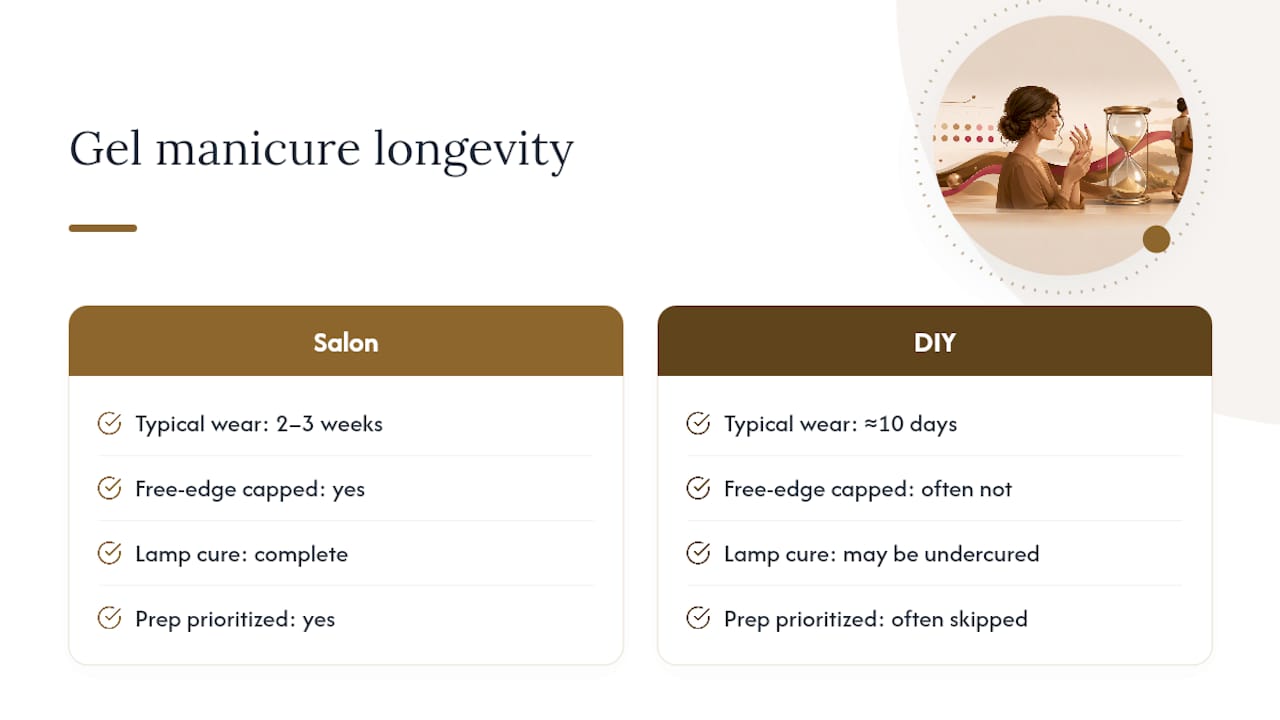
Where conventional advice falls short is treating every gel manicure as identical. A rushed, undercured at-home application and a properly capped, salon-applied gel are not the same product wearing at the same rate, even though people compare them like they are. The gap between a 10-day DIY manicure and a 3 week salon one usually comes down to two things: whether the free edge got capped, and whether the lamp actually finished the cure.
If you take one thing from this, prioritize prep and edge capping over expensive top coats or trendy gel brands. Cuticle oil helps, but it can’t compensate for oil trapped under the polish on day one. Fix the fundamentals first.
— Cuong
Ready for Gel Nails That Actually Hold Up?
If you’re tired of gel chipping before the two week mark, the fix usually isn’t a different polish. It’s proper prep, a strong cure, and edge capping done right the first time, which is exactly what a trained technician brings to the table over a rushed at-home attempt.

When you book a Gel Manicure at Foxy Nails, ask your tech three things: whether they cap the free edge, what lamp they use, and what their gel removal and refill timeline looks like. Those three questions tell you almost everything about how long your manicure will actually last. Want more durability for an active schedule? Look into Gel X or hard gel extensions, both built for longer stretches between appointments. Ready to book? Visit the Foxy Nails services page to pick your service and get on the schedule.
Sources
For deeper reading on gel wear and nail safety, the American Academy of Dermatology covers infection risk from prolonged wear, Mayo Clinic explains safe removal and long-term nail health, and GELCARE breaks down the technical causes of early lifting in more detail.
- How Long Do Gel Nails Last? (And How to Make Them Last Longer) | NailAtlas
- How Long Does a Gel Manicure Last? | GELCARE
- How to care for nails and avoid infections | American Academy of Dermatology (AAD)
- Nail disorders and care | Mayo Clinic
FAQ
How long should you keep getting gel nails before taking a break?
There’s no strict limit on how many gel manicures you can get over time, as long as you’re removing them properly between fills. Giving your nails a short break every few months lets the plate recover, which dermatology sources recommend for anyone doing back-to-back enhancement services.
What are the negatives of gel nails?
The main risks are nail thinning from repeated removal, moisture trapped under lifted areas, and irritation from UV or LED curing lamps. Most of these come from improper removal or over-wearing gels past the recommended window rather than the gel itself.
Will gel nails last 4 weeks?
Some gel services, especially Gel-X or hard gel extensions, can hold up structurally for 3 to 5 weeks. But most professionals still recommend removal or a refill by week three since wearing gels past four weeks raises the risk of lifting and moisture buildup underneath.
Do salons remove gel nails for free?
This depends entirely on the salon’s own policy. At Foxy Nails, gel removal is a separate line item, the Gel Removal Add-On, rather than a free service, since a proper soak-off takes real technician time to do safely.