
Abstract nail art uses color, line and negative space to create nonrepresentational, wearable designs. Below you’ll find a style-by-style gallery, short tutorials, a tools rundown and dermatologist-backed safety steps. If you’d rather hand the work to a pro, our Reno salon can help bring a look you save to life.
TL;DR:
- The American Academy of Dermatology recommends soaking nails in 100% acetone for 10–15 minutes with foil wraps and never peeling gel polish.
- Before UV curing, apply SPF 30 or higher to your hands or wear fingertip cut gloves; persistent redness, swelling, or itching warrants a dermatologist.
- Beginners can start with regular polish, which is easier to change but wears sooner; gel lasts longer and stays workable until cured.
- Short nails suit thinner lines and smaller motifs, while long nails can carry broad color fields; nude bases keep designs subtle, and high contrast accents add impact.
- Simple lines, speckles, and color blocks suit home application, while detailed marbling and layered gel art are better handled by a nail technician.
Table of Contents
- 1. Which abstract nail designs are worth saving?
- 2. How do you do abstract nails step by step?
- 3. What tools and products do you need?
- 4. How can you keep abstract nails safe for your nails?
- 5. How do you adapt abstract designs to your nails?
- 6. How do you brief a nail tech on abstract art?
- 7. Where can you get custom abstract nail art in Reno?
- FAQ
- Sources
1. Which abstract nail designs are worth saving?
Think of abstract design as a collection of style families. Pick one, then use the quick tip under each look to keep it wearable.
- Brushstroke looks: Watercolor wash layers sheer pastel strokes over a milky base. Single swipe is one bold streak across a bare nail. Tip: sheer pinks or sage on a clear base keep it soft.
- Line art: Floating curves are thin, uncrossed arcs, and crossed lines add a second color at an angle. Tip: a nude base with one contrasting line color is hard to beat, and repeating a motif across a few nails keeps the set cohesive, as Adobe Express’s nail design roundup also notes.
- Geometric: Color blocks split each nail into flat shapes, and triangle corners tuck a small wedge near the cuticle. Tip: limit yourself to three colors.
- Marbled: Milky marble swirls white through sheer pink, and ink marble uses black veins on cream. Tip: keep veins thin so the base color still leads.
- Speckle: Terrazzo flecks scatter tiny dots in two or three tones. Tip: a sand or oat base reads calm; a bright base reads playful.
- Negative space: Half moons leave the base of the nail bare, and window cutouts frame a clear gap in a solid color. Tip: choose a glossy top coat so the clear areas look intentional.
A few micro-trends show up across current collections: minimal abstract (one small gesture per nail), micro French (a hairline tip instead of a thick band) and line art over sheer bases. If minimal is your lane, our minimalist nail art ideas go deeper on understated sets.
2. How do you do abstract nails step by step?
Every technique follows the same arc: prep, base, technique, seal. Each one follows a short routine.
Thin line art
- Push back cuticles, buff lightly and wipe with alcohol.
- Apply a nude or sheer base and cure or dry fully.
- Dip a liner brush in polish and pull one long, steady line.
- Fix wobbles with a clean brush dipped in remover.
- Seal with top coat.
Brushstroke wash
- Prep and apply a milky base.
- Dab two sheer colors onto a palette.
- Drag a flat brush across the nail in one direction.
- Seal, then add a second pass only if it looks thin.
Two-color negative space
- Prep and apply a clear base.
- Stick a striping tape or sticker where you want bare nail.
- Paint the second color over the open area.
- Peel the guide while still tacky, then seal.
Fluid marbling
- Apply a white or pale base and cure.
- Dot two shades onto the nail.
- Drag a thin tool through the dots to blend lightly.
- Seal before the pattern settles.
Speckle and texture
- Apply a solid base and cure.
- Tap a dotting tool into black or brown polish.
- Press tiny dots irregularly, with no grid.
- Seal with a glossy top coat.
Pro Tip: Work one nail at a time and steady your painting hand’s pinky on the table. Detailed marbling and multi-layer gel art are where a technician saves you time.
3. What tools and products do you need?
You don’t need a full kit. Start with these:
- Liner or striper brush: for hairlines and curves.
- Flat shader brush: for washes and brushstrokes.
- Dotting tool: for speckles and tiny accents; a bobby pin tip works as a DIY stand-in.
- Striping tape: for clean geometric edges and negative space.
- Palette and remover brush: a scrap of foil works for mixing, and a small brush dipped in remover fixes mistakes.
- Regular polish: easiest for beginners and easy to change, but shorter wear.
- Gel polish: longer wear and crisp control, since it stays workable until cured.
- Builder gel and dip: best when you want strength or length under the art. For a closer comparison, see our gel vs. regular polish guide.
Spend on a good top coat and a quality liner brush. Palettes, tape and dotting tools are fine to DIY.
4. How can you keep abstract nails safe for your nails?
Long-lasting art shouldn’t cost you healthy nails. The American Academy of Dermatology recommends soaking only the nail plate in 100% acetone for 10–15 minutes, using foil wraps to localize the exposure, and never picking or peeling gel polish.
Peeling and picking gel thins and weakens the nail plate, and improper removal can leave it brittle. The same guidance recommends removing gel with soaking, not scraping.
Gel and acrylic services also carry some skin risk. A systematic review of nail cosmetics links gel manicures to allergic contact dermatitis, onycholysis and nail dystrophy, with acrylates a frequent risk factor. Reviewers of contemporary manicure methods also stress hygiene and UV precautions.
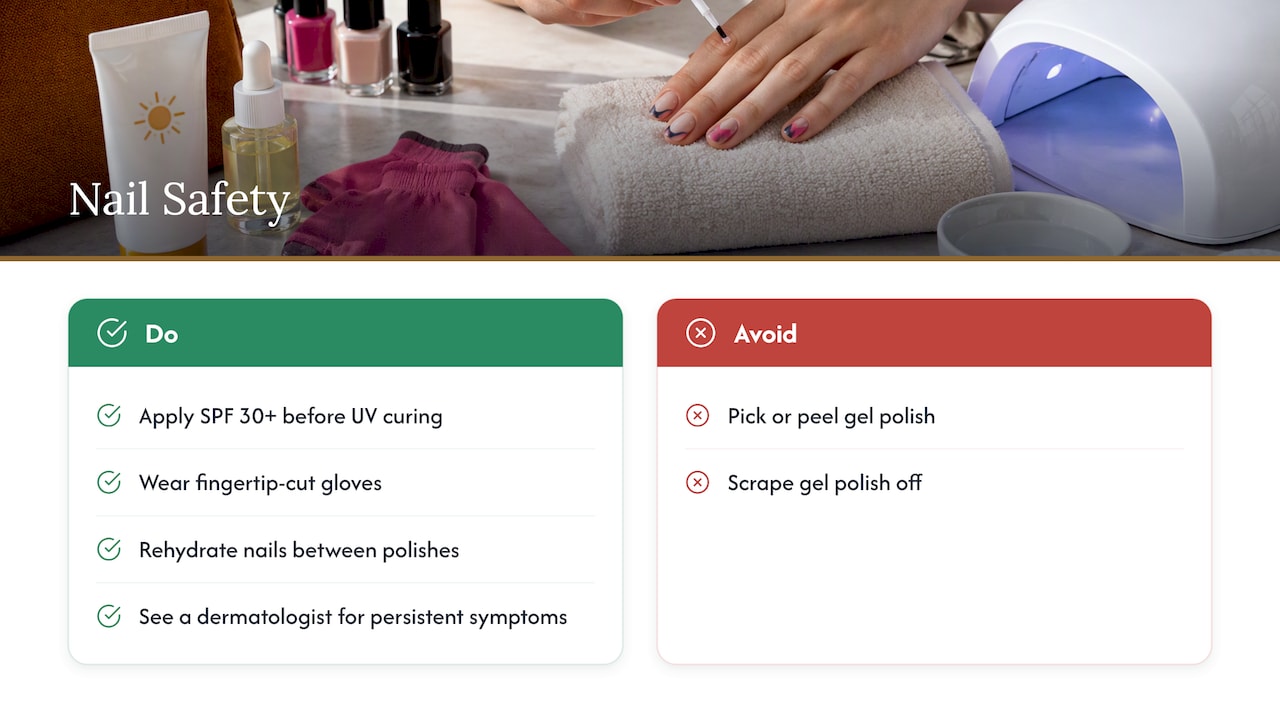
To lower your risk, apply broad-spectrum SPF 30 or higher to your hands before UV curing or wear fingertip-cut gloves, and rehydrate nails between polishes. If redness, swelling or itching around the nail persists, see a dermatologist. Our manicure aftercare guide covers the rest.
5. How do you adapt abstract designs to your nails?
A few rules make any look fit:
- Short nails: use thinner lines and smaller motifs so the art doesn’t crowd the nail.
- Long nails: go broader with color fields, since there’s room for a wash or large color block.
- Finish: glossy brightens colors, matte softens them and makes line art look graphic, and a glitter top coat adds sparkle without changing the design.
- Wearable palette: nude bases keep things subtle for the office.
- Statement palette: high-contrast accents on one or two nails make a bold set.
- Wardrobe: repeat one outfit color in a single line or fleck.
6. How do you brief a nail tech on abstract art?
Name the technique when you book. Words like “line art,” “aura” or “micro French” help a technician estimate time and materials far better than a screenshot alone. In our experience at the salon, simple lines, speckles and color blocks suit DIY, while detailed marbling and multi-layer gel art are worth the chair time. Foxy Nails is a luxury Reno salon with a personal, client-focused approach, and we’re happy to custom-design art to your reference.
— Cuong
7. Where can you get custom abstract nail art in Reno?
Want the finished look without the practice rounds? We build abstract art over the services you already know, with gentle removal when it’s time for a change:
- Gel Manicure ($40), the base for most line art and wash designs
- Gel X, Acrylic and Hard Gel sets for length and structure, from $55 to $60
- Nail art add-ons to bring your saved design to life
Browse everything on our services page, then bring your screenshot and ask us to match it.
This article is general information, not a substitute for advice from a qualified doctor. Consult a qualified healthcare professional about your own circumstances before acting on anything here.
FAQ
What are some different types of nail art designs?
Common types include abstract, line art, geometric, marbled, speckle, French and negative-space designs. Abstract styles tend to be the most flexible because they don’t need symmetry or perfect shapes.
What are some creative ideas for abstract art on nails?
Try a watercolor wash, floating curves, color-block geometry or terrazzo speckles. Pairing one gesture per nail with a nude or sheer base is a reliable way to make abstract nail art look modern.
How to print pictures for nail art?
We don’t suggest printing photos for home use, because the process involves special decals or water transfer film. A technician can recreate an image with hand-painted lines or color blocks, so bring the picture as a reference instead.
Does abstract nail art damage your nails?
The art itself doesn’t, but gel, acrylic and rough removal can. Soaking in acetone with foil wraps and never peeling polish protects the nail plate, according to the American Academy of Dermatology.
Sources
- Dermatologic Conditions Associated With Various Types of Popular Nail Cosmetics: A Systematic Review of Existing Literature and Future Recommendations – PubMed
- Cosmetically Induced Disorders of the Nail with Update on Contemporary Nail Manicures – PMC