
Good nail salon etiquette comes down to five things: show up on time, keep your hands and feet clean and product-free, communicate clearly about what you want, stay relatively still and quiet during the service, and tip 15 to 20 percent, with 20 percent as the default when the visit involves extra time or detailed work. Cash tips are usually preferred, but a card tip works fine if you tell the front desk who did the work. The sections below cover booking, in-chair behavior, tipping math, and what to do if a service goes wrong.
TL;DR:
- Arriving on time, bringing reference photos, and avoiding self-removal of polish help ensure efficiency and prevent delays.
- Tipping 15 to 20 percent is standard, with 20 percent recommended for complex work or longer appointments, and cash tips generally preferred.
- Disclosing existing nail enhancements, allergies, or infections when booking or during the service prevents complications and safety issues.
- Communicating immediately about discomfort or issues during the appointment allows for quick correction and better results.
- Respecting shared spaces, using quiet tones, and wearing casual clothing contribute to a smooth and respectful salon experience.
Table of Contents
- 1. Top salon etiquette rules to follow every visit
- 2. Tipping: how much to leave, cash vs card, and splitting tips
- 3. Booking and preparing before your appointment
- 4. How to behave and communicate once the service begins
- 5. What to do if something’s wrong with your nails
- 6. Special cases: kids, allergies, and existing nail work
- 7. Salon perspective: what technicians want clients to know
- 8. Cultural sensitivity and respecting salon staff
- 9. Handling shared spaces and communal items
- 10. What to wear to a nail salon appointment
- 11. Giving feedback or compliments the right way
- What nail salon etiquette actually gets wrong
- Sources
- FAQ
1. Top salon etiquette rules to follow every visit
Most etiquette problems come down to the same handful of habits repeated across salons. Nail technicians who spoke to Reader’s Digest about client behavior they dislike most point to phone use, fidgeting, and clients who remove their own gel polish before arriving, all of which slow down the appointment or damage the nail bed. Following a short checklist avoids nearly all of it.
- Arrive on time and call ahead if you are running late.
- Show up with clean hands or feet and skip heavy lotion or oil beforehand.
- Bring reference photos and confirm the shape and color before the technician starts.
- Keep phone use to a minimum, step outside for calls, and use headphones for video or music.
- Sit still and let your hands or feet stay relaxed rather than pulling away mid-application.
- Leave the tools and drying station alone, since they are part of the technician’s workspace.
- Ask for a quiet appointment upfront if you would rather not chat.
- Follow posted health policies and mention any cuts, infections, or allergies before the service starts.
- Tip based on the full service and try to hand it to the person who actually did the work.
- Speak up right away if something feels off, before you leave the chair.
Pro Tip: Decide on your color and shape before you sit down. Technicians say indecision at the polish wall is one of the biggest time drains in a full day of back-to-back appointments.
2. Tipping: how much to leave, cash vs card, and splitting tips
Tipping is where most etiquette questions actually start. Industry guidance places the standard range at 15 to 20 percent of the service price, with 20 percent or more recommended for detailed nail art, acrylic work, or a removal that takes longer than expected.
Industry standard tip range: 15 to 20 percent, with 20 percent common for extra time or complex work, according to tipping guidance from industry experts. That baseline applies whether you are getting a $15 manicure or a $65 pedicure package.
- Cash tips reach the technician immediately and skip any card-processing deduction.
- If you tip on a card, tell the front desk which technician should receive it, especially if more than one person worked on you.
- For a mani-pedi with two different technicians, calculate the tip separately: 20 percent of the manicure price goes to that tech, 20 percent of the pedicure price goes to the other.
- A quick mental shortcut to estimate a tip is to use about fifteen to twenty percent of the bill total.
- On a manicure, a tip within the typical tipping range is common; on a pedicure package, a tip that reflects the service cost is expected.
Cash also avoids the situation where processing fees quietly shrink a card tip before it reaches the technician. Our tipping guide breaks down more examples by service type.
3. Booking and preparing before your appointment
A smooth appointment starts before you ever sit down. Salons build their schedules around how long each service should take, and skipping prep steps throws that timing off for everyone booked after you.
- Mention any existing gel, acrylic, or dip enhancements when booking, so the salon can allow enough time for removal.
- Send reference photos 24 to 48 hours ahead if you want intricate nail art or a specialty finish.
- On the day of, remove old polish if asked, skip heavy lotion or oil, and wash your hands or feet beforehand.
- Avoid shaving your legs right before a pedicure. Waiting at least 24 hours reduces the risk of irritation from the foot soak.
- Give as much cancellation notice as you can. Many salons expect 24 or more hours and may charge a fee for same-day changes.
- Reschedule if you are contagious or have an open wound or infection near the area being treated.
Full prep details, including how far ahead to book for acrylics or fills, are covered in our guide on choosing a nail salon.
4. How to behave and communicate once the service begins
Once you are in the chair, the goal is simple: help the technician work efficiently and speak up the moment something feels wrong. A one-sentence brief at the start, confirming shape, length, and color, saves time and prevents a redo later.
- If the curing lamp feels too hot or the drill vibrates uncomfortably, say so immediately rather than gritting through it, and consider benefits from a brushless nail drill which boosts efficiency and reduces discomfort.
- Keep your hands or feet relaxed and avoid flexing or pulling away during polish or gel application.
- Silence your phone, skip speakerphone, and step outside if a call comes in.
- Headphones are fine as long as you can still hear the technician’s instructions.
- Skip eating at the station, keep children supervised if they are with you, and follow whatever policies are posted at the front desk.
Pro Tip: If you want to relax with your eyes closed, tell the technician upfront. That way they know your stillness is comfort, not discomfort.
5. What to do if something’s wrong with your nails
Most problems are easiest to fix in the chair. If a shape looks off or a color is wrong, point it out before the polish sets rather than waiting until you get home.
- During the appointment, flag issues right away so the technician can correct them on the spot.
- After you leave, contact the salon promptly. Many salons, including guidance from general etiquette resources, offer a repair window of about 7 days for lifts or breaks.
- When you message or call, include the appointment date and time, a photo of the issue, the technician’s name, and a specific description of the problem.
- If a clear mistake goes unaddressed, ask to speak with a manager before considering a public review.
- Tip for the corrected work if a fix is provided. If no remedy is offered for an obvious error, it is fair to adjust the tip and explain why when you reach out.
6. Special cases: kids, allergies, and existing nail work
A few situations call for extra care beyond the standard checklist.
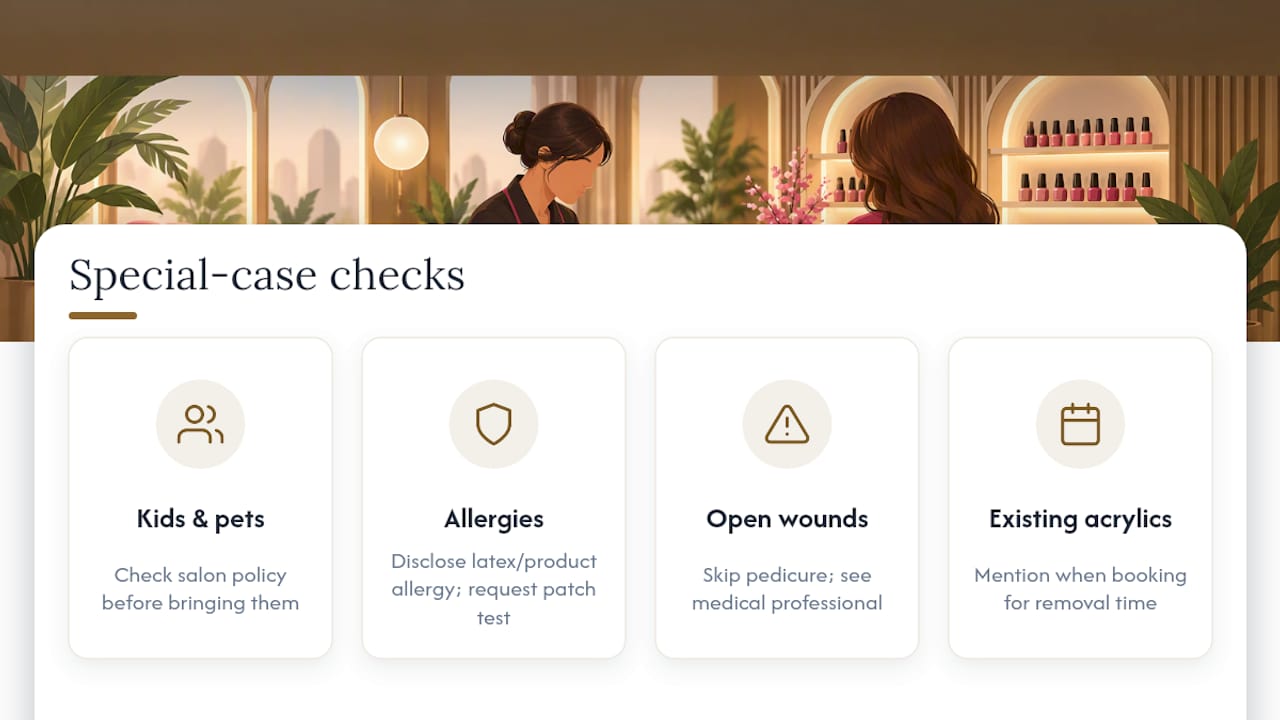
Check the salon’s policy before bringing children or pets, since many salons limit both for safety around chemicals and equipment. If you have a latex or product allergy, mention it before the service and ask about patch testing for anything new. Skip a pedicure entirely if you have an open wound or active infection. Health guidance on pedicure safety recommends seeing a medical professional for foot infections rather than treating them at a salon. And if you already have acrylic or gel on your nails, mention it when booking so the salon can schedule enough time for a proper removal.
7. Salon perspective: what technicians want clients to know
There is a luxury nail salon in Reno, Nevada, offering manicures, spa and deluxe pedicures, and nail enhancements including acrylic, hard gel, dipping powder, and Gel X, with a focus on personal service and a welcoming atmosphere for families and kids. That day-to-day experience lines up closely with what technicians elsewhere describe as the habits that make or break an appointment.
- Send reference photos 24 to 48 hours before your visit so the technician can plan colors, shapes, or specialty finishes in advance.
- If you are tipping by card, name your technician directly rather than leaving it to the front desk to guess.
- Ask for a quiet appointment if you would rather relax without conversation. Most technicians are glad to oblige when asked upfront.
When something does not turn out right, the priority is a quick fix rather than a drawn-out back-and-forth. Clients who reach out promptly with clear details tend to get the fastest resolution, and that same courtesy of clear, early communication is what keeps most visits running smoothly in the first place.
8. Cultural sensitivity and respecting salon staff
Nail salons across the country employ technicians from a wide range of backgrounds, and basic respect goes further than most clients realize. Speak directly and patiently if there is a language difference rather than talking over the technician or getting visibly impatient. A pointed gesture toward a color swatch or a photo on your phone communicates just as clearly as a long explanation, and it avoids putting anyone on the spot.
Avoid comments about a technician’s accent, name, or where they are from. These come up more often than clients realize and rarely land the way they are intended. If you are not sure how to pronounce someone’s name, ask once and use it correctly afterward.
Tipping fairly and on time is itself a form of respect. Technicians are typically paid per service rather than a flat hourly wage, so the tip is a meaningful part of their income, not an optional bonus. Treating every technician the same way regardless of who is assigned to you, rather than requesting a switch based on assumptions, keeps the relationship professional on both sides.
9. Handling shared spaces and communal items
Nail salons rely on shared resources: lotion pumps, polish racks, magazines, and sometimes a coffee or water station. Testers exist so you can check a color against your skin tone, but use a cotton swab or a fresh tip rather than dipping your finger directly into a bottle.
Wipe down a lotion pump or wash basin area if you notice residue, and let staff know if a bottle is running low or a tool looks like it needs cleaning rather than leaving it for the next client to discover. If a magazine or phone charger is in use, ask before taking it rather than assuming it is free.
Shared drying stations and UV lamps also need turnover time between clients. Moving your own hands in and out of a communal lamp before the technician says it is your turn can throw off someone else’s cure time.
10. What to wear to a nail salon appointment
There is no formal dress code for a nail salon, but a few practical choices make the appointment easier for everyone. Open-toe shoes or slides simplify a pedicure since you will not need to wrestle out of closed shoes or wait for polish to dry before putting boots back on. Loose sleeves that push up easily help if you are getting a manicure, since a tight cuff dragging across wet polish is a common way to smudge fresh work.
Skip freshly applied lotion or oil on the day of your appointment since both interfere with polish adhesion. Comfortable, casual clothing is standard. Nail salons are not formal spaces, and technicians are focused on your hands and feet, not your outfit.
11. Giving feedback or compliments the right way
A quick, specific compliment goes further than a generic one. Telling a technician the cuticle work looked especially clean or that the color match was exactly right gives them something concrete, and it is the kind of comment technicians remember when you return.
If something is not quite right, raise it calmly and specifically while you are still in the chair rather than saving it for a review later. Most technicians would rather fix a shape or smooth a rough edge on the spot than hear about it after you have already left.
For a positive experience overall, a review that names the salon and, when you know it, the technician helps far more than a vague star rating. Specific praise is also the fastest way to build a rapport with a technician you want to keep booking with going forward.
What nail salon etiquette actually gets wrong
Most etiquette advice focuses on rules that make the visit pleasant for you: sit still, silence your phone, pick a color quickly. Fewer articles focus on the part that actually determines whether the result holds up, which is disclosure. Telling your technician about existing gel, a skin sensitivity, or an infection before they start matters more than any amount of politeness during the service itself.
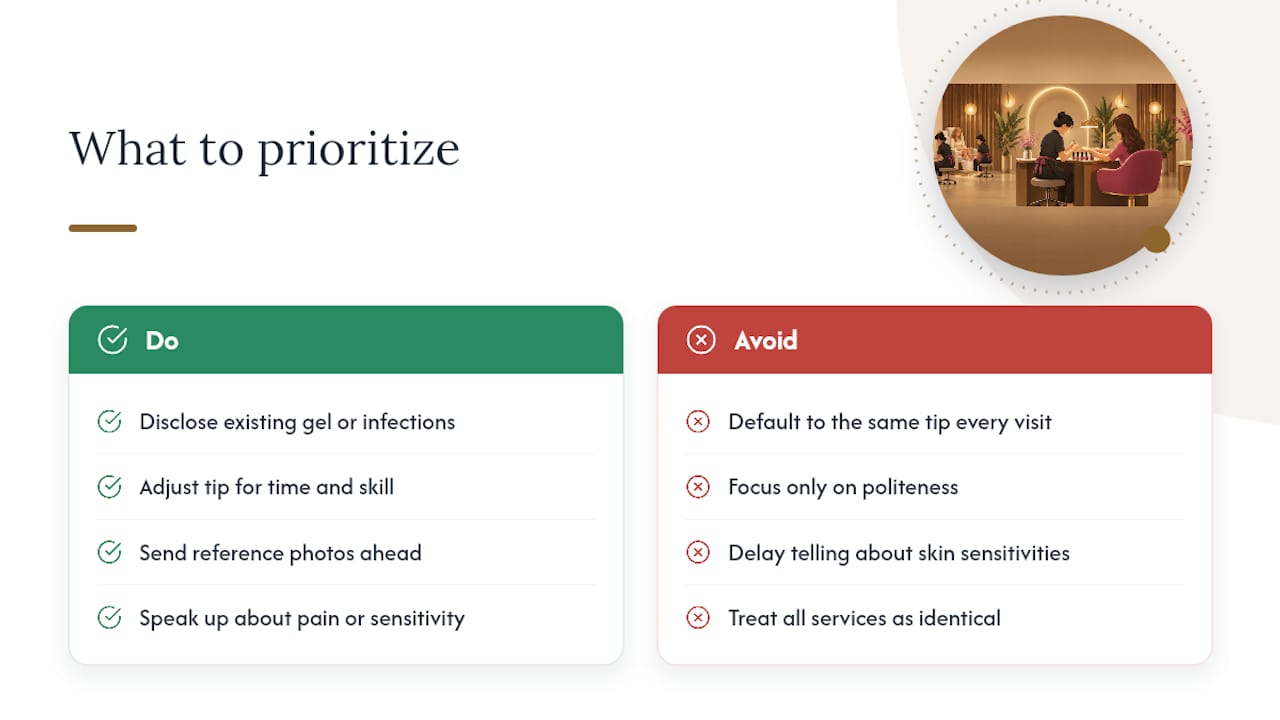
The tipping conversation also gets oversimplified into a single percentage, as if every visit is the same. A 15-minute polish change and a two-hour full set with hand-painted art are not the same job, and treating them identically shortchanges the technician doing the harder work. Adjust the tip to the actual time and skill involved rather than defaulting to the same number every visit.
If there is one thing worth prioritizing above the rest, it is early communication. Whether that means a reference photo sent two days ahead or a quick word about pain during a fill, speaking up before or during the service prevents almost every complaint people later post about after the fact.
— Cuong
Sources
- Nail-salon etiquette mistakes: Polite habits nail techs actually dislike — Reader’s Digest
- Nail Salon Etiquette: What to Do (and Not Do) at Your Appointment | NailAtlas
- How To Tip At The Nail Salon, According To Experts – AOL
FAQ
What do nail techs hate the most?
Technicians most often cite excessive phone use, fidgeting during application, and clients who remove their own gel polish before arriving, according to technicians interviewed by Reader’s Digest. Clear communication and staying relatively still solve most of these issues.
Is it rude not to tip at a nail salon?
Skipping a tip entirely is considered a breach of standard etiquette in most salons, since tipping guidance from industry sources places the expected range at 15 to 20 percent of the service price. If service quality was genuinely poor, address it with the salon directly rather than simply withholding a tip.
What is the red nail rule?
The “red nail rule” refers to a personal safety trend where someone wears red nail polish on a first date so a friend can check in using a coded phrase, unrelated to salon etiquette. Definitions of the trend vary by source, so treat it as a social custom rather than a formal salon guideline.
How much tip should I give at a nail salon?
The standard range is 15 to 20 percent of the total service price, with 20 percent common for detailed nail art, acrylics, or a longer-than-usual appointment, per expert tipping guidance. Cash is generally preferred, but a card tip works if you name the technician for the front desk.