Tip between about 15% and 20% of the pre-tax service price, with 20% commonly considered the standard for good service. Go higher, toward 25% or more, for intricate nail art, a full acrylic set, or a technician who worked past the booked time. Calculate your tip before sales tax is added, and if more than one person worked on you, tip each of them.
TL;DR:
- Tipping between 15% and 20% of the pre-tax service price is typical, with higher tips justified for complex nail art or late-extended appointments.
- For low-cost services like polish changes, a flat tip of at least $5 is recommended, regardless of the percentage calculation.
- Tip each technician individually when multiple professionals handle your service, especially for combined tasks like a manicure and pedicure.
- Cash tips ensure the technician receives the full amount immediately, while card tips may be processed through payroll, possibly delaying or reducing the amount received.
- Always ask if a mandatory service charge applies and whether it replaces or supplements the tip, especially in salons with integrated employee benefits fees.
Table of Contents
- How much to tip by service type
- How to calculate your tip without overthinking it
- Who gets the tip when more than one person works on you
- Cash vs. card tips: where your money actually goes
- What a Reno salon wants you to know about tipping
- Does tipping custom change depending on where you live
- When and how to tip for unsatisfactory service
- Other ways to show appreciation besides a tip
- A quick word on getting this right
- A friendly note from a Reno salon on tipping and booking
- Sources
- FAQ
How much to tip by service type
The right tip depends less on the dollar total and more on how much skill and time the service took. A quick polish change calls for a smaller percentage than a two-hour full set with hand-painted art, even though both are “just nails.”
As a baseline, use these examples on a pre-tax total:
- A $35 manicure: $7 at 20%.
- A $50 pedicure: $10 at 20%.
- A $70 service, such as a full acrylic set: $14 at 20%, or $17.50 at 25% if the work was especially detailed.
Around 15% is reasonable for a fast, simple service like a polish change or a basic buff, where the technician’s time investment is low. Twenty percent fits most standard appointments, including a regular manicure or a classic pedicure, and it is the range most etiquette guides point to as the default for satisfactory to excellent service.
Complex work deserves more. Elaborate nail art, hand-painted designs, or a full set that takes well over an hour often justifies 20% to 25% or higher, especially if the technician customized the design or fixed a tricky nail bed. The same logic applies if your appointment ran long because the salon squeezed you in last minute or a technician stayed late to finish your set.
A few situations call for tipping above your usual range regardless of the service:
- The technician accommodated a same-day or late booking without complaint.
- You brought a complicated reference photo and they nailed the design on the first try.
- The appointment ran well past the scheduled time due to the complexity of your request, not a service delay.
None of this means you need to do mental gymnastics at the register. Pick a tip percentage that matches the complexity of what you got done, round to a number that feels fair, and move on.
How to calculate your tip without overthinking it
Start with the pre-tax price on your receipt, not the total after sales tax. Most etiquette guidance, including Real Simple’s breakdown of nail salon tipping, recommends this because sales tax has nothing to do with the service you received, and tipping on top of it inflates the gratuity without benefiting the technician anymore fairly.
Here is the simple process:
- Find the pre-tax service price on your ticket or ask the front desk.
- Decide your percentage based on service complexity (15% for quick, 20% for standard, 20% to 25%+ for intricate work).
- Multiply the price by that percentage.
- Round to a clean number, usually up, since technicians rarely get the benefit of exact change working in their favor.
For low-cost services like a gel polish removal or a quick add-on, a strict percentage can shortchange the technician. A $10 polish removal at 15% comes out to $1.50, which barely registers as a thank-you for five or ten minutes of careful work. Real Simple’s tipping guidance suggests a flat minimum tip of around $5 for these smaller services instead of a strict percentage.
Quick mental math makes this painless. To find 10% of any price, move the decimal point one place left: $45 becomes $4.50. Double that for 20%: $9.00. Add half of the 10% figure again to land near 25% if the service calls for it.
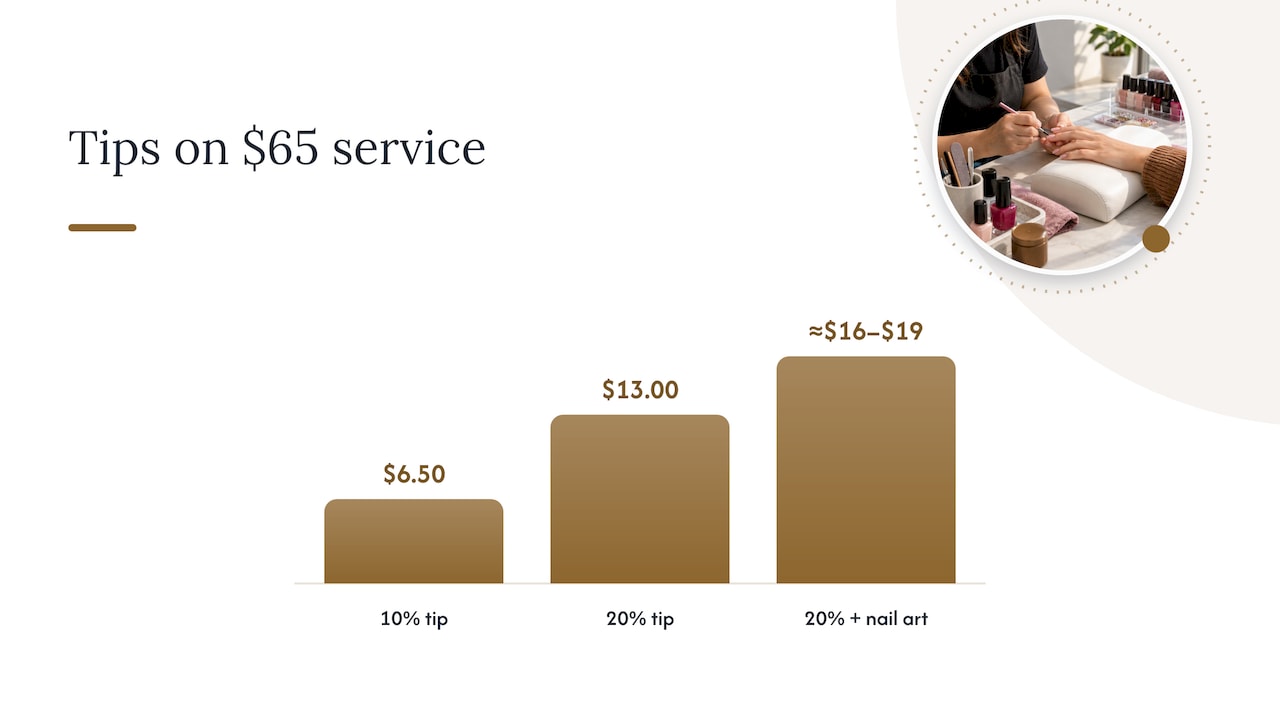
Walking through a real example: your bill shows a $65 gel manicure before tax. Ten percent is $6.50. Double it for 20%, landing at $13. If the technician did detailed art on top of the base service, add roughly $3 to $6 more, bringing your tip to around $16 to $19.
Pro Tip: Keep a small stash of $5 and $10 bills in your bag before a salon visit so you’re never stuck tipping only what a card reader suggests.
Who gets the tip when more than one person works on you
Full sets and detailed pedicures often involve more than one set of hands. One technician might do your pedicure while another handles your gel manicure, or someone might assist with soaking and buffing before the main technician takes over. Each of those people should be tipped separately, not lumped into a single gratuity that only reaches the person who checked you out.
A few guidelines help when the lines get blurry:
- Tip each technician individually, in cash when possible, if two different people handled your manicure and pedicure.
- If an assistant helped at a shared station, you can hand them a small tip directly or ask the front desk how tips are usually shared among staff.
- If the salon owner personally did your service, tipping is still appropriate and often appreciated, even though they also run the business.
Mandatory service charges complicate this further. Some salons add a set percentage, often labeled as an employee benefits charge or service fee, to every ticket regardless of how you tip. That charge is not the same as a voluntary tip. Under Section 45B and related FICA tip credit guidance, mandatory service charges are treated as regular wages paid by the employer, not as tips, and they cannot be counted toward the employer’s tip credit calculations. In practice, that means a service charge on your bill does not guarantee your technician sees that money the way they would see a cash tip handed to them directly.
If you notice a service charge on your receipt, ask the front desk whether it replaces the need for an additional tip or whether technicians still expect one on top of it. Policies vary by salon, and assuming the charge covers your technician’s gratuity can leave them without the tip they were counting on.
Cash vs. card tips: where your money actually goes
Cash remains the most reliable way to make sure your tip reaches your technician in full and right away. When you hand cash directly to the person who did your nails, there is no processing delay, no payroll routing, and no card fee eating into the amount. NerdWallet’s reporting on nail salon tipping notes that cash tips are widely preferred by salon professionals for exactly this reason: the money lands in their hands immediately.
Card tips often take a longer route. When you add a tip through a card reader, that amount typically gets processed through the salon’s payroll system rather than handed over on the spot. Depending on the salon’s policies, card tips may be distributed on the next pay cycle, and some salons deduct a portion to cover card processing fees before passing the rest along. If you prefer paying by card, it is reasonable to ask the front desk how card tips are distributed and how quickly technicians see that money.
Tax treatment adds another layer. Employees are required to report cash tips of $20 or more per month in writing to their employer, and this reporting is what underpins an employer’s ability to claim the federal tip credit under Section 45B. Mandatory service charges, by contrast, are treated as non-tip wages and do not qualify for that credit. The distinction matters because it shapes how a salon accounts for the money on its books, even if it does not change what you, the customer, owe at checkout.
What a Reno salon wants you to know about tipping
Years of working directly with clients have taught the team at Foxy Nails a few practical lessons about tipping that etiquette articles do not always cover. Technicians depend on tips as a meaningful part of their income, and small habits on your end make a real difference in how smoothly that works.
A few things Foxy Nails recommends to every client:
- Carry some small bills before your appointment to make tipping easier, especially if you prefer cash.
- Tip each technician individually if more than one person worked on your service.
- Ask about any automatic service charges before you book, so you understand your total payment.
Consistent, fair tipping also tends to build a better working relationship between you and your technician over time, something TODAY’s reporting on salon tipping points to as well. Clients who tip reliably often find it easier to get flexible scheduling or extra attention to detail on future visits. If you are still deciding where to book, Foxy Nails’ guide to choosing a safe nail salon and its overview of tipping practices cover both the etiquette and safety side of a good salon visit.
Does tipping custom change depending on where you live
Tipping culture in the United States is not perfectly uniform from state to state, and nail salons are no exception. In larger coastal cities, where the overall cost of living and service prices tend to run higher, a 20% tip on a pricier ticket naturally means a larger dollar amount than the same percentage would yield in a smaller market. That does not mean the percentage itself changes, but it does mean your actual tip in dollars will track local pricing.
In some regions, mandatory service charges and benefits fees show up more often on tickets, particularly in salons that have shifted toward an employee-based pay structure rather than independent contractor arrangements. Where that is the case, it is worth asking directly whether the listed charge replaces an expected tip or sits separately from it.
Smaller markets and suburban salons sometimes lean more heavily on repeat, relationship-based business, where consistent tipping has an outsized effect on how a regular client gets treated over time. Regardless of where you live, the safest approach is the same: calculate your tip on the pre-tax total, lean toward 20% as a default, and ask the salon directly if anything on your ticket looks unfamiliar.
When and how to tip for unsatisfactory service
A bad service does not automatically mean you should tip nothing. If the technician made a genuine effort but the result fell short due to things outside their control, like a nail bed condition or a product limitation, a reduced tip in the 10% to 15% range is usually more appropriate than skipping a tip altogether.
If something is genuinely wrong, speak up during the appointment rather than waiting until checkout. A chipped polish, an uneven shape, or a design that does not match what you asked for can often be fixed on the spot if you mention it calmly while the technician is still working. Most salons would rather correct an issue in the moment than have a client leave unhappy.
Reserve a very low or absent tip for situations involving real negligence, such as rushed, careless work or an unsanitary practice you witnessed directly. Even then, it helps to mention the issue to the salon manager so they are aware, rather than letting a missing tip be the only feedback the business receives.
Other ways to show appreciation besides a tip
Tipping is the primary way U.S. salon clients show appreciation, but it is not the only one. Referring friends and family to a technician you like is a meaningful form of support, since new clients often matter more to an independent technician’s income than a slightly larger tip on a single visit.
Leaving a positive, specific review that names the technician by name helps them build a reputation and can lead to more requests for their chair specifically. Booking directly with the same technician each time, rather than taking whoever is available, also signals loyalty that many salons track and reward with better scheduling priority.
A small gift during the holidays or on a technician’s work anniversary is another common gesture in U.S. salon culture, separate from your regular per-visit tip. None of these replace a fair tip, but together they round out a relationship that benefits both you and the person doing careful work on your hands and feet.
A quick word on getting this right
Budgeting for a tip before you walk in makes the whole visit easier. If you know roughly what a manicure or full set costs, set aside 20% in cash ahead of time so you are not doing math at the counter while someone waits for payment.
If something about your service needs adjusting, say so kindly while the technician is still working rather than staying quiet and tipping less afterward. Most technicians want the chance to fix a problem, and a calm, specific comment in the moment usually gets a better result than silence.
Reasonable tipping, even on a tighter budget, is noticed and appreciated far more than people assume. A fair tip paired with honest, friendly communication tends to go a long way toward a better experience for everyone in the chair.
— Cuong
A friendly note from a Reno salon on tipping and booking
Knowing what to tip is only half the equation. Finding a salon where that tip actually reflects a good experience matters just as much, and that is where a little local knowledge helps.

A local nail salon offers a range of services where the tipping guidance above applies directly, from everyday care to more detailed work:
- Manicures and gel manicures for a quick polish change or a longer-lasting finish.
- Spa and deluxe pedicures for a more relaxing, time-intensive visit.
- Nail enhancements like acrylic, Gel X, and dipping powder for longer-lasting results.
Before you book anywhere, it is worth asking whether the salon adds a mandatory service charge and how card tips are distributed to staff, since that shapes what your technician actually takes home. If you would rather skip that question entirely and tip in cash the old-fashioned way, bringing a few small bills to your appointment solves it outright.
Foxy Nails also sells gift cards if you are looking for a tip-friendly gift for someone who loves a good manicure. To see current offerings and book a visit, check the full services and pricing page.
Sources
This guide draws on NerdWallet’s nail salon tipping guidance, Real Simple’s tipping etiquette breakdown, TODAY’s reporting on salon tipping, and tax guidance on the Section 45B tip credit. For context on how service pricing affects technician pay more broadly, see this overview of stylist compensation.
- How much to tip at the nail salon | NerdWallet
- How much to tip at the nail salon | Real Simple
- FICA tip credit: Section 45B now reaches salons and barbershops | ToProAccounting
- How much to tip at salons | TODAY
FAQ
Is $10 a good tip for a $40 pedicure?
Yes, $10 on a $40 pedicure comes out to 25%, which sits above the standard 15% to 20% range and reflects generous appreciation for good service. A 20% tip on that pedicure would be $8, so $10 is a solid choice if the service ran long or included extra care.
How much should I tip for $70 nails?
At the standard 20% rate, a $70 nail service calls for a $14 tip, calculated on the pre-tax price. If the work involved detailed art or a full set that took significant time, pushing toward 25%, or about $17.50, is appropriate.
Do you have to pay a 20% tip in America?
There is no legal requirement to tip exactly 20% at a nail salon in the United States, but 20% is commonly treated as the standard for good service, with 15% acceptable for simpler services. Tipping below that range is generally reserved for service that fell noticeably short.
Is $10 a good tip for a $100 salon visit?
A $10 tip on a $100 salon visit works out to 10%, which falls below the typical 15% to 20% range most etiquette guides recommend for satisfactory service. Unless the service was brief or something went wrong, a tip closer to the standard 15% to 20% better matches customary U.S. salon norms.