
Most lifting on acrylics, gel, dip powder, or Gel X comes down to one thing: something got between the product and your natural nail plate before it ever cured. Cuticle tissue, oils, or dust left behind during prep account for the majority of cases, and a skilled technician can usually fix it with a proper re-prep or a targeted repair rather than a full redo. Foxy Nails sees this constantly in the chair, and the fix is almost always technique, not product.
TL;DR:
- Proper removal of cuticle tissue and the use of dehydrators are critical, as most lifts are caused by contamination or incomplete prep.
- Lifts starting at the cuticle indicate prep failure, while tip-first lifts suggest the free edge was not capped during application.
- Repeated lifts in the same spot often result from improper technique rather than product issues, and changing systems may help if prep is consistently correct.
- Post-care habits like hot water exposure and oil application before visits significantly affect enhancement longevity, making client routines equally important.
- Repair is usually sufficient for localized lifts if no discoloration or odor exists, but extensive or recurring lifts may require switching to more flexible overlay systems.
Table of Contents
- What Causes Nails to Lift, and How to Spot the Pattern
- The Salon Prep and Application Checklist That Actually Prevents Lifting
- Everyday Habits That Make Enhancements Last Longer
- Repair or Full Removal: How Technicians Decide
- What Years in the Chair Teach You About Lifting
- How Foxy Nails Fixes and Prevents Lifting
- Sources
What Causes Nails to Lift, and How to Spot the Pattern
Where the lift starts on your nail tells you almost everything about why it happened. That’s the first thing a good technician checks before touching a file.
Cuticle-first lifting (the product pulls away right at the base) almost always points to prep failure. Skin cells, natural oils, or leftover cuticle tissue physically blocked the bond before it started. Tip-first lifting (separation begins at the free edge and creeps backward) usually means the free edge wasn’t capped during application, so moisture and daily wear worked their way underneath. Patchy or bubble lifting in random spots on the nail plate signals either trapped air, an undercured layer, or old product residue that wasn’t fully removed before the new application went on.
Gel and acrylic don’t stick to your nail through glue-style adhesion. They form a molecular bond to the keratin in a clean, dry nail plate. Any contamination, even invisible traces of oil, creates a physical barrier that prevents that bond from ever forming properly. That’s why lifting that shows up in the first two to seven days almost always traces back to what happened during prep, not what happened after you left the salon.
The top causes break into five categories:
- Prep issues: leftover cuticle tissue, skipped dehydrator step, natural oils not fully removed
- Application errors: product touching skin, thick cuticle lines, free edge not capped
- Curing problems: underpowered or aged lamp, wrong cure time for the product, mismatched wavelength
- Product issues: expired primer, contaminated product, incompatible base and top coat
- Client habits: frequent hot water exposure, picking, oil applied right before the appointment
Inadequate cuticle preparation alone is responsible for roughly 70% of all gel lifting problems, which is why the next section spends most of its time there.
The Salon Prep and Application Checklist That Actually Prevents Lifting
Good retention isn’t a matter of luck or a fancier product line. It’s a sequence, done in order, every single time.
- Remove cuticle tissue completely. The gold standard here is Russian-style e-file preparation, which clears microscopic pterygium (the thin skin that clings to the nail plate) far more thoroughly than traditional push-and-file methods.
- Cleanse the nail plate. This strips oils and dust left behind from filing.
- Dehydrate. A dehydrator pulls remaining moisture from the plate so the next layer can actually bond.
- Apply a thin coat of primer or pH bond. This step happens last, immediately before product application, never earlier in the appointment.
- Leave a 1 to 2 millimeter gap at the cuticle. Product that floods the skin is one of the most reliable ways to trigger early lifting.
- Cap the free edge on every single layer, not just the final one.
- Build in thin, even layers with the apex placed correctly, rather than one thick layer that traps stress and air.
- Verify the cure. Lamp wavelength and irradiance matter more than wattage alone, and LED bulbs lose output over time even when they still light up. A tacky, unset base coat is the clearest sign of undercure.
If you’re a chronic lifter despite proper prep every time, the fix usually isn’t switching brands. Brand-hopping rarely solves a prep problem. What often helps instead is changing base systems entirely, such as moving to a rubber-elastic base or a builder base overlay that flexes with your natural nail rather than fighting it.
Pro Tip: If you notice the same finger lifting appointment after appointment, mention it before your technician starts. A recurring pattern on one nail often points to a structural issue with that specific nail, not bad luck.
Everyday Habits That Make Enhancements Last Longer
What you do in the 48 hours after your appointment matters almost as much as what happened in the chair.
Right after your service, skip the hot soak, keep cuticle oil away from the nail plate for a few hours, and dry your hands gently rather than rubbing them with a towel. Any of these can interfere with the final cure or introduce moisture before the bond fully sets.
For daily habits, a few adjustments go a long way:
- Wear gloves for dishwashing, cleaning, and gardening
- Ask about an elastic or flexible base system if your job means constant hand-washing
- Book fill-ins on schedule instead of pushing past three weeks
- Keep cuticle oil in your routine between appointments, just not immediately before one
Frequent hot water exposure and picking at the edges are two of the most common client-side reasons enhancements fail early, according to salon-observed retention patterns. If a lift starts before you can get in, resist the urge to glue it down yourself. Superglue traps moisture underneath and can make the eventual professional fix harder. A small piece of nail tape over the lifted section is a safer stopgap until you’re back in the chair.
Pro Tip: If you have a physically demanding job with constant water exposure, ask your technician about a builder base rather than a traditional overlay. It flexes instead of cracking under daily stress.
Repair or Full Removal: How Technicians Decide
Not every lift means starting over. A technician looks at scope and condition before deciding.
- Repair works when the lift is localized, there’s no odor, and no discoloration underneath.
- Full removal is safer when there’s a musty smell, green or dark discoloration, or lifting across more than one nail or a wide section.
- A typical repair takes 10 to 20 minutes: the lifted section gets filed back, re-prepped, and rebuilt with fresh product.
- Removal protects the natural nail when contamination has already set in, since sealing over it would trap the problem underneath.
After a repair, expect two to three weeks of solid wear before your next scheduled fill. If the same nail keeps lifting despite correct prep, that’s the signal to talk about switching enhancement systems rather than repeating the same fix.
What Years in the Chair Teach You About Lifting
Most conversations about lifting online focus on product blame, gel brand A versus brand B, when to switch, whether a cheaper polish is the problem. That framing misses what actually happens on the nail. In practice, the technicians who see the fewest callbacks aren’t using different products than everyone else. They’re just more disciplined about the boring parts: e-file prep, dehydrator timing, capping every layer instead of just the last one.
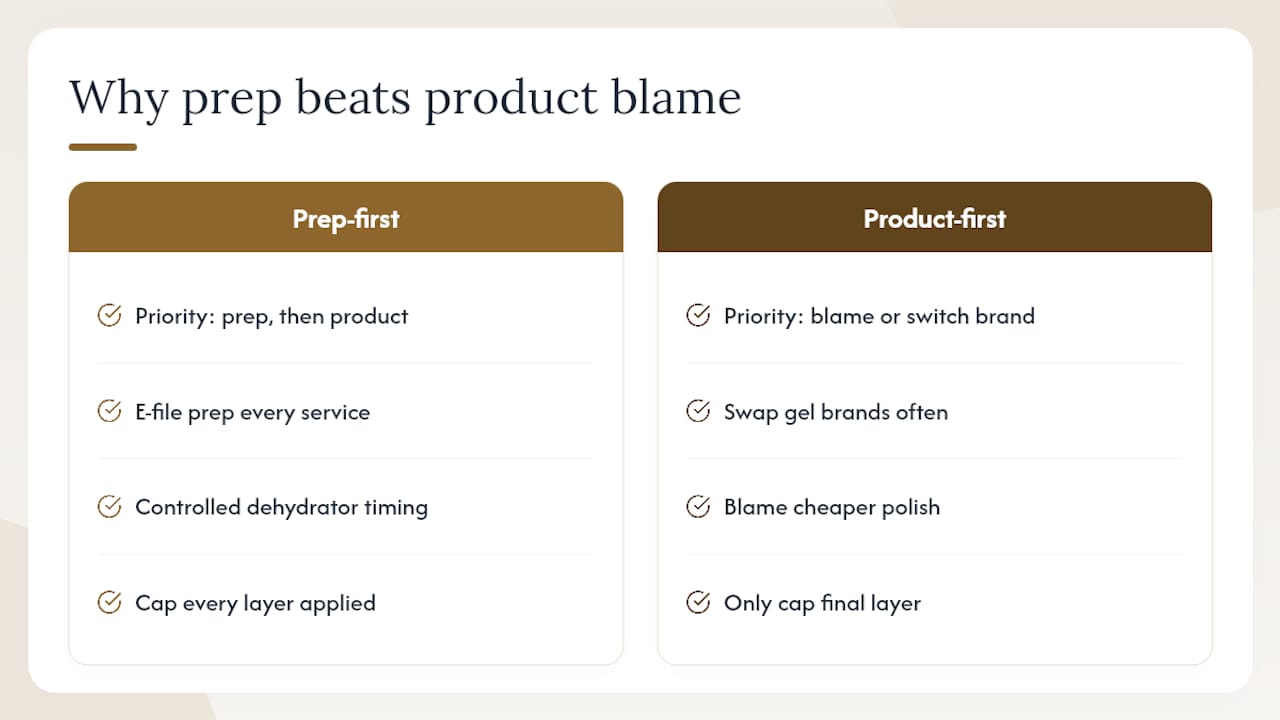
At Foxy Nails, retention gets treated as a prep problem first and a product problem a distant second. That’s the order clients rarely hear about, but it’s the order that actually matters. If you’ve cycled through three different gel brands chasing better wear and nothing’s changed, the brand was probably never the issue.
. If a lift keeps recurring in the same spot, ask directly about switching to a nail overlay or a different base system before assuming you just need a new coat.
— Cuong
How Foxy Nails Fixes and Prevents Lifting
Foxy Nails treats lifting as a repair problem to solve properly, not a reason to sell you a full redo you don’t need. If your enhancement has started separating, a proper consultation comes first: your technician checks whether it’s localized enough to repair or whether the natural nail needs a clean start.

For clients who keep coming back with the same complaint, the answer is often a different system altogether. A builder base or overlay flexes with daily wear instead of cracking under it, and Gel X or hard gel can outperform traditional acrylic for anyone whose hands are in water constantly. If your nails have taken damage from repeated lifting and removal cycles, there’s also a recovery plan built specifically for that. For readers who want to support nail strength between visits, a supplement like Onyx Wellness’s hair, skin, and nails strips can complement in-salon work, though it’s never a substitute for correct prep.
The best next step is simple: book a manicure or pedicure appointment and mention the lifting pattern you’ve noticed. Your technician can diagnose it in the chair and recommend the right fix on the spot.
Sources
- Why Does My Gel Polish Keep Lifting? (15 Causes + Professional Fixes) – Artistic Touch – Professional Nail Training Academy
- 10 Reasons Why Your Gel Polish Is Peeling Off (And How to Fix Each One – DTK Nail Supply