
Short nails win for hygiene, typing, manual work, and anyone who wants low maintenance. Long nails win when visible nail art and a dramatic look matter more to you than convenience, since they demand more upkeep and carry a higher break risk. The simplest rule: pick for health and daily function first, then adjust for style.
TL;DR:
- The CDC recommends keeping nails short, trimming them often, and scrubbing underneath with soap and water or a nail brush during handwashing.
- Dermatologists link continuous acrylic or long gel wear to thinning, brittleness, and possible nail bed damage, and recommend breaks between enhancement cycles.
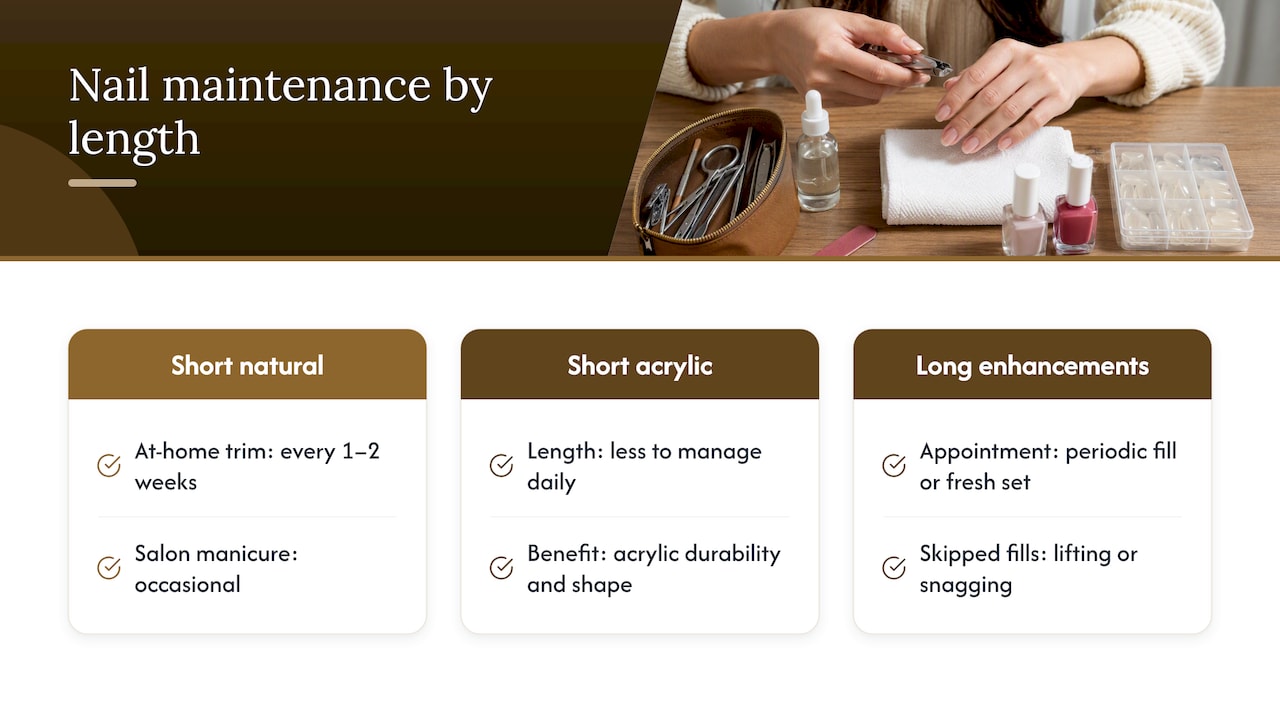
- Short natural nails usually need a home trim every week or two, while enhancements require periodic fills; delaying them raises lifting and snagging risk.
- Ask a professional to remove enhancements safely if they lift persistently or you notice redness, swelling, discharge, or repeated breaks; do not peel them off.
Table of Contents
- Nail Length Bands and Terms You Need to Know
- Short vs Long Nails: A Quick Pros and Cons Rundown
- What Hygiene Research and Dermatologists Actually Say
- How Much Time and Money Each Length Actually Costs You
- Which Length Makes Daily Tasks Easier?
- Nail Art and Shape Options by Length
- How to Choose: A Simple Scoring Method
- When to See a Nail Pro and What They Can Do
- Our Take: Moderation Beats Extremes
- Get the Right Length for Your Hands and Your Life
- FAQ
- Sources
Nail Length Bands and Terms You Need to Know
Before comparing short and long nails, it helps to agree on what those words actually mean. “Short” and “long” get used loosely, so here are working bands we’ll use throughout this article:
- Short: a small amount of free edge past the fingertip.
- Medium: a moderate amount of free edge past the fingertip.
- Long: a substantial amount of free edge past the fingertip.
These aren’t strict rules, just a consistent reference point so comparisons make sense. A few salon and anatomy terms come up often in this discussion. The free edge is the part of the nail that extends beyond the fingertip, the part you trim or shape. The nail plate is the hard surface of the nail itself, made of layered keratin. The cuticle is the thin skin at the base of the nail that protects new nail growth from bacteria.
On the service side, gel polish is a UV or LED cured polish that lasts longer than regular lacquer. Acrylic is a liquid and powder mix sculpted into an extension or overlay. Dip powder uses colored powder layered with a bonding resin, and Gel X is a pre-formed soft gel extension applied with adhesive rather than sculpted from scratch. Knowing these terms makes the maintenance and salon sections ahead easier to follow.
Short vs Long Nails: A Quick Pros and Cons Rundown
If you just want the fast version before committing to a length, here’s how the two sides stack up.
Short nails tend to win on:
- Hygiene: less surface area under the free edge for dirt and bacteria to collect.
- Daily ease: typing, texting, cooking, and chores all go smoother without a free edge catching on things.
- Durability: less leverage means less breaking, chipping, or lifting.
- Dry time: less polish surface means faster dry times after a manicure.
Long nails tend to win on:
- Nail art real estate: more surface for detailed, layered, or 3D designs.
- Visual drama: longer nails elongate the look of the fingers and hand.
- Statement style: stiletto, coffin, and oval shapes show up best at length.
Who gravitates toward which? Healthcare workers, food service staff, parents of young kids, and anyone doing hands-on manual work tend to prefer short nails simply because the job demands it. Fashion-forward clients, people prepping for a wedding or photoshoot, and anyone who treats their nails as a canvas for self-expression tend to lean long, accepting the extra upkeep as the cost of the look.
Neither preference is wrong. The right pick depends on what you do with your hands all day and how much maintenance time you’re willing to spend.
What Hygiene Research and Dermatologists Actually Say
This is where the decision gets less about taste and more about health, and it’s worth taking seriously if you’re on the fence.
The CDC’s nail hygiene guidance is direct: dirt and germs can live under fingernails and contribute to the spread of infections, and the agency recommends keeping nails short, trimming them often, and scrubbing underneath with soap and water or a nail brush during hand washing. Nails that extend past the fingertip simply have more surface area where buildup happens, which is why healthcare settings in particular favor shorter lengths for anyone with direct patient contact.
Nails that extend further past the fingertip tend to collect more dirt and germs under the free edge, which lines up with why trimming them short is the CDC’s core recommendation for everyday hygiene.
On the enhancement side, the American Academy of Dermatology’s guidance on artificial nails points to a different kind of risk. Continuous wear of acrylics or long gels is linked to thinning, brittleness, and potential damage to the nail bed, which is why dermatologists recommend reserving artificial nails for special occasions rather than wearing them nonstop. Giving nails recovery time between sets matters as much as the length itself.
Watch for these signs that your nails need a break, regardless of length:
- Lifting: polish or product separating from the nail plate, often at the base.
- Onycholysis: the nail separating from the skin underneath, which can look like a white or yellow patch.
- Persistent brittleness: nails that split, peel, or crack even after you stop wearing enhancements.
If you notice any of these, the practical fix is the same: shorten the nail, take a break from polish or enhancements, and keep the nail bed hydrated with cuticle oil or a moisturizing treatment. Catching damage early is a lot easier to reverse than waiting until it’s advanced.
How Much Time and Money Each Length Actually Costs You
Maintenance is where short and long nails diverge the most, and it’s worth being honest with yourself about how much time you want to spend in a salon chair.
Short natural nails are the lowest-maintenance option. A home trim every week or two, plus an occasional manicure, keeps them looking clean. A regular manicure runs a quick, affordable visit and doesn’t require the frequent rebooking that enhancements do.
Long nails, especially enhancements, run on a tighter schedule. Acrylic, gel, Gel X, and dip powder sets typically need a fill or a fresh set periodically, depending on how fast your natural nails grow and how much wear the product gets. Skipping fills too long increases the odds of lifting or snagging, since the gap between your growing nail and the product becomes a weak point.
If you want long nails without full enhancements, short acrylic nails are a middle path: you get the durability and shape of acrylic with less length to manage day to day. For natural, shorter styling, a standard manicure covers most of what you need.
Pro Tip: Book your fill or manicure alongside a pedicure in the same appointment, and ask about off-peak time slots. It saves a trip and often costs less than booking services separately.
Taking occasional “polish holidays,” weeks without any gel or acrylic, also protects your nail plate and stretches the life of your natural nails between enhancement cycles.
Which Length Makes Daily Tasks Easier?
If you spend your day typing, texting, or working with your hands, length has a real effect on how smoothly things go.
Short nails generally make typing, smartphone use, and playing instruments easier and safer. There’s no free edge catching on keys, strings, or touchscreens, and less risk of the nail bending backward under pressure. For anyone who types for a living or plays an instrument regularly, this isn’t a minor convenience, it’s often the deciding factor.
Long nails increase the odds of snagging or breaking during chores, childcare, or contact sports. Changing a diaper, doing dishes, or catching a ball all become trickier with extended length, and a snapped nail at length is painful and takes longer to grow out than a short break.
If you want some of both worlds, a few compromise options help:
- Short rounded tips: softened edges reduce snag risk while keeping some length.
- Trimmed sidewalls: narrower nails catch on fewer surfaces during daily tasks.
- Conservative shapes: squoval or soft square shapes balance durability with a finished look.
These middle-ground shapes let you keep a manicured look without sacrificing function if your days are hands-on.
Nail Art and Shape Options by Length
Length changes what’s possible on the design side, and knowing what each length does best helps you set realistic expectations before you sit down for a service.
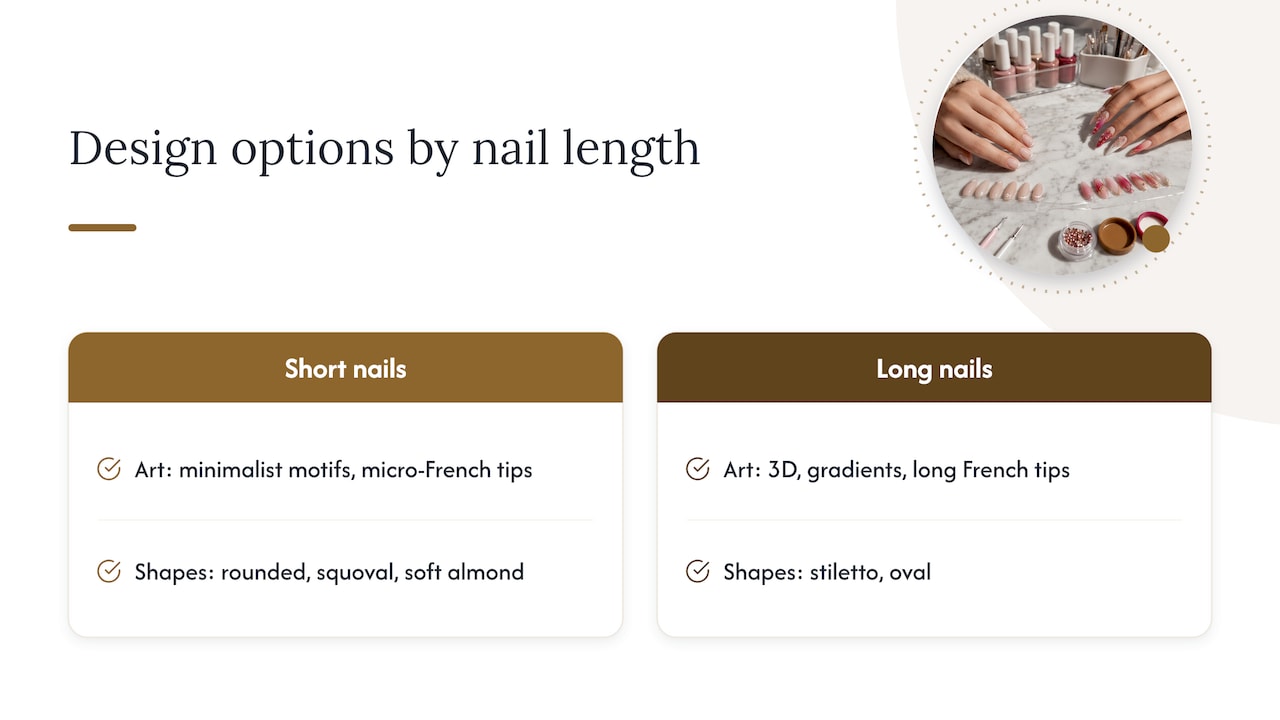
Long nails open up space for 3D art, extended gradients, and long French tip styles that need to surface area to read clearly. Stiletto and oval shapes in particular are built for length, since the dramatic point or curve only shows up with enough nail to work with.
Short nails aren’t a design limitation, they just call for a different approach. Minimalist art, scaled-down motifs, and micro-French tips all translate well to a smaller canvas, often looking cleaner and more wearable day to day than busier designs would. Rounded, squoval, and soft almond shapes flatter short nails by working with the natural nail bed instead of fighting it.
If you want ideas scaled to shorter nails, short nail designs for small nail beds and minimalist nail art are both built around that exact need. Shorter nails can absolutely carry personality, the designs just lean simpler and more precise rather than large and layered.
How to Choose: A Simple Scoring Method
If you’re still torn, a quick scoring exercise can cut through the back-and-forth faster than more reading will.
- List your top priorities: hygiene, daily function, style, and budget.
- Rate how much each one matters to you on a scale of 1 to 5.
- Give short nails a score for how well they satisfy each priority, then do the same for long nails.
- Add up each column. The higher total points you toward the better fit.
Ask yourself a few direct questions as you score: Do you work with your hands for most of the day? Do you like changing your look often, or do you prefer consistency? Do you mind frequent salon visits, or would you rather minimize them?
As a rough pattern, if hygiene and function scored highest, short nails usually come out ahead. If style and willingness to maintain enhancements scored highest, long nails usually win. Most people land somewhere in between, which is exactly why compromise shapes and shorter enhancements exist.
When to See a Nail Pro and What They Can Do
Some situations call for professional help rather than a DIY fix. Persistent lifting that won’t stay down, any sign of infection like redness, swelling, or discharge, repeated breakage at the same spot, or wanting a complex enhancement design are all good reasons to book an appointment rather than troubleshoot at home.
A nail professional can safely remove gel, acrylic, or Gel X without the damage that picking or peeling at home causes, rebuild a nail that’s grown out unevenly, and recommend a rehydration plan if your nails are showing brittleness. Professional aftercare guidance also helps extend the life of whatever length or service you choose.
- Watch for: lifting at the base, discoloration, or tenderness around the nail.
- Ask for: a soak-off removal rather than filing or peeling product off.
Pro Tip: If your nails lift soon after a new set, it may be a prep or application issue, not a you issue. Flag it at your next visit so the technician can adjust.
Our Take: Moderation Beats Extremes
Most of the short-versus-long debate misses the real point: nail health and personal style aren’t actually in conflict, they just need honest pacing. The nails that look the best long term aren’t the ones kept at maximum length or maximum shortness forever, they’re the ones that get a break between enhancement cycles and get care tailored to what someone actually does all day.
We help clients figure out a length that fits their work, their hands, and their habits, not just a trend, and we build in moderation so style doesn’t come at the expense of the nail bed underneath it. When you’re unsure, a quick consultation beats guessing.
— Cuong
Get the Right Length for Your Hands and Your Life
Whatever you land on, from a classic manicure to a full Gel X set, we offer the range to get there without you having to choose between looking good and keeping your nails healthy.
- Want low maintenance? A regular or gel manicure keeps things simple.
- Want durability with less length? Short acrylics give you shape without the upkeep of a full set.
- Want a statement look? Full sets in acrylic, liquid gel, Gel X, or dip powder are all on the table.
Browse our services page to see what fits, or book an appointment and we’ll help you pick the length and finish that works for your hands.
FAQ
Is it better to have short nails or long nails?
Neither is universally better. Short nails are better for hygiene, typing, and manual tasks, while long nails are better suited to nail art and a dramatic look, so the right choice depends on your daily routine and how much upkeep you want.
What is the most attractive nail length?
Attractiveness is subjective and depends on hand shape, lifestyle, and personal taste rather than a single ideal length. Many people find that a length proportional to their fingers, whether short and clean or long and sculpted, reads as the most polished.
Are long or short nails in for 2026?
Short, minimalist styles and longer sculpted shapes can suit different tastes, so one length isn’t right for everyone. Shorter nails have gained ground for their practicality, while long nails stay popular for special occasions and detailed art.
Are short nails more classy?
Short nails are often seen as polished and professional, especially in minimalist or micro-French styles, but “classy” ultimately depends on the finish and care rather than length alone. A well-maintained long set can look just as refined as a short, clean manicure.
Sources
- Artificial nails: Dermatologists’ tips for reducing nail damage
- Healthy Habits: Nail Hygiene | Water, Sanitation, and Environmentally Related Hygiene (WASH) | CDC