
Book your final bridal manicure one to two days before your first wedding event if you’re getting gel or dip, and the day before for regular polish. Acrylic, Gel X, or any extension needs two to four days for adjustment and repair buffer. If your nails are damaged or brittle, start strengthening treatments three or more months out, and lock in your trial four to eight weeks before the big day.
TL;DR:
- Extensions like acrylic or Gel X need to be scheduled two to four days before the wedding to allow for adjustments and repairs.
- Nail strengthening treatments should start at least three months out, with a trial appointment four to eight weeks before the wedding date.
- The final manicure timing varies by system: gel or dip within one to two days, regular polish the day before, and extensions two to four days prior.
- Nail trials should be booked early, with testing of shape, color, and wear to avoid surprises during the wedding.
- Pedicures are best scheduled two to three days before the event to prevent sensitivity and allow feet to recover before standing in heels.
Table of Contents
- Your Complete Wedding Nails Timeline, Month by Month
- How Do You Plan a Nail Trial the Right Way?
- Which Nail Products Need Different Booking Windows?
- What Goes Into a Wedding Morning Emergency Kit?
- How Foxy Nails Handles Bridal Timelines
- Why Most Wedding Nail Advice Gets the Timing Backward
- Ready to Book Your Bridal Nail Trial?
- Sources
Your Complete Wedding Nails Timeline, Month by Month
A wedding nails timeline works backward from your ceremony date, and each block of time has a specific job. Skip a step and you’re either scrambling the week of or showing up with regrowth in every close-up photo.
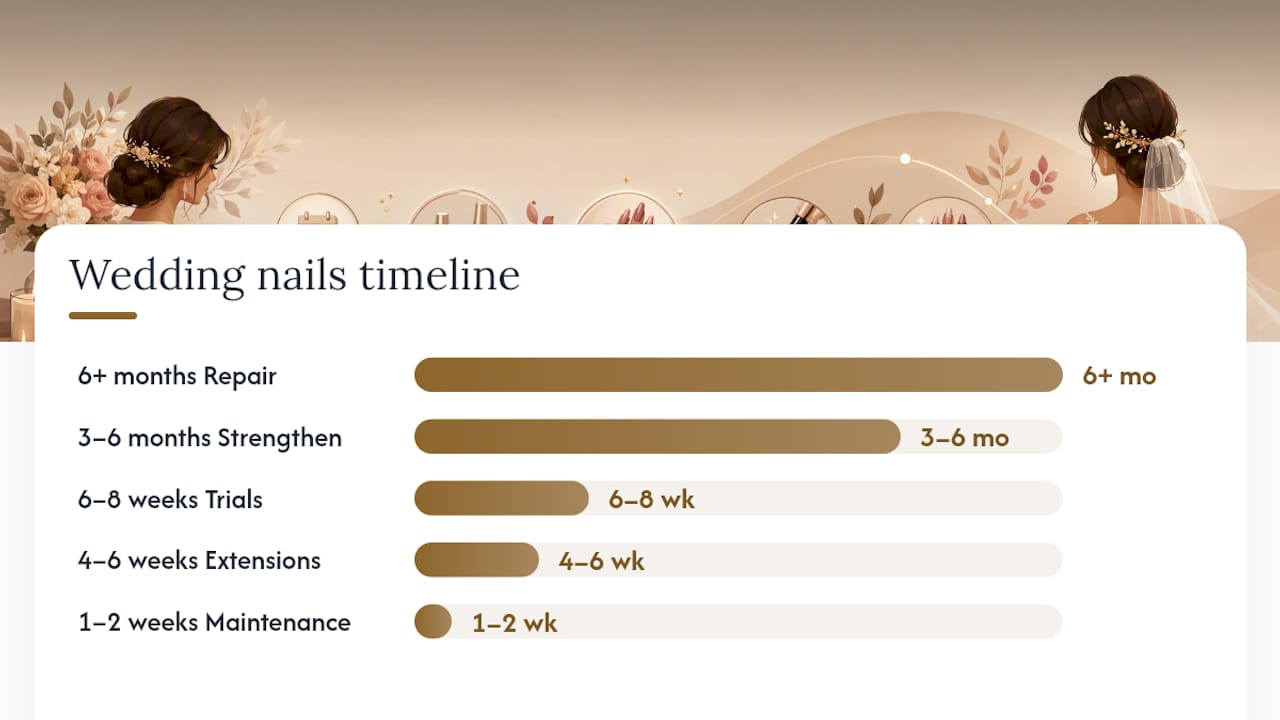
Six or more months out. If your nails are peeling, brittle, or just tired from years of gel, this is when repair starts. Fingernails grow roughly 3 millimeters a month, so meaningful recovery from damage takes real time, not a rushed two weeks before the ceremony. Start a strengthening routine, get regular cuticle oil into your nightly habits, and cut out the behaviors that keep nails weak, like picking at gel or peeling off polish instead of soaking it off as explained in your nail care routine between salon visits.
Three to six months out. Keep the strengthening routine going. The American Academy of Dermatology recommends keeping nails moisturized and avoiding aggressive removal methods, which sounds basic until you realize how many brides strip gel with a metal tool the week before their trial and set their progress back a month.
Six to eight weeks out. This is trial season. Book your bridal nail trial now, not the week before the wedding, so you have room to change your mind. Bring photos of shapes and colors you like, and test how they photograph in different light.
Four to six weeks out. If you’re planning extensions or a BIAB (builder gel in a bottle) system that needs a longer build than a single appointment allows, schedule that now. This also gives your nail technician time to see how a specific product wears on your hands before committing to it for wedding week.
One to two weeks out. Treat this stretch as maintenance, not experimentation. Technicians consistently advise against trying new shapes or lengths this close to the date and recommend skipping heavy chores that risk a snapped nail. If you’re switching nail systems (say, going from acrylic to gel for the wedding), get old enhancements removed properly during this window so your nail bed has time to recover before the final appointment.
Three to five days out. Pedicure time. More on why this sits earlier than your manicure below.
One to two days out. Final manicure, with the exact timing depending on what you’re getting. Here’s the quick rundown:
- Regular polish: the day before, or morning of if your schedule allows
- Gel or dip: one to two days before
- Acrylic, Gel X, or extensions: two to four days before, to leave room for adjustment
- BIAB or strengthening treatments: should already be established well before this window, not started here
That buffer on extensions isn’t arbitrary. New length changes how your hands move and feel, and technicians often need 48 to 72 hours of wear before confirming the shape sits right and nothing needs a quick fix. Booking extensions the morning of the wedding gives you zero room to catch a lifted tip or an edge that needs filing.
How Do You Plan a Nail Trial the Right Way?
A trial isn’t just a practice run. It’s your one chance to catch a color that looks perfect on a swatch but reads orange under flash photography, or a shape that doesn’t suit your finger length once it’s actually on your hand.
Here’s what to actually test:
- Shape and length — square, almond, coffin, whatever you’re drawn to, worn for at least a few hours to see how it feels doing normal tasks.
- Color and finish — bring your dress swatch or a photo of your bouquet if you’re coordinating tones.
- Photos in multiple lighting conditions — natural window light and flash both. A trial that includes photos under different lighting catches color surprises before wedding day, not during it.
- Wear test — how does the polish or gel hold up after a few days of your actual routine?
Book your trial in the same window as your hair or makeup trial if your schedule allows. It’s easier to picture your full bridal look, and you avoid burning separate trips across a busy month. If your bridal party wants matching or coordinated nails, this is also when to sort out group logistics: hiring an on-site technician for wedding morning versus booking block appointments at a salon in the weeks before.
Pro Tip: Confirm deposits and timing in writing once you book your trial slot. Salons get flooded with wedding bookings during peak season, and a verbal agreement made in March can get fuzzy by October.
Which Nail Products Need Different Booking Windows?
Not every manicure ages the same way, and that’s the whole reason a one-size-fits-all timeline fails brides.
- Regular polish chips easily and shows wear within a day or two, so it belongs the day before or morning of your event.
- Gel and dip systems hold their finish for one to two weeks but look their absolute best in the first 48 hours, which is why the one to two day window is the sweet spot.
- Acrylic, Gel X, or hard gel extensions need two to four days before the wedding for adjustment and repair time, since new length takes a day or two to feel natural.
- BIAB and strengthening systems aren’t a last-minute booking. They’re part of your nail-health plan starting months out.
- Press-ons are a legitimate backup option if you’re worried about a last-minute chip or breakage and don’t have salon access on wedding morning.
Pedicures follow their own logic entirely. Book yours two to three days before the ceremony, because cuticle work and callus removal can leave feet temporarily red or sensitive, and that settles within about a day. Getting a pedicure the morning of, especially before a full day of standing in heels, raises your blister risk right when you need your feet cooperating.
What Goes Into a Wedding Morning Emergency Kit?
A manicure appointment on the actual wedding morning should be the exception, not the plan. Reserve it for touch-ups only, not your full service, since the morning is already packed with hair, makeup, and photos, and a rushed manicure is where corners get cut.
Pack a small kit and hand it to your maid of honor:
- Matching polish or topcoat for quick touch-ups
- A nail file for a snagged edge
- Nail glue for a lifted tip or a loose extension
- A spare press-on or two, sized to your fingers, just in case
- Cuticle oil and cotton swabs for last-minute cleanup
Pro Tip: Ask whoever’s doing your hair or makeup on wedding morning if they’d notice a chipped nail before you would. Photographers definitely will. Regrowth and gaps read even more visibly in extreme close-up ring shots, which is exactly why the final timing matters as much as the design itself.
Have a backup plan too: know which salon could squeeze you in same-day if something genuinely goes wrong, even if you never need to call them.
How Foxy Nails Handles Bridal Timelines
Foxy Nails builds bridal appointments around the same logic covered above: trials that test shape and color weeks out, extension services timed with a buffer for adjustments, and pedicures scheduled to avoid wedding-morning sensitivity. The salon offers acrylic, hard gel, dipping powder, and Gel X, which covers most of the timing scenarios brides ask about.
A trial isn’t about picking a color once. It’s about seeing that color on your hand, in your light, days before it matters.
Brides can view real examples of finished sets and trial results on the salon’s video gallery before booking.
Why Most Wedding Nail Advice Gets the Timing Backward
Most bridal guides treat nail timing as an afterthought bolted onto a hair and makeup checklist. That’s backward. Nails show up in more close-up photos than almost anything else on your body, ring shots, bouquet shots, hand-holding shots, and they’re one of the few beauty choices that can be tested weeks in advance without any risk.
The overrated piece of advice is “get your nails done the day before, just to be safe.” That works fine for polish. It’s a mistake for extensions, which need real adjustment time, and it wastes the option of a trial altogether. The underrated move is treating your trial with the same seriousness as a dress fitting. Photograph it in different light, wear it for a few days, and actually decide if you love it before committing.
If you take one thing from this timeline, prioritize the trial first and the countdown math second. Get the design right weeks out, and the final appointment becomes a formality instead of a gamble.
— Cuong
Ready to Book Your Bridal Nail Trial?
Skip the guesswork of coordinating multiple salons for your bridal party. Foxy Nails handles trials, extensions, and wedding-morning touch-ups under one roof in Reno, which means one deposit, one set of appointment reminders, and one team who already knows your color and shape by the time your wedding week arrives.

Start with a trial appointment through the manicure and pedicure booking page, and bring a swatch of your dress fabric or bouquet ribbon so your technician can match tones on the spot. If you’re weighing extensions, the nail extensions guide breaks down which system fits your timeline best. Confirm your deposit and preferred dates early, especially if your wedding falls during peak season, since bridal slots fill months ahead.