Typical use of a UV or LED nail lamp carries a low but not zero risk, and you can cut that risk further starting with your next appointment. Three moves matter most: apply broad-spectrum sunscreen to your hands, wear fingerless UV-protective gloves during curing, and don’t book gel fills more often than you need to. A 2025 scoping review found no confirmed link between nail lamp use and skin cancer in humans, though it flagged DNA damage in lab studies and a handful of case reports; this is exactly why the photoprotection habit is worth building now rather than later.
- Apply broad-spectrum sunscreen well before your appointment
- Bring or ask for fingerless UV-protective gloves
- Choose LED lamps over older UV bulbs when you have the option
- Space out gel manicures instead of stacking cured layers weekly
Key Takeaways
Reducing UV exposure during a gel manicure comes down to three habits: sunscreen applied ahead of time, fingerless gloves during curing, and reasonable spacing between appointments.
| Point | Details |
|---|---|
| Verdict on risk | Typical nail lamp use carries low but nonzero risk, per the 2025 scoping review. |
| LED still means UVA | LED lamps cure faster than UV bulbs but emit the same type of radiation, just for less time. |
| Sunscreen timing matters | Apply broad-spectrum SPF 30+ to hands 20 minutes before your appointment. |
| Frequency drives cumulative risk | Spacing out gel fills matters more than which specific lamp brand a salon uses. |
| Ask before you sit down | Foxy Nails uses LED curing stations and offers sunscreen, gloves, or lamp-free alternatives on request. |
Table of Contents
- Is UV Nail Lamp Safety Actually a Legitimate Concern?
- What Does the Research Actually Say About Skin Damage?
- How Does a Manicure Compare to Sun or Tanning Bed Exposure?
- Practical Ways to Reduce UV Exposure at the Salon
- Who Should Skip the Lamp Entirely, and What Are the Alternatives?
- How a Safety-Minded Salon Handles Lamp Risk
- The Gap Between Nail Lamp Fear and Nail Lamp Reality
- Book a Gel Manicure That Takes Safety Seriously
- Frequently Asked Questions
- Sources
Is UV Nail Lamp Safety Actually a Legitimate Concern?
Yes, but not for the reason most people assume. Both UV and LED nail lamps emit UVA radiation, and the “LED” label does not mean UV-free. LED devices simply use a different bulb technology tuned to cure gel polish faster, which happens to shorten the amount of time your hands sit under the light.
That shorter cure time is the real safety advantage. A UV lamp might run 2 minutes per coat; an LED unit often finishes in 30 to 45 seconds. Less time under the light generally means a lower total dose per session, even though the type of radiation is the same.
A few device factors change how much UVA you actually absorb:
- Wattage — higher-wattage lamps can deliver more intense output per minute
- Bulb age — degraded bulbs sometimes force techs to run longer cycles to fully cure polish
- Lamp design — reflector shape and bulb placement affect how evenly light hits your nails
- Timers — lamps without accurate timers risk overcuring, which means more exposure than necessary
Your nail plate does offer some natural shielding. Research measuring UVA transmission through the nail plate found only only a small fraction (a low single-digit percentage) penetrates the tissue underneath. That’s meaningful protection, but it’s partial. The skin around your cuticles and knuckles gets no such shield.
Pro Tip: Ask your tech how old the lamp’s bulbs are. Bulbs that haven’t been replaced on schedule often run hotter and require longer cure times to compensate, which quietly raises your exposure without anyone intending it.
What Does the Research Actually Say About Skin Damage?
The strongest available evidence is the 2025 scoping review published on PMC, and its conclusion is more nuanced than either “totally safe” or “obviously dangerous.” Researchers found no proven causal link between nail lamp use and skin cancer in humans. At the same time, they documented in vitro DNA damage in cell studies and pointed to isolated case reports of skin cancers appearing on the hands of frequent nail lamp users. The review’s own recommendation: people who use these lamps often should adopt photoprotection anyway, given the uncertainty.
Lab studies exposing cells to UV doses well beyond what a typical manicure delivers have shown measurable DNA damage. But those exaggerated exposures don’t reliably mirror how human skin actually behaves, because skin has its own repair mechanisms that a petri dish does not.
That distinction matters for reading the in vitro findings correctly. A cell culture blasted with concentrated UVA for research purposes tells you something about DNA’s vulnerability in principle. It does not tell you what happens to a customer getting a short LED cure every few weeks.
The FDA classifies nail curing lamps as low risk when used as directed, a position echoed by measurement studies showing most commercial units emit far less UVA per session than a tanning bed. Dermatology groups and cancer centers still recommend photoprotection, not because the data proves harm, but because the fix is cheap, easy, and has zero downside. The gap in the evidence is longitudinal human data. Nobody has yet tracked thousands of regular gel manicure clients over 20 years to see if skin cancer rates differ from non-users, and until someone does, “probably low risk” is the honest answer, not “zero risk.”
How Does a Manicure Compare to Sun or Tanning Bed Exposure?
Put simply: a single gel manicure delivers a fraction of the UVA dose you’d get from a tanning bed session. MD Anderson Cancer Center reports that nail lamps typically produce irradiance much lower than tanning equipment, and modeling in a recent risk-assessment study concluded that calculated carcinogenic risk from typical nail lamp use is minimal. Getting your hands anywhere near tanning bed exposure levels would require an unrealistic number of back-to-back sessions.
Risk isn’t flat across everyone, though. A few things push individual exposure higher:
- High-irradiance lamps at salons using outdated or mismatched bulbs
- Weekly or more frequent gel appointments over months or years
- Lamp misuse, like overcuring because a bulb is degraded
- Stacking cured layers without breaks between fills
Certain people carry more risk from any UVA exposure, cumulative or not. That includes anyone on photosensitizing medications (some antibiotics and acne treatments included), people with a personal or family history of skin cancer, and immunosuppressed individuals. For these groups, the calculation changes even if the average customer’s risk stays low.
Practical Ways to Reduce UV Exposure at the Salon
You don’t need to give up gel manicures to manage this sensibly. A few concrete habits, most of them requiring nothing more than a request to your tech, close most of the gap between “average user” and “cautious user.”
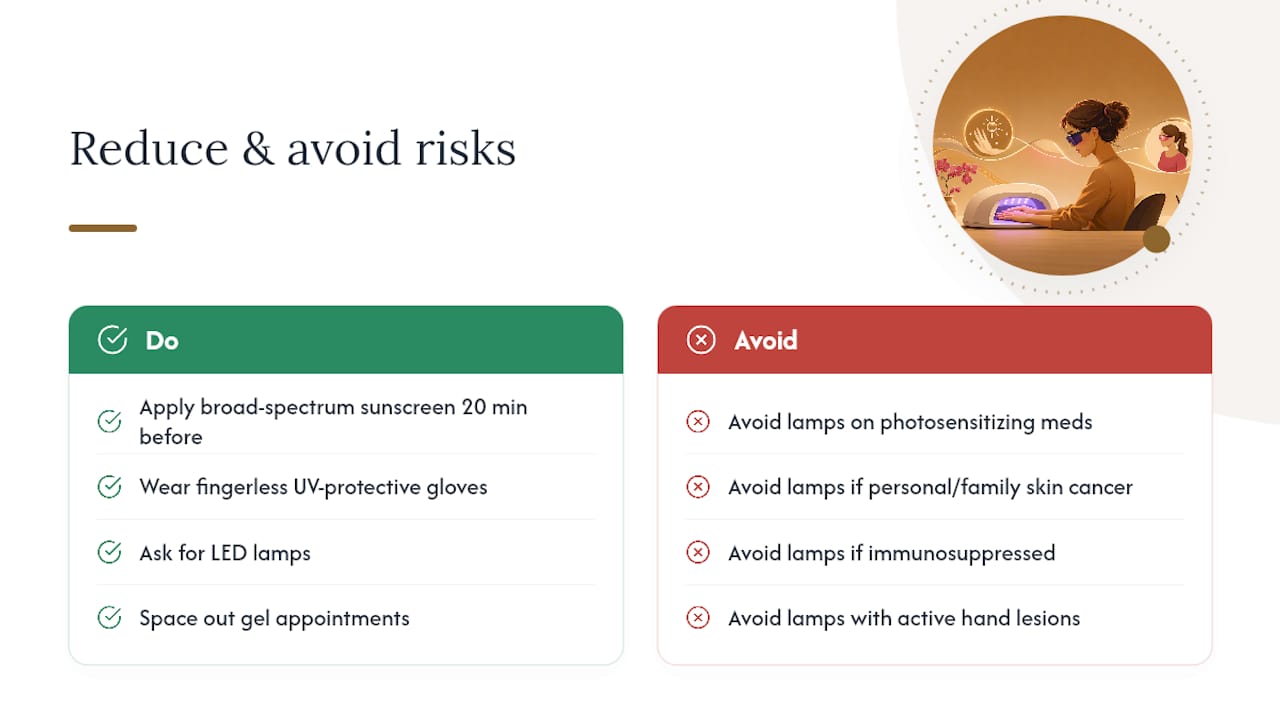
- Apply broad-spectrum sunscreen with SPF 30 or higher to your hands 20 minutes before your appointment. Harvard Health specifically recommends this step, and 20 minutes gives the sunscreen time to bind to skin before the lamp comes out. Reapply if your appointment runs long, since UVA coverage from sunscreen fades faster than most people expect.
- Wear fingerless UV-protective gloves during curing. These leave your nails exposed while covering knuckles and the backs of your hands, which is where most of the unprotected skin sits.
- Ask for LED lamps with a visible countdown timer. A timer you can see helps confirm you’re not sitting under the light longer than the polish needs.
- Ask when the salon last replaced its bulbs. Degraded bulbs often need longer cure cycles, which quietly increases your dose.
- Space out your gel appointments rather than booking back-to-back fills, and avoid asking for extra cured layers “just to be safe” on durability.
- If you’re on a photosensitizing medication or have a history of skin cancer, talk to your dermatologist before your next gel appointment, or ask your salon about lamp-free alternatives instead.
Pro Tip: Keep a travel-size broad-spectrum sunscreen in your bag specifically for nail appointments. Twenty minutes before your seat time, apply it in the car. It’s one less thing to remember once you’re in the chair.
Who Should Skip the Lamp Entirely, and What Are the Alternatives?
If lamp exposure is a real concern for your situation, several nail services skip curing altogether. Regular nail polish requires no lamp at all, drying through evaporation instead of UV curing. Dip powder systems, done correctly, also avoid lamp exposure since the powder sets through a chemical activator rather than light. Some acrylic workflows are lamp-free too, though it’s worth confirming with your tech whether a particular acrylic or Gel X process includes a curing step.
A few groups should lean toward these options rather than gel or Gel X services that require curing:
- People taking photosensitizing medications (check with your pharmacist if unsure)
- Anyone with a personal history of skin cancer, or a strong family history
- Immunosuppressed individuals
- Anyone with active skin lesions, cuts, or irritation on their hands
Requesting a lamp-free service is a normal, common ask. A salon that takes safety seriously should be able to walk you through which services need curing and which don’t, without pushback.
How a Safety-Minded Salon Handles Lamp Risk
At Foxy Nails, LED equipment is the standard for gel and Gel X services specifically because shorter cure cycles mean less time under the light for every client. Staff are trained on correct cure timing per polish brand, since overcuring wastes time and raises exposure for no benefit.
Here’s what that looks like in practice:
- Visible timers on every curing station
- Staff who can walk you through sunscreen or fingerless glove options before your service
- Clear, no-pressure answers if you ask about lamp-free service options
Pro Tip: Watch a station’s curing process before you commit if you’re unsure. Our video walkthroughs show how LED curing and timing work in practice.
The Gap Between Nail Lamp Fear and Nail Lamp Reality
Most of what circulates online about nail lamps either overstates the danger or dismisses it entirely, and neither extreme is useful. The scoping review data doesn’t support panic. It also doesn’t support ignoring the issue, which is where a lot of salon marketing gets it wrong by treating “FDA classifies this as low risk” as the end of the conversation instead of the starting point.
Here’s what the evidence actually supports prioritizing: the sunscreen habit matters more than agonizing over which specific lamp your salon uses. Twenty minutes of lead time with broad-spectrum SPF is a bigger lever than swapping one LED unit for another, because the UVA that reaches your skin around the cure area is the same regardless of brand. Frequency is the second lever. Someone getting fills every two weeks for years is in a meaningfully different position than someone doing gel three times a year, and the current research, thin as it is on long-term human data, points toward treating cumulative exposure as the variable that actually moves risk.
If you take one thing from the research, let it be this: photoprotection is cheap, easy, and has no downside, so there’s no real reason to skip it while waiting for better long-term studies to arrive.
Book a Gel Manicure That Takes Safety Seriously
If you’d rather not overthink lamp exposure every time you book, that’s the point of choosing a salon that already builds these habits into the service. Foxy Nails runs LED curing stations on its gel manicure services, and clients are welcome to ask for sunscreen application time or fingerless gloves before curing starts. Anyone who’d rather skip curing altogether can ask about our dip powder and lamp-free options instead.
You don’t have to choose between pretty nails and peace of mind. Check current gel manicure availability and book your next appointment with a team that treats these questions as normal, not inconvenient.
Frequently Asked Questions
Are UV nail lamps safe for regular use?
Typical use is considered low risk. The scoping review found no proven human causal link to skin cancer, but recommends photoprotection for frequent users given remaining uncertainty.
Is LED nail lamp exposure different from UV lamp exposure?
Both emit UVA. LED lamps just cure faster, which shortens the time your hands sit under the light and typically lowers total dose per session.
How can I reduce UV nail lamp health risks?
Apply broad-spectrum sunscreen 20 minutes before your appointment, wear fingerless UV-protective gloves, ask for LED lamps, and space out gel appointments rather than booking them weekly.
Who should avoid UV nail lamps altogether?
People on photosensitizing medications, those with a personal or family history of skin cancer, immunosuppressed individuals, and anyone with active skin lesions on their hands should consider lamp-free alternatives or consult a dermatologist first.
What are lamp-free alternatives to gel manicures?
Regular nail polish and most dip powder systems don’t require UV curing. Ask your salon whether a specific acrylic or Gel X process includes a curing step before booking.
This article is general information, not a substitute for advice from a qualified doctor. Consult a qualified healthcare professional about your own circumstances before acting on anything here.
Sources
- Safety of LED nail lamps
- Is your gel manicure safe? (MD Anderson Cancer Center)
- Revisiting Cutaneous Carcinogenic Risk From Ultraviolet Nail Polish Dryer Lamp Exposure