
If your fingertips are red, itchy, and swollen after a gel manicure, you’re likely dealing with allergic contact dermatitis triggered by acrylate and methacrylate monomers, most often HEMA (2-hydroxyethyl methacrylate). This isn’t a mystery rash. It’s your immune system reacting to a chemical it has been sensitized to, sometimes after years of trouble-free manicures.
Here’s what to do right now:
- Stop wearing the product and avoid touching any uncured gel or acrylic surfaces.
- Wash the area gently with mild soap and lukewarm water. Skip hot water, which worsens inflammation.
- Apply a fragrance-free emollient, and use an over-the-counter hydrocortisone cream only if the skin isn’t broken or infected.
- Do not attempt to “test” other nail products on yourself to see what triggers it. That risks new sensitization.
- If swelling is mild and confined to the nail folds, self-care and avoidance for a few days is often enough.
- If you see spreading redness, pus, fever, or swelling that moves beyond your fingers (especially toward your hand or face), get medical care the same day.
Pro Tip: Take a photo of the reaction and save the product name and lot number before you throw anything away. Both details matter if you end up seeing a dermatologist.
Key Takeaways
A gel nail allergy is allergic contact dermatitis caused by acrylate monomers like HEMA, confirmed only through clinician-administered patch testing, not guesswork or home trials.
| Point | Details |
|---|---|
| Identify the cause | HEMA and related methacrylates in gel and acrylic systems are the most common triggers. |
| Watch the timeline | Sensitization can build silently for months, with reactions often appearing around 30 months after starting gel use. |
| Never DIY test | Patch testing must be done by a dermatologist or allergist to avoid creating new sensitization. |
| Treat and avoid | Topical steroids, antihistamines, and strict avoidance of the confirmed allergen resolve most cases. |
| Choose safety-focused service | Foxynailsreno offers consultations to review product choices and curing practices for clients with sensitivities. |
Table of Contents
- What Causes a Gel Nail Allergy?
- What Are the Symptoms of a Gel Nail Allergic Reaction?
- Why Did This Allergy Appear After Years of Manicures?
- How Is a Gel Nail Allergy Diagnosed?
- How Do You Treat a Gel Nail Allergic Reaction?
- How Can You Prevent a Gel Nail Allergy?
- What Are Your Options If You’re Allergic to Gel Nails?
- When Should You See a Doctor for a Nail Allergy?
- What Does the Research Say About Gel Nail Allergies?
- Frequently Asked Questions
- Sources
What Causes a Gel Nail Allergy?
A gel nail allergy is a type IV delayed hypersensitivity reaction, which is a different animal from an irritant rash. Irritation happens to almost anyone with enough exposure to a harsh chemical. An allergy only happens after your immune system has been primed to recognize a specific molecule as a threat, and then it overreacts every time that molecule shows up again.
The usual suspects are acrylate and methacrylate monomers, including HEMA, 2-HPMA (2-hydroxypropyl methacrylate), methyl methacrylate (MMA), and ethylene glycol dimethacrylate (EGDMA). These small molecules penetrate skin and gloves far more easily than fully cured, hardened nail product does. That’s why the real danger zone isn’t your finished manicure. It’s uncured or under-cured gel that hasn’t fully polymerized under the UV or LED lamp.
Acrylates in nail cosmetics are currently one of the most significant sources of this kind of allergic contact dermatitis, and once you’re sensitized to one methacrylate, cross-reaction to related ones is common.
- HEMA, MMA, and EGDMA are chemically similar enough that your immune system often can’t tell them apart.
- “HEMA-free” doesn’t mean acrylate-free. It usually means the formula swapped in a related methacrylate instead.
Pro Tip: If a product claims to be hypoallergenic, ask what replaced the removed ingredient. A different acrylate can trigger the same reaction.
What Are the Symptoms of a Gel Nail Allergic Reaction?
The most common signs show up right where the product touches skin: redness, swelling, itching, and a burning sensation around the nail folds and fingertips. Blistering is common in more intense reactions, and in cases that go unaddressed, the nail plate itself can lift away from the nail bed, a condition called onycholysis.
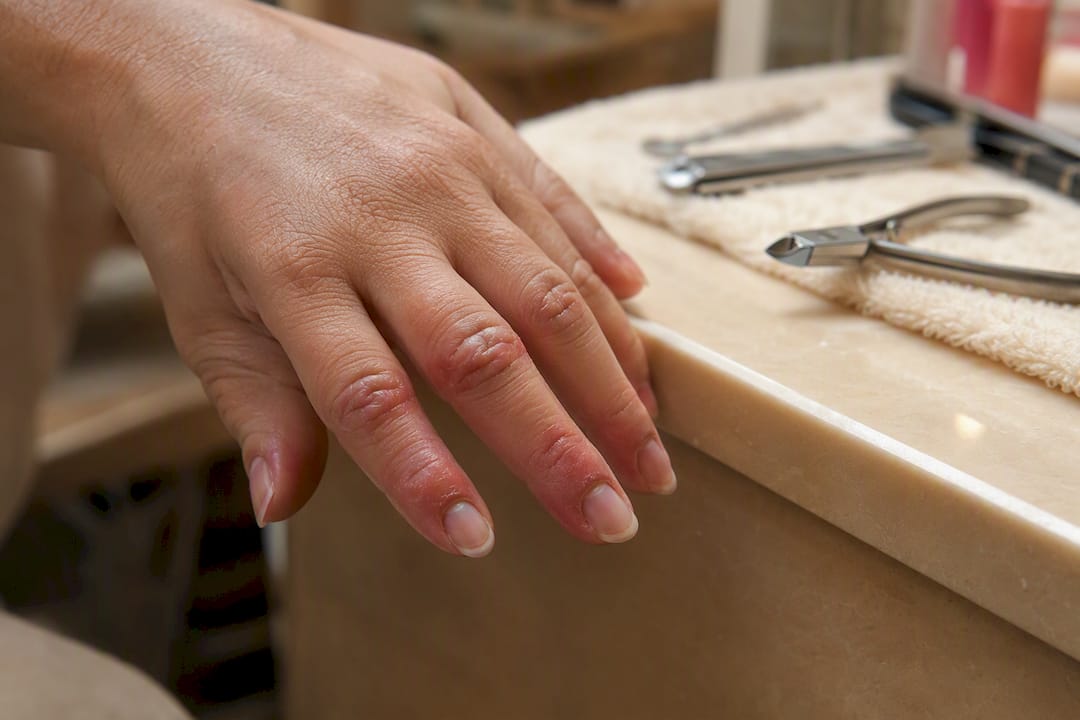
Symptoms don’t always stay put. Because people touch their faces constantly, dermatitis can show up on the eyelids, neck, or cheeks even though the exposure happened on the hands. Nail technicians with heavier occupational exposure sometimes report mild respiratory or mucosal irritation, though that’s far less common than skin symptoms.
Timing matters here. Sensitization itself can take weeks to months of repeated exposure to build. But once you’re sensitized, a flare typically appears within hours to a few days of contact. In one review of gel polish complications, allergic contact dermatitis developed on average about 30 months after someone started using gel polish, often with no warning beforehand.
Watch for these red flags that go beyond a routine flare:
- Rapidly spreading redness or swelling beyond the fingers.
- Visible pus or a foul odor, suggesting secondary infection.
- Fever accompanying a hand or finger reaction.
- Swelling that reaches the face or affects breathing.
Any of those means you need same-day medical attention, not a wait-and-see approach.
Why Did This Allergy Appear After Years of Manicures?
This is the part that confuses most people. You’ve gotten gel manicures for three years with zero issues, and suddenly your hands are on fire. That’s exactly how sensitization works. Your immune system needs repeated exposure before it builds the antibodies that cause a delayed reaction. The first ten manicures might do nothing visible. The eleventh triggers a full flare.
Cumulative exposure plays a role too. Nail technicians face this risk more intensely than occasional clients simply because they handle the product daily, which is why so many report developing sensitivities within their first year of working with acrylates.
A few common scenarios tend to trigger a sudden reaction:
- Switching to a new brand or salon with a different formulation.
- Increasing frequency, including regular at-home gel kits.
- Inconsistent or rushed curing that leaves more monomer unreacted.
Pro Tip: If you notice new irritation after switching products, don’t assume it’s unrelated just because you’ve used gel for years without a problem. That’s often exactly when sensitization catches up.
How Is a Gel Nail Allergy Diagnosed?
Patch testing performed by an allergist or dermatologist is the diagnostic standard, and it’s not something you can safely replicate at home. A clinician applies small, controlled amounts of specific allergens, including HEMA, 2-HPMA, MMA, and EGDMA, to your skin under adhesive patches, then reads the results over multiple visits, typically at 48 and 96 hours. Deliberately applying nail product monomer to your own skin to “test” a reaction is genuinely risky. It can create a brand-new sensitization rather than confirm an existing one.
Before your appointment, a little preparation goes a long way:
- Take clear photos of the rash at its worst, since it may have calmed down by the visit.
- Write down every nail product used in the past six months, brand names included.
- Stop applying topical steroids to the affected area beforehand if your clinician asks you to, since steroids can mask a positive patch test.
- Expect a possible referral to an allergist if your dermatologist doesn’t run acrylate series in-house.
A positive HEMA reaction on patch testing is common enough that studies analyzing tested patients found nail cosmetics were a dominant exposure source behind relevant, confirmed allergic reactions.
How Do You Treat a Gel Nail Allergic Reaction?
Treatment splits into what you do immediately and what a clinician may prescribe if it doesn’t resolve on its own.
Right away:
- Remove yourself from further exposure. If polish remnants are still on the nail, avoid picking or filing them, which can spread monomer to surrounding skin.
- Cleanse the area gently with a mild, fragrance-free soap.
- Apply cool, damp compresses for 10 to 15 minutes to calm swelling and itch.
- Follow with a plain emollient, and use over-the-counter hydrocortisone if the skin isn’t broken.
If it doesn’t improve within a few days, a dermatologist may step in with:
- Prescription-strength topical corticosteroids for more stubborn inflammation.
- A short course of oral corticosteroids for severe, widespread flares.
- Oral antihistamines to control itching, especially at night.
- Antibiotics if there are signs of secondary bacterial infection, such as increasing warmth, pus, or spreading redness.
Removing the exposure typically resolves the dermatitis unless infection or chronic skin thickening has set in, according to dermatology sources on nail cosmetic allergy. What it won’t do is cure the underlying sensitivity. There’s currently no way to reverse an established acrylate allergy, only to avoid triggering it again.
Pro Tip: Resist the urge to “push through” a mild reaction by getting your next fill anyway. Repeated exposure while you’re still sensitized tends to make each subsequent flare worse, not better.
Go to urgent care or an emergency room if you notice rapid swelling, difficulty breathing, facial involvement, or fever alongside the hand reaction. Those are signs the situation has moved past simple contact dermatitis.
How Can You Prevent a Gel Nail Allergy?
Prevention comes down to limiting skin contact with uncured product and making sure whatever technique is used actually cures the gel completely.
Salon-side controls that matter:
- Full curing under a properly maintained LED or UV lamp, following the manufacturer’s exact time.
- Careful application that keeps product off the skin and cuticle, not just the nail plate.
- Good ventilation in the workspace and clean, non-reused files and wipes.
Incomplete curing or a mismatched lamp and gel system lets more raw monomer sit on your skin during filing or removal, which is one of the more overlooked triggers behind sudden reactions, according to industry curing guidance.
Glove and PPE guidance for technicians:
- Nitrile gloves work well for short procedures but should be swapped roughly every 15 to 30 minutes, since acrylates can diffuse through them over time.
- For longer procedures, 4H protective gloves or fingerstalls offer stronger resistance, even if they’re less comfortable.
- Never reuse gloves or wipes that have touched uncured product.
If you’re a client, a few questions to your nail technician go a long way: What brand of gel do they use? Learn more about butterfly weft education for stylists to understand professional beauty training standards. What lamp, and how do they verify cure time? How often do they change gloves? A tech who can answer confidently is one who takes this seriously.
Pro Tip: Don’t assume “hypoallergenic” or “HEMA-free” on a label means risk-free. Cross-reactivity between related methacrylates is common, so those claims describe one ingredient swap, not a guarantee.
What Are Your Options If You’re Allergic to Gel Nails?
Being allergic to acrylates doesn’t necessarily mean the end of manicures altogether, but it does mean rethinking what goes on your nails. Some people with a confirmed methacrylate allergy tolerate traditional nail polish just fine, since standard lacquer formulas don’t rely on the same monomer chemistry as gel or acrylic systems. Others explore acrylate-free polish lines, though “tolerate” should always be confirmed cautiously rather than assumed.
The trade-offs are real. Regular polish chips faster and won’t give you the weeks-long wear gel offers. Fewer product lines mean fewer color and finish choices. And even with a supposedly safer product, ongoing vigilance for cross-reactions matters, since your skin has already shown it can develop new sensitivities.
- Talk to a dermatologist or allergist before trying any new nail product once you’ve had a confirmed reaction.
- When your clinician suggests testing an alternative, do it under their guidance rather than on your own.
- Consider comparing gel and acrylic systems with a technician who understands your allergy history before booking anything new.
Pro Tip: Bring your patch test results to any new salon appointment. A tech who knows your specific triggers can help you avoid products containing them.
When Should You See a Doctor for a Nail Allergy?
See a dermatologist or allergist if the dermatitis keeps coming back after you’ve stopped exposure, if the cause isn’t obvious, or if you work with nail products professionally and suspect occupational sensitization.
Treat it as an emergency if you notice spreading redness, fever, pus, severe pain, facial swelling, or any breathing difficulty. Head to urgent care or an emergency room rather than waiting for a scheduled appointment.
When you do get referred, bring your product list, photos of the reaction at its worst, and avoid re-exposing yourself to suspected products before testing.
What Does the Research Say About Gel Nail Allergies?
The clinical picture here is fairly consistent across sources. Reviews identify acrylates as a leading and increasingly common cause of allergic contact dermatitis tied specifically to nail cosmetic exposure, with HEMA showing up repeatedly as a frequent culprit.
- One analysis found gel polish related ACD developed on average roughly 30 months after someone began using the product, reinforcing that this is a slow-building sensitivity, not an immediate red flag.
- Elimination of the identified allergen, confirmed through patch testing, remains the primary and most reliable management strategy once a reaction is diagnosed.
The practical clinical takeaway is simple: if you suspect a gel nail allergy, patch testing with HEMA and related acrylates is the step that turns a guess into an actual diagnosis you can act on.
A Note From the Salon Floor
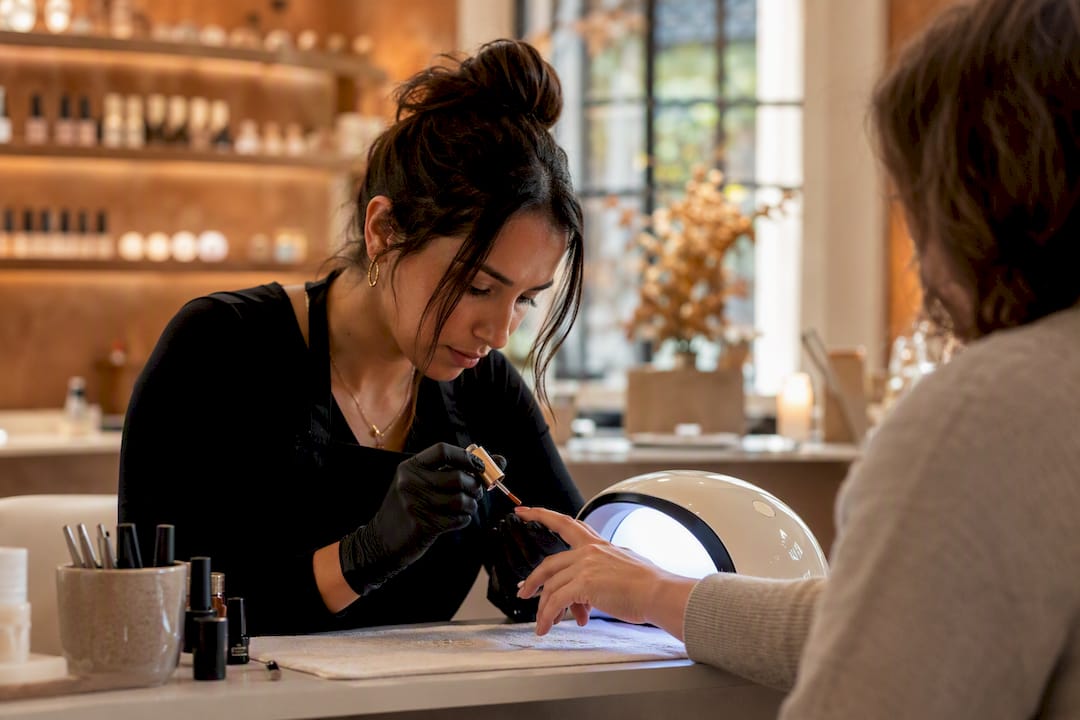
Every technician at Foxynailsreno follows strict curing times, glove changes, and skin-contact avoidance, because we’ve seen how quickly a sensitivity can develop with sloppy technique. When a client mentions a past reaction, we talk through alternatives and, when needed, point them toward a dermatologist for patch testing before booking anything new.
Book a Safety-Focused Appointment
If you’ve had a reaction before, or you’re simply cautious about what touches your skin, Foxynailsreno offers real consultation time before any service starts, not just a quick color pick. We’ll talk through your history, review which systems (gel, Gel X, or dip powder) fit your situation, and adjust technique accordingly rather than rushing you into a standard fill.

For clients managing sensitivities during pregnancy or with prior allergic reactions, our pregnancy-safe manicure guidance walks through safer product choices in more detail. Ready to book a consultation focused on your specific needs? Visit our manicure and pedicure booking page to schedule a visit where safety comes first.
Frequently Asked Questions
Can you suddenly become allergic to gel nails after years of no problems?
Yes. Sensitization builds gradually with repeated exposure, so a reaction can appear after months or even years of trouble-free manicures.
What are the first symptoms of a gel polish allergy?
Redness, itching, burning, and swelling around the nail folds and fingertips are the earliest and most common signs, sometimes followed by blistering.
Does “HEMA-free” mean a product is safe for someone with an acrylate allergy?
Not necessarily. Cross-reactivity between related methacrylates is common, so a HEMA-free formula can still trigger a reaction from a different acrylate.
How long does a gel nail allergic reaction take to heal?
Mild cases often improve within days once exposure stops. More significant reactions may take one to two weeks with topical treatment, and full recovery can take longer if infection develops.
Should nail technicians worry about occupational gel allergy?
Yes. Technicians face higher cumulative exposure than clients, and many cases of sensitization develop within their first year of work, which is why consistent glove use and proper curing matter most for them.
This article is general information, not a substitute for advice from a qualified doctor. Consult a qualified healthcare professional about your own circumstances before acting on anything here.
Sources
- Acrylates as a significant cause of allergic contact dermatitis: new sources of exposure – PMC
- Contact Dermatitis in Nail Cosmetics
- CTPA Guideline on Artificially Enhanced Nails and Minimising the Risk of Allergy
Patch testing always requires a qualified dermatologist or allergist. Never attempt to diagnose an acrylate allergy on your own.