
Dip powder is a strong pick if you want a chip-resistant manicure that skips the UV lamp and outlasts regular polish by weeks, not days. It’s not automatically the best pick for everyone, though. The tradeoff is real: you trade some finish delicacy and easy removal for durability.
Here’s the fast version before you dig into the details:
- Best fit: People who use their hands hard all day (parents, cooks, gym regulars) and anyone growing out damaged nails who wants a protective, hard-wearing layer.
- Main risk: Salon hygiene and rough removal. Communal dip jars can spread bacteria, and picking off the powder instead of soaking it can thin your natural nail. Ask about pour-over application and always soak off with acetone.
- Next step: Book a consult with an experienced tech, like the team at Foxy Nails, or research a reputable at-home kit before you commit to your first set.
Key Takeaways
Dip powder delivers longer wear than most gel manicures without a UV lamp, but its safety and finish depend almost entirely on salon hygiene and proper acetone removal.
| Point | Details |
|---|---|
| Best-fit user | People with active hands or nails growing out damage benefit most from dip’s durability. |
| Typical wear time | Most sets last 2 to 4 weeks, with some high-durability applications reaching 6 weeks. |
| Biggest safety factor | Avoid communal jars; ask for pour-over or single-use pots to cut infection risk. |
| Removal matters most | Always soak with acetone for 10 to 15 minutes; never peel dip powder off. |
| Where to go for a safe set | Foxy Nails applies dip with individually portioned powder and files layers thin on request. |
Table of Contents
- What Are Dip Powder Nails, Exactly?
- Pros and Cons of Dip Powder Nails
- How Long Does Dip Powder Last, and What Does It Cost?
- Dip vs. Gel vs. Acrylic: Which One Actually Fits You?
- Is Dip Powder Safe? What Dermatologists Say
- At-Home Dip Kits vs. Booking a Salon
- How to Remove Dip Powder Without Wrecking Your Nails
- Ready for a Dip Powder Manicure? Here’s How to Book One Safely
- Frequently Asked Questions
- Sources
What Are Dip Powder Nails, Exactly?
Dip powder, sometimes called SNS after the original Signature Nail Systems brand, is a colored acrylic powder applied over your natural nail in thin layers and bonded with a liquid activator instead of a UV lamp. Kiara Sky and OPI Powder Perfection are two other formulas you’ll see on salon shelves, and all three work on roughly the same principle: powder, glue, repeat.
The salon process usually goes like this:
- Nails are cleaned, pushed back, and lightly buffed to help the base coat grip.
- A bonder or base coat goes on first.
- The nail is dipped into powder (or the powder is brushed on) and the excess tapped off.
- That step repeats two or three times until the color is fully opaque.
- A liquid activator seals each layer chemically, no lamp needed.
- The tech files and shapes the nail, then finishes with a glossy top coat.
Because the activator cures the powder through a chemical reaction rather than light, dip is genuinely UV-free, though some technicians add a gel top layer and cure that separately if a client wants extra shine.
Pro Tip: Ask your tech whether they use pour-over application or single-use powder pots. Dipping your fingers straight into a shared jar that other clients have touched is where most hygiene complaints start.
Pros and Cons of Dip Powder Nails
Dip earns loyalty for a reason, but it’s not without downsides.
What works in its favor:
- Chip resistance that beats regular polish and often gel.
- No UV lamp, which some people prefer for skin or time reasons.
- A huge range of shades and finishes, including glitter and matte options.
- Available at salons and through at-home kits.
- A protective layer for nails that are splitting or growing out damage.
Where it falls short:
- Feels noticeably thicker than gel unless your tech files it down.
- Removal requires an acetone soak, not a quick peel.
- Aggressive removal or over-buffing can thin and weaken the natural nail.
- Shared powder jars carry infection risk if the salon isn’t careful.
Most dip manicures hold up for 2 to 4 weeks, and some high-durability applications stretch to around 6 weeks before you notice lifting or excessive growth at the cuticle. Compared to gel, dip usually wins on longevity but loses a little on how delicate and glossy the finish looks straight off the file.
How Long Does Dip Powder Last, and What Does It Cost?
A typical wear time many clients report is around a few weeks, with some able to stretch a set closer to a month if their nails grow slowly and they’re gentle with their hands. Faster growers or anyone who works with their hands constantly (think dishwashing, gardening, gym chalk) will see lifting sooner.
- Salon pricing: Expect a range depending on your market and whether you add nail art, though dip typically lands in a similar bracket to gel manicures.
- At-home kits: Generally cheaper per application once you own the base products, but you’re covering the upfront cost of powders, activator, and top coat yourself.
- Reappointment window: Plan to remove or refill around the 3 to 4 week mark. Pushing much past that invites lifting, trapped moisture, and a rougher removal later.
Dip vs. Gel vs. Acrylic: Which One Actually Fits You?
Each method solves a different problem, and the right one depends on what you’re optimizing for: wear time, gentleness, or length.
| Factor | Dip Powder | Gel | Acrylic |
|---|---|---|---|
| Durability | 2 to 4 weeks, up to 6 in some cases | Typically 2 to 3 weeks | 3 to 4 weeks with fills |
| Finish | Thicker unless filed down, satin to glossy | Thin, glassy shine | Sturdy, can be sculpted thin or thick |
| Curing method | Chemical activator, no UV needed | UV or LED lamp | Air-dries with liquid monomer |
| Removal difficulty | Acetone soak, moderate effort | Acetone soak, generally gentler on the nail | Filing down or acetone soak, more involved |
| Cost shape | Comparable to gel in most salons | Comparable to dip | Often similar or slightly higher for fills |
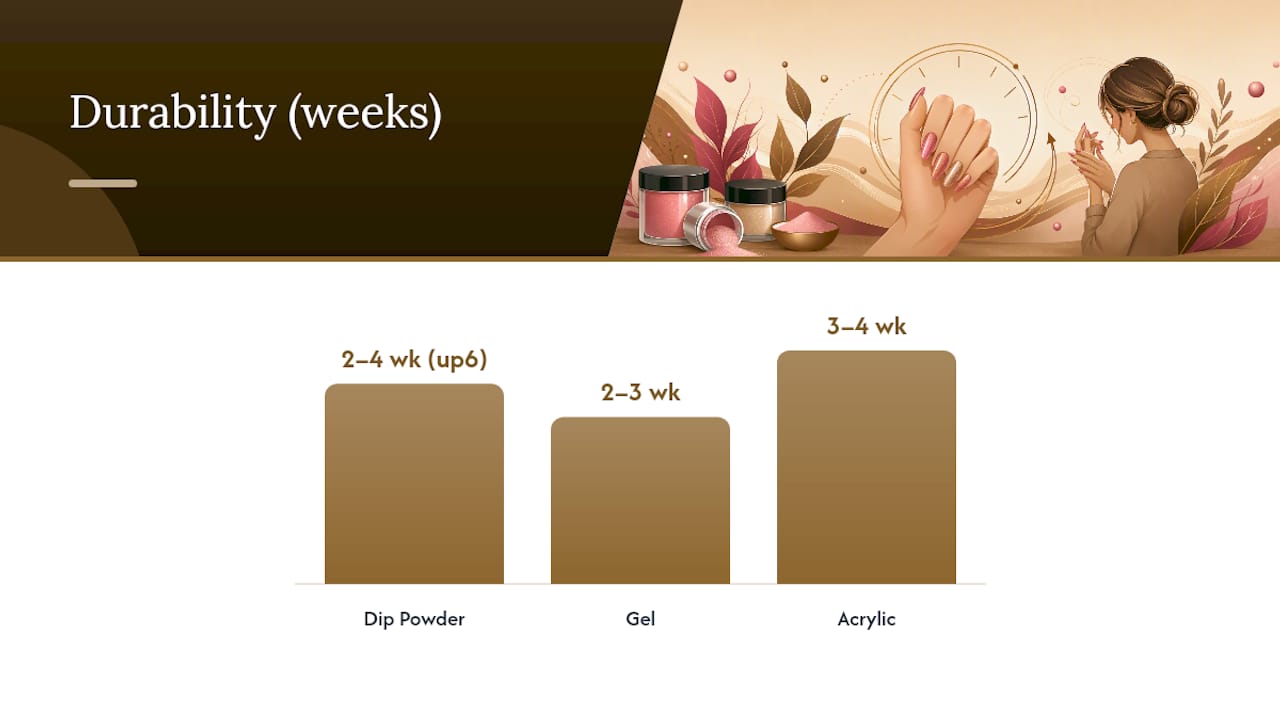
If long wear matters most, dip usually outlasts a standard gel manicure. If you want the gentlest option on your natural nail and don’t mind fewer weeks of wear, gel is the better call, and it’s easier for intricate nail art. If you need actual length, not just a hard shell over your own nail, acrylic or Gel X extensions do that job better than dip ever will.
Is Dip Powder Safe? What Dermatologists Say
The chemistry itself isn’t the main worry. The bigger concern is what happens between clients.
Dermatology guidance on manicure safety points to one clear priority: sterilize tools between clients and avoid shared containers whenever possible to cut infection risk during nail services.
That’s the core hygiene principle behind why pour-over and single-use pot methods exist. Dipping bare fingers into a communal jar that dozens of other clients have touched that week is exactly the scenario dermatologists flag.
Look for these signs of a hygienic setup:
- Pour-over application or individually labeled, single-use powder pots.
- Sealed, clean containers rather than open tubs with visible residue.
- Tools that are sterilized or disposable between clients.
- No double-dipping, meaning the same brush or fingers never re-enter a shared jar.
- A visibly clean workstation and a technician who can explain their sanitation process without hesitation.
Pro Tip: Before you sit down, just ask: “Do you use pour-over or single-use pots for dip powder, and how do you sterilize your tools?” A confident, specific answer is a good sign. A vague one is your cue to look elsewhere.
If you’ve had a reaction to acrylics before (redness, itching, swelling around the nail bed), mention it before your appointment. Pros warn that contact allergies to acrylic-based products, while uncommon, do happen, and a patch test on one nail is a reasonable ask if you’re nervous.
At-Home Dip Kits vs. Booking a Salon
Salons win on control and speed. A trained tech manages hygiene, files the layers down so they don’t feel bulky, and gets you in and out faster than a first-time DIY attempt.
At-home kits win on cost per use, and they solve the shared-jar problem entirely since you’re only ever dipping your own fingers into your own powder.
If you’re going the DIY route, here’s what you actually need:
- A base or bonder coat.
- Your powder colors of choice.
- Liquid activator.
- A glossy top coat.
- Nail files and a cuticle tool.
- Pure acetone for eventual removal.
Buy from established beauty retailers rather than unfamiliar third-party marketplace sellers, since product quality varies a lot at the cheap end. Common at-home mistakes include getting activator on the skin (it stings and can irritate), over-buffing in an attempt to thin the layers, and picking at lifted edges instead of doing a proper acetone soak.
How to Remove Dip Powder Without Wrecking Your Nails
Peeling it off is the single fastest way to damage your natural nail. Do this instead:
- Gently file down the shiny top coat so the acetone can penetrate.
- Soak a cotton ball in acetone, press it against the nail, and wrap the fingertip in foil.
- Leave it for 10 to 15 minutes.
- Gently push off the softened powder with a cuticle stick, never scrape or pry.
- Re-soak for a few more minutes on any stubborn spots rather than forcing them.
After removal:
- Apply cuticle oil daily for at least a week to rehydrate the nail plate.
- Give your nails a break of a few weeks between sets if you notice any brittleness or thinning.
- Avoid jumping straight into a new set the same day you remove one.
Warning: If you notice persistent peeling, deep splitting, ongoing pain, or unusual discoloration after removal, that’s beyond normal dryness. See a dermatologist or an experienced nail tech rather than covering it with another set.
A Salon’s-Eye View on Dip Powder
At Foxy Nails, the most common request we hear isn’t about color, it’s “can you make it thin?” Clients love the wear time but don’t want the bulky feel, so filing each layer down before the next coat matters as much as the shade they picked.

Pro Tip: We keep dip powders in individually portioned containers per client and never dip fingers straight into a shared jar. It’s a small habit that changes the whole safety equation.
Ready for a Dip Powder Manicure? Here’s How to Book One Safely
If everything above sounds appealing but you’re not eager to manage hygiene questions and removal technique on your own, that’s exactly what a trained salon solves. Foxy Nails handles the pour-over application, sterilized tools, and thickness adjustments so you get the long wear without the bulky feel or the guesswork about who touched the jar before you.

Our techs will talk you through color and finish options, tell you honestly whether dip, gel, or an extension service fits what you’re asking for, and file every layer to a natural thickness before it leaves the chair. If you’re ready to see what a properly applied set feels like, book your manicure appointment and ask for dip powder when you schedule.
Frequently Asked Questions
Is dip powder bad for your nails?
Dip powder itself isn’t inherently damaging. The risk comes from removal technique and hygiene. Peeling it off or over-buffing can thin your natural nail, while a proper acetone soak minimizes harm.
How is dip powder different from SNS nails?
SNS, short for Signature Nail Systems, was one of the original dip powder brands, and the name stuck around as a generic term for the technique. Kiara Sky and OPI Powder Perfection use the same basic method.
Can you remove dip powder nails at home?
Yes, with pure acetone, cotton, and foil. File the top coat first, soak for 10 to 15 minutes, then gently push off the softened product rather than prying it.
How often should you take a break from dip powder?
A few weeks off between sets is a reasonable habit if you notice any brittleness, and it gives your natural nail time to rehydrate before the next application.
Is dip powder better than gel nails?
Dip usually lasts longer, but gel tends to be gentler on the nail plate and easier to remove. The better choice depends on whether you prioritize wear time or a lighter, more delicate finish.
Sources
- Dip Powder Nails: Pros & Cons
- What Are Dip Powder Nails? Experts on Cost, Risks, and …
- Dip Nails Are the Long-Lasting Manicure Pros Recommend | Glamour
- Dip Powder Nails: What They Are, Pros, Cons & Cost | Vogue
- Manicure and pedicure safety | AAD