
For U.S. Twenty percent is the easiest default for good work, and industry sources confirm that 15–20% is the practical norm across the country. Tipping is customary, not legally required, but it forms a meaningful part of most technicians’ take-home pay.
A few situations call for more:
- Intricate nail art or long sets: Go 25% or higher when the work is freehand, detailed, or runs well past a standard appointment slot.
- Holiday and peak-season visits: Many clients add a few extra dollars in December or around major holidays as a seasonal thank-you.
- Exceptional service: If your tech went out of their way, 25% is a fair signal.
If service disappoints, don’t reflexively leave nothing. Raise the issue with management first. Withholding a tip punishes the technician without fixing the problem.
Key Takeaways
nail salons. Cash handed directly to your technician is the most reliable way to ensure they receive it.
| Point | Details |
|---|---|
| Default tip: 20% | Tip 15–20% of the service price; 20% is the safe default for good work. |
| Tip on original price | Calculate on the pre-discount price, not the coupon-reduced total. |
| Cash reaches techs faster | Card tips may be reduced by processing fees or delayed until payday. |
| Two techs, two tips | When two technicians work simultaneously, tip each one separately. |
| Poor service: escalate first | Speak to management before reducing or withholding a tip. |
Table of Contents
- How much should you tip for each nail service?
- How do you calculate and pay your tip correctly?
- Worked examples: exact tip amounts for common bills
- What should you do when service is poor or unsafe?
- Why tips matter to nail technicians
- Do tipping norms vary by region in the US?
- Should you tip the receptionist or non-technical staff?
- A note from the Foxynailsreno team
- Sources
How much should you tip for each nail service?
The percentage stays consistent across services, but the dollar amount shifts with price. Here’s a quick breakdown:
- Basic manicure ($20–$30): 15–20% lands at $3–$6. A $3–$5 floor is reasonable even on the cheapest services.
- Gel manicure ($35–$55): 20% puts you at $7–$11. Round up to the nearest dollar.
- Full acrylic set ($50–$75): 20% is $10–$15. These appointments run long and require real skill, so tipping on the higher end is appropriate.
- Fill ($30–$50): 15–20%, or $5–$10. Fills are shorter but still technical.
- Basic pedicure ($30–$45): 15–20%, landing at $5–$9. Many guides name 20% as the one-number default to avoid hesitation at checkout.
- Spa pedicure ($55–$80): 20% puts you at $11–$16. The extended time and added treatments justify the full percentage.
- Polish change ($10–$20): A flat $3–$5 tip is standard when the percentage math produces an awkwardly small number.
- Nail art add-ons: Add at least $5–$10 on top of your base tip for detailed freehand designs. Complex art takes time that a flat percentage often undervalues.
The standard range is 15–20% for most nail services, with 20% as the practical default for good work and 25%+ for especially detailed or time-consuming appointments. TipTaxCalc and similar guides consistently land on this range.
When the service price is very low, a percentage tip can feel insulting to both parties. A $3–$5 floor keeps things fair.
How do you calculate and pay your tip correctly?
Tip on the original service price, not the discounted total. If you used a coupon that dropped a $60 pedicure to $45, tip on $60. The technician spent the same time and skill regardless of what you paid at the register. Real Simple’s etiquette guidance is clear on this: the tip should reflect the full value of the work performed.
Here’s how to work through common scenarios:
- Single service: Multiply the original price by 0.20 for a 20% tip. A $50 gel manicure = $10 tip.
- Combined services (one tech): Add the service prices first, then apply the percentage to the total. A $35 manicure plus a $50 pedicure = $85 total; 20% = $17.
- Mani-pedi with two techs working simultaneously: Tip each technician separately for the portion they performed. Bring small bills. If your manicure was $35 and your pedicure was $50, hand $7 to the manicurist and $10 to the pedicurist rather than leaving one pooled amount at the desk.
- Unclear tip pooling: Ask at checkout how card tips are distributed. If the answer is vague, cash is safer.
Pro Tip: Keep a few small bills in your wallet before every salon visit. Cash tips reach technicians immediately and avoid the card processing fees or payroll delays that can reduce what they actually receive. If you pay by card, name the specific technician at checkout so the tip is correctly assigned.
Waldev’s etiquette guide recommends handing cash directly to the technician when possible, which removes any ambiguity about distribution.
Worked examples: exact tip amounts for common bills
No calculator needed. Here are pre-done numbers for the most common price points:
- $30 gel manicure: $4.50 at 15% / $5.40 at 18% / $6 at 20% — round to $5, $5, or $6.
- $40 pedicure: $6 at 15% / $7.20 at 18% / $8 at 20% — round to $6, $7, or $8.
- $55 acrylic set: $8.25 at 15% / $9.90 at 18% / $11 at 20% — round to $8, $10, or $11.
- $70 combined service (mani + pedi): $10.50 at 15% / $12.60 at 18% / $14 at 20% — round to $10, $13, or $14.
Rounding to the nearest dollar is fine. Rounding to the nearest $5 is generous and always appreciated. During the holidays or if your tech squeezed you in last-minute, add $5 on top of whatever the math produces.
What should you do when service is poor or unsafe?
Tipping is discretionary. Poor service does not obligate a full tip, and genuinely unsafe or unsanitary conditions can justify withholding one entirely. But the tip line is not the right place to send feedback.
Here’s the better path:
- Speak up during the appointment. If something feels wrong — a tool looks unclean, the shape is off, the polish is uneven — say so while there’s still time to fix it.
- Ask for a correction. Most technicians want to get it right and will adjust without complaint.
- Escalate to the manager if the tech can’t or won’t address the issue. Etiquette guidance from VBeautyPure is consistent: raise unresolved problems with management so the salon can remedy them.
- Document serious hygiene or safety issues. A photo taken discreetly gives you something concrete if you need to follow up or file a complaint.
Pro Tip: Keep your receipt and note the technician’s name. If you need to contact the salon later about a sanitation concern, having that information makes the conversation faster and more productive.
Minor mistakes that were corrected mid-service still warrant a standard tip. Unaddressed hygiene problems or genuinely unsafe practices are a different matter. Posting a public review is not a substitute for immediate escalation — management can’t fix what they don’t know about.
Why tips matter to nail technicians
Tips are not a bonus. For most nail technicians in the U.S., gratuities make up a significant share of weekly take-home pay, especially in salons where base wages are structured around the expectation of tips. The work is physically demanding, requires real technical training, and involves close personal contact with clients for hours at a time.
A few realities worth knowing:
- Individual vs. pooled tips: Some salons let each tech keep their own tips; others pool and distribute. If you want your tip to reach a specific person, cash handed directly is the most reliable method.
- Card processing fees: When you tip by card, the salon’s payment processor often takes a small cut. The technician receives slightly less than you entered. Real Simple notes that card tips can also be delayed until payday if run through payroll.
- Owners who work the floor: At many nail salons, the owner also performs services. TipTaxCalc’s guidance is straightforward: tip them the same as any other technician.
At Foxynailsreno, services like spa pedicures, acrylic sets, and Gel X enhancements involve skilled technicians who invest real time in each appointment.
Do tipping norms vary by region in the US?
The differences show up in the floor, not the ceiling.
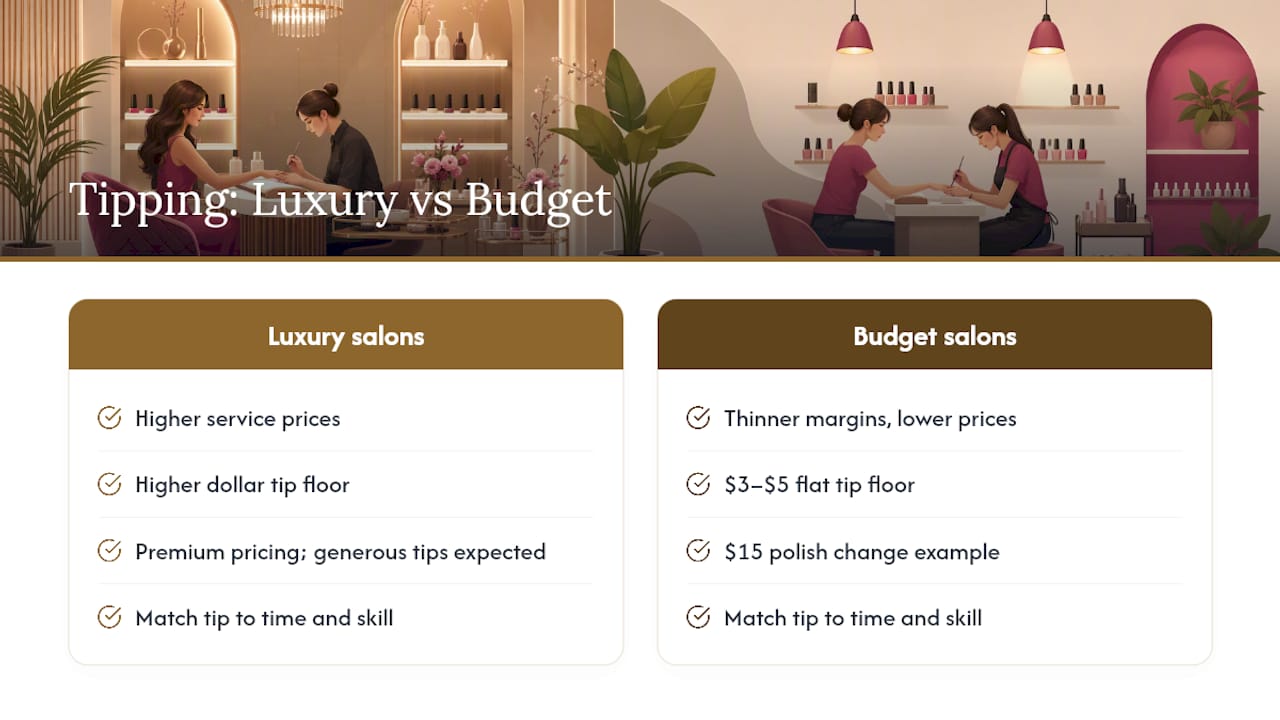
Salons in these markets often have higher service prices, which means the dollar amounts are larger even at the same percentage.
High-end salons with premium pricing carry an implicit expectation of generous tipping. Budget salons in strip malls operate on thinner margins, and a $3–$5 flat tip on a $15 polish change is genuinely appreciated even when the percentage looks small. The principle stays the same: match the tip to the time and skill involved, not just the sticker price.
Should you tip the receptionist or non-technical staff?
Generally, no. Tipping norms at nail salons apply to the people who perform hands-on services. The receptionist who books your appointment, answers the phone, or rings you up is typically salaried or paid hourly and is not part of the tipping culture in the same way technicians are.
The same logic applies to staff who sell you nail polish at the front desk or hand you a beverage while you wait. A friendly thank-you is appropriate; a cash tip is not expected.
The exception: if a staff member goes significantly out of their way, like staying late to accommodate you or handling a complicated rebooking, a small gesture is always your call. But it’s not a standard expectation, and you shouldn’t feel obligated.
For private beauty events where multiple artists work a party or workshop, tipping norms can differ. Henna for Fun’s event services are one example of a context where event-based gratuity follows different conventions than a standard salon visit.
A note from the Foxynailsreno team
Tips are what let us keep our technicians trained, motivated, and here. When a client books a gel manicure or a spa pedicure at Foxynailsreno, the technician has often spent years developing the precision and speed that makes the appointment feel effortless. The best thing you can do to make sure your tip reaches the right person: hand it in cash directly to your technician before you leave, or confirm at the front desk exactly how card tips are assigned.
Ready to book your next appointment? Foxynailsreno offers manicures, pedicures, and nail enhancements in Reno, NV, with skilled technicians who take every service seriously.

Sources
- How Much Should You Tip at the Nail Salon? – NerdWallet
- How Much to Tip at a Nail Salon in 2026 | TipTaxCalc
- How Much to Tip a Nail Technician – waldev
- How much to tip at the nail salon – RealSimple
- How Much to Tip for a Pedicure (Use This Calculator) | Mirellé Inspo